
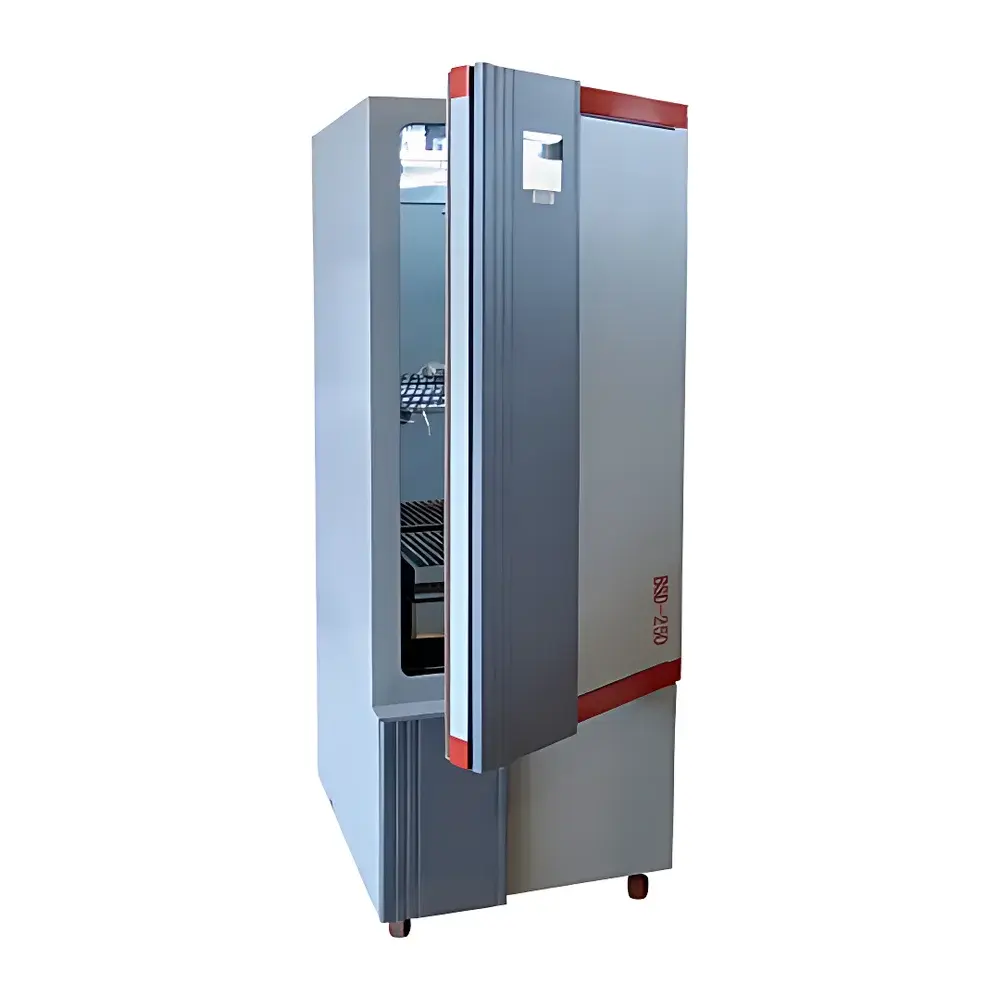
Jihepu BSD-250 Orbital & Reciprocating Shaking Incubator
| Brand | Jihepu |
|---|---|
| Model | BSD-250 |
| Origin | Shandong, China |
| Temperature Range | 0–60 °C |
| Temperature Uniformity | ±1 °C |
| Temperature Fluctuation | ±0.5 °C |
| Resolution | 0.1 °C |
| Humidity Range | 20–90 %RH |
| Chamber Capacity | 108 L |
| Internal Dimensions (W×D×H) | 510×450×1100 mm |
| External Dimensions (W×D×H) | 650×740×1726 mm |
| Power Input | 1150 W |
| Timer Range | 0–9999 min |
| Shaking Modes | Orbital (0–220 rpm, 20 mm amplitude) and Reciprocating (0–300 cpm, 30 mm amplitude) |
| Shelf | 1 adjustable stainless-steel tray |
| Interface | RS-485 |
| Programmability | 10 segments × 99 cycles |
Overview
The Jihepu BSD-250 Orbital & Reciprocating Shaking Incubator is a dual-mode environmental control system engineered for precise cultivation, fermentation, and biochemical reaction studies under dynamically controlled temperature, humidity, and mechanical agitation. It integrates a thermally stabilized incubation chamber with independently adjustable orbital and reciprocating shaking mechanisms—enabling researchers to replicate diverse physiological shear and mixing conditions essential for microbial growth kinetics, cell suspension culture, BOD assays, enzyme production, and seed germination studies. The unit operates on a robust refrigeration architecture featuring an internationally certified compressor and eco-friendly non-CFC refrigerant, supporting continuous operation across the full 0–60 °C range. Its microprocessor-based PID control system maintains thermal stability with ±0.5 °C fluctuation and ±1 °C uniformity—validated per ISO 17025 traceable protocols—making it suitable for GLP-compliant laboratories conducting regulatory microbiological testing or environmental monitoring in accordance with EPA Method 5210B and ASTM D5210.
Key Features
- Intelligent dual-mode shaking platform: Independently selectable orbital (0–220 rpm, 20 mm amplitude) and reciprocating (0–300 cpm, 30 mm amplitude) motion profiles, each calibrated for reproducible mechanical input across load variations up to 15 kg.
- Advanced air management: Patented dual-fan convection system with asymmetric airflow ducting ensures homogeneous thermal distribution; integrated fresh-air inlet (30/60 mm ID/OD) enables controlled gas exchange without compromising chamber integrity.
- Robust chamber construction: Cold-rolled steel exterior with electrostatic epoxy coating; mirror-polished 304 stainless-steel interior with removable, height-adjustable shelf for flexible vessel configuration (compatible with Erlenmeyer flasks, culture bottles, and multi-well plates).
- Comprehensive safety architecture: Self-diagnostic refrigeration system with automatic defrost cycle (non-energy-intensive, temperature-neutral); over-temperature cut-off, power-failure data retention, and auto-restart functionality compliant with IEC 61000-4-2 EMC standards.
- Programmable operation: 10-segment × 99-cycle time-temperature-shaking profile scheduler; real-time LCD display with parameter lockout and password-protected settings for audit trail integrity.
Sample Compatibility & Compliance
The BSD-250 accommodates standard laboratory vessels including 500 mL–5 L Erlenmeyer flasks, serum bottles, and stacked culture trays. Its 108 L working volume supports simultaneous processing of up to twelve 2 L flasks at 150 rpm (orbital) or eight 1 L bottles at 250 cpm (reciprocating). The unit meets structural and operational requirements outlined in ISO 13408-1 (aseptic processing), USP (environmental monitoring), and EN 61010-1 (safety of laboratory equipment). Humidity control (20–90 %RH) facilitates long-term fungal and algal culture maintenance, while the sealed chamber design allows optional CO2 or N2 purging when interfaced with external gas manifolds (not included).
Software & Data Management
Equipped with RS-485 serial interface, the BSD-250 enables bidirectional communication with third-party data loggers or LIMS platforms using Modbus RTU protocol. Optional PC software provides remote parameter configuration, real-time graphing of temperature/shaking profiles, and CSV export for statistical analysis (e.g., ANOVA of growth rate vs. agitation frequency). All session logs—including setpoint deviations, alarm events, and power interruption timestamps—are stored with ISO/IEC 17025-aligned metadata (date, operator ID, instrument ID). When configured with optional GPRS module, SMS alerts are triggered upon deviation from user-defined thresholds—supporting 21 CFR Part 11–compliant electronic recordkeeping when paired with validated timestamping servers.
Applications
- Environmental microbiology: BOD5 determination per APHA Standard Methods 5210B; wastewater biodegradability screening; phytoplankton enrichment cultures.
- Pharmaceutical QC: Stability testing of liquid formulations under agitated storage; microbial limit test preparations (USP ); endotoxin recovery validation.
- Agricultural research: In vitro plant tissue propagation; rhizobial inoculant development; pesticide degradation kinetics in aqueous media.
- Industrial biotechnology: High-density bacterial fermentation optimization; recombinant protein expression in shake-flask bioreactors; biofilm dispersion assays.
- Academic teaching labs: Kinetic modeling of microbial growth (Monod equation fitting); comparative studies of shear-sensitive vs. shear-tolerant strains.
FAQ
What is the maximum flask size supported on the shaking platform?
The 420 × 320 × 200 mm platform accommodates up to four 5 L Erlenmeyer flasks (with proper balancing) or twelve 1 L flasks at ≤180 rpm orbital speed.
Does the unit support sterile operation protocols?
Yes—the stainless-steel chamber, smooth internal corners, and absence of exposed gaskets permit routine ethanol wiping and UV irradiation; optional HEPA-filtered air inlet kit available for Class II biosafety integration.
Can humidity be maintained during active shaking?
Humidity control remains functional across the full shaking range; however, sustained operation above 80 %RH at >200 rpm may require periodic condensate drainage via the rear-mounted port.
Is calibration certificate included with shipment?
A factory-issued NIST-traceable temperature calibration report (at 25 °C and 37 °C) is provided; optional on-site IQ/OQ validation packages comply with ISO/IEC 17025 and FDA Annex 11 requirements.
What maintenance intervals are recommended?
Compressor oil inspection every 24 months; fan filter cleaning every 3 months; door gasket integrity verification semiannually per manufacturer’s maintenance log template.





