
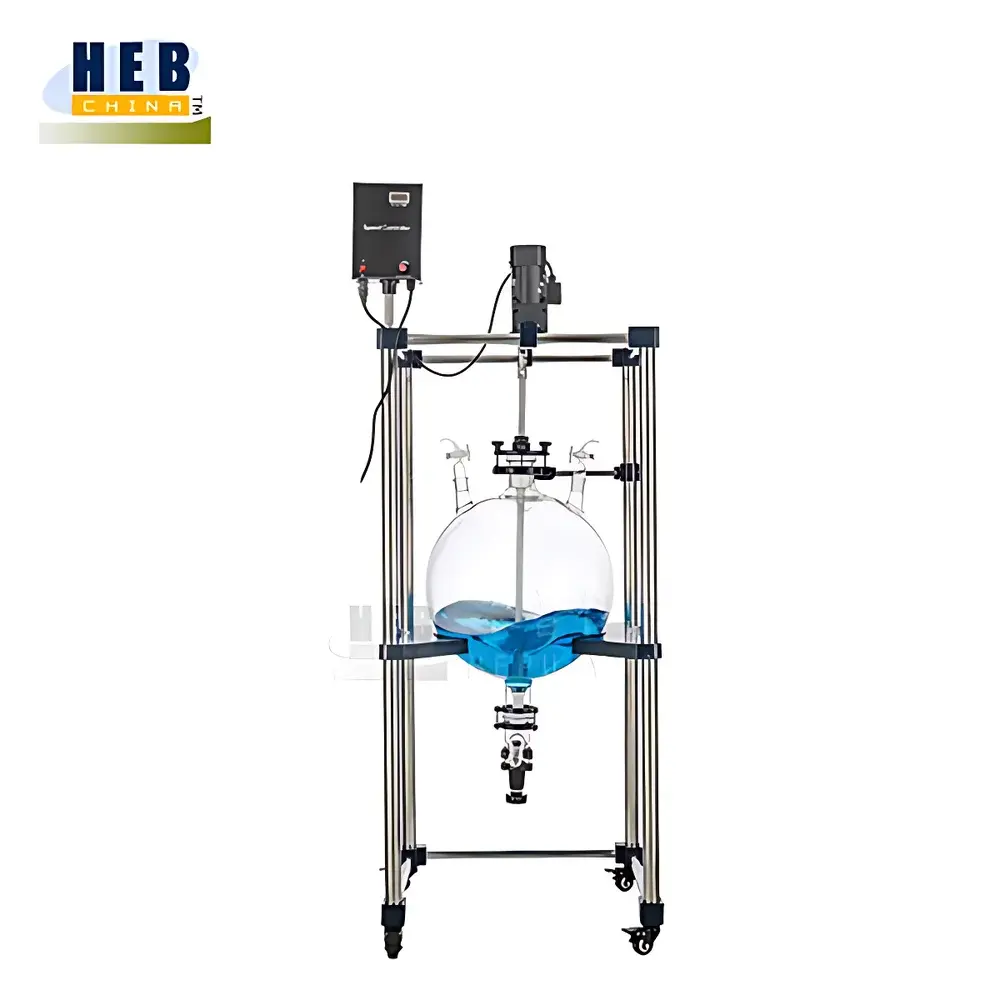
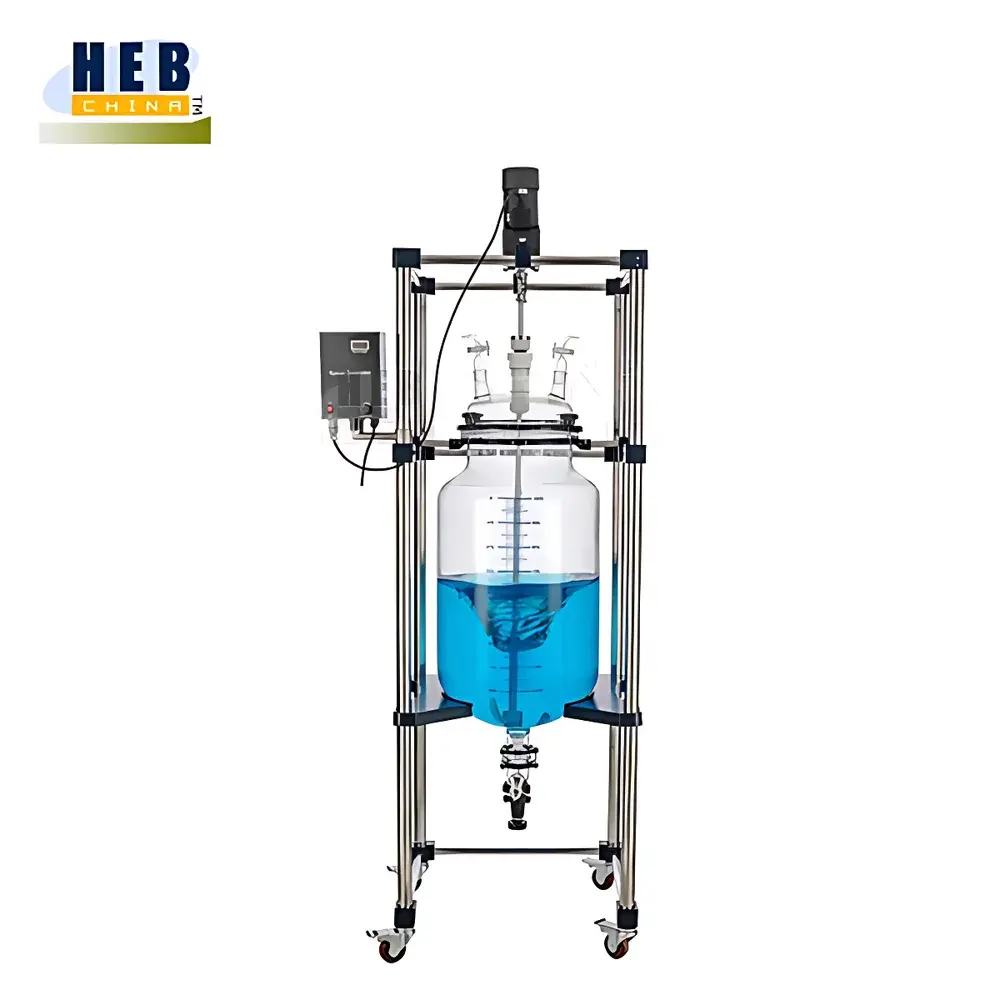
Jihepu FY-30L Spherical Glass Separatory Reactor
| Brand | Jihepu |
|---|---|
| Origin | Shandong, China |
| Model | FY-30L |
| Capacity | 30 L |
| Material | High-borosilicate glass (3.3 expansion coefficient) and PTFE |
| Working Pressure | Low-pressure |
| Vacuum Degree | 0.098 MPa |
| Stirring Speed Range | 0–450 rpm |
| Motor Power | 120 W |
| Voltage/Frequency | 220 V / 50 Hz |
| Overall Dimensions (W×D×H) | 610 × 520 × 1600 mm |
| Net Weight | 38 kg |
| Packaging Volume | 0.5 m³ |
| Compliance | Designed for GLP-aligned laboratory workflows |
Overview
The Jihepu FY-30L Spherical Glass Separatory Reactor is an integrated low-pressure reaction and liquid–liquid separation system engineered for controlled synthesis, phase separation, and batch-wise fractionation in research and pilot-scale laboratories. Its spherical borosilicate glass vessel (Φ420 mm) provides uniform stress distribution under vacuum and thermal cycling, while the geometry enhances gravitational phase settling efficiency post-reaction. The reactor operates on a fundamental principle of density-driven stratification: after homogeneous mixing via mechanical agitation, immiscible liquid phases separate under static conditions; layered discharge is then executed sequentially through a side-mounted, PTFE-lined glass valve without cross-contamination. This architecture supports both stoichiometric reaction monitoring and post-reaction workup—common in organic synthesis, extractive metallurgy, pharmaceutical intermediate purification, and green solvent recovery protocols.
Key Features
- High-borosilicate glass (DIN ISO 3585, coefficient of expansion 3.3) construction ensures chemical inertness toward acids, bases, and halogenated solvents, with thermal shock resistance up to ΔT = 120 °C.
- PTFE-sealed spherical glass body with four standardized 34/42 ground-glass joints (stirring port Φ80 mm, feed port, vacuum port, and bottom discharge port), enabling modular integration with condensers, dropping funnels, or pressure sensors.
- Low-speed high-torque stirring system: 120 W brushless motor with digital RPM display and stepless electronic speed control (0–450 rpm); ceramic bearing and dual mechanical seal prevent particle shedding and maintain vacuum integrity during prolonged operation.
- Y-shaped agitator assembly: 304 stainless steel shaft sheathed in PTFE tubing, fitted with PTFE-coated stainless steel blades (blade span 190 mm, total length 850 mm) for gentle yet effective homogenization of viscous or heterogeneous mixtures.
- Side-exit inclined discharge port (Φ34 mm, height 350 mm above floor) with PTFE/glass valve eliminates dead volume and enables drip-free, layer-selective drainage—critical for isolating aqueous, organic, or denser ionic liquid phases.
- Mobile aluminum–stainless steel frame with locking casters (load capacity ≥50 kg), integrated thermal fuse (250 V / 3 A), and ergonomic height-adjustable design for safe handling of 30 L volumes.
Sample Compatibility & Compliance
The FY-30L is compatible with non-explosive, non-peroxide-forming organic solvents (e.g., ethyl acetate, dichloromethane, toluene), aqueous electrolyte solutions, and moderate-concentration acid/base systems (pH 1–12). It is not rated for autoclave sterilization, hydrogenation pressures (>0.1 MPa), or fluorinated solvents at elevated temperatures. All wetted surfaces conform to USP Class VI and FDA 21 CFR 177.1550 for PTFE components. While the unit itself carries no CE or UL certification, its mechanical and material specifications align with ASTM E2656 (Standard Guide for Laboratory Reactor Safety) and support traceable documentation practices required under GLP (OECD Series No. 1) and GMP Annex 15. Vacuum performance (0.098 MPa absolute) meets typical requirements for solvent removal prior to phase separation per USP residual solvent guidelines.
Software & Data Management
This analog-controlled reactor does not include embedded software or digital connectivity. All operational parameters—including stirring speed, duration, vacuum level (monitored externally via analog vacuum gauge), and temperature (measured via optional external probe)—must be recorded manually or logged via external data acquisition systems. For regulated environments, users are advised to implement paper-based or validated electronic lab notebook (ELN) entries with operator signature, timestamp, and equipment ID (e.g., “FY-30L-042”) to satisfy audit trail requirements under 21 CFR Part 11 when paired with compliant ELN platforms.
Applications
- Multi-step synthesis requiring in-situ quenching and immediate phase isolation (e.g., Grignard reactions followed by aqueous workup).
- Extraction optimization studies: screening solvent pairs (e.g., n-hexane/water, MTBE/phosphate buffer) for bioactive compound recovery from fermentation broths.
- Pilot-scale purification of APIs where crystallization mother liquors require sequential solvent stripping and impurity partitioning.
- Teaching laboratories demonstrating Le Chatelier’s principle, liquid–liquid equilibrium, and interfacial tension effects under controlled vacuum.
- Environmental labs performing EPA Method 3510C-style separatory funnel simulations with improved repeatability and reduced operator exposure.
FAQ
Can the FY-30L be used under positive pressure?
No. It is rated exclusively for low-pressure and vacuum operation (max. 0.098 MPa absolute); pressurized use voids safety compliance and risks glass fracture.
Is the stirring system suitable for highly viscous polymer solutions?
The 120 W motor delivers sufficient torque for viscosities up to ~5,000 mPa·s at ≤150 rpm; for >10,000 mPa·s, pre-dilution or auxiliary heating is recommended.
How is cleaning validation performed for multi-product use?
Residue testing follows standard swab/rinse protocols per ICH Q5C; the absence of metallic leachables (confirmed by ICP-MS) and visual inspection of transparent glass surfaces support cleaning verification.
Does the unit include calibration certificates for vacuum or speed measurement?
No. Users must perform third-party calibration of external vacuum gauges and tachometers per ISO/IEC 17025 if required for regulatory submissions.
What maintenance intervals are recommended for the mechanical seal and ceramic bearing?
Inspect seal integrity and bearing smoothness every 200 operating hours; replace PTFE components annually or after 500 cycles under continuous vacuum duty.



