
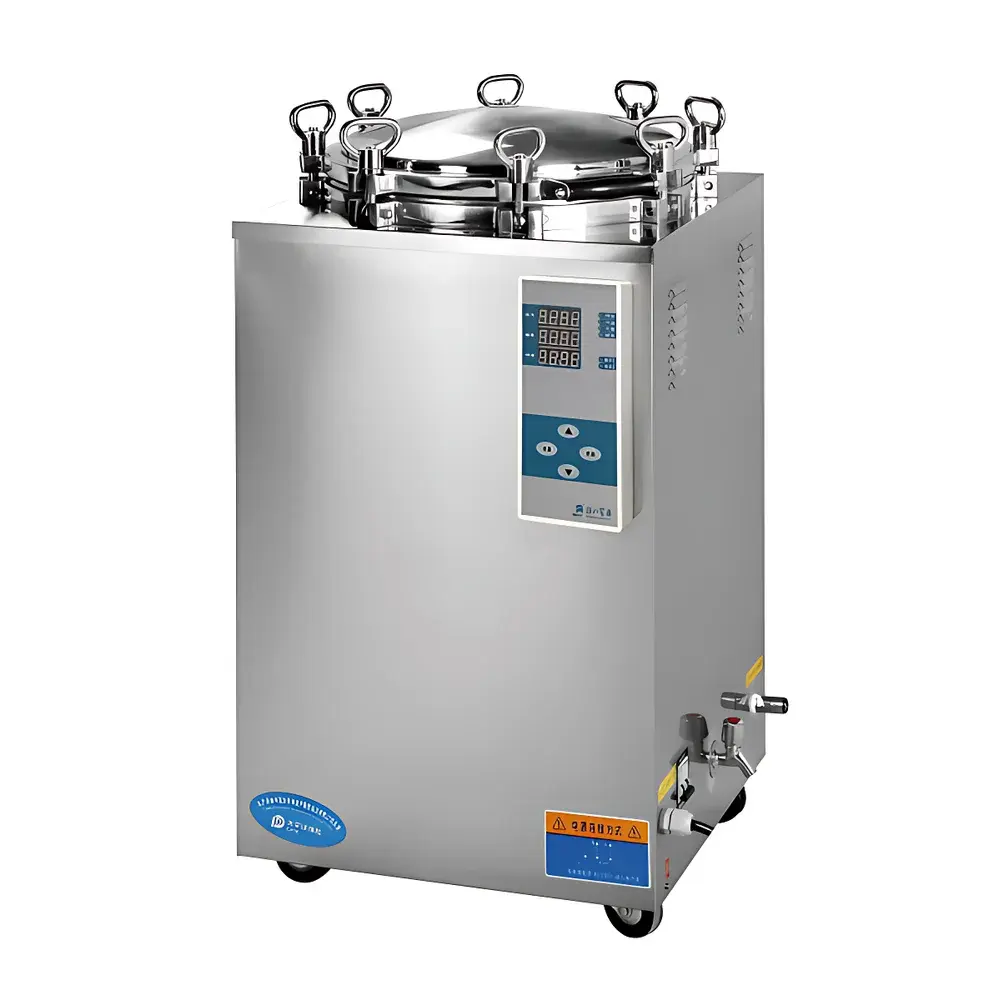
Jihepu LS-100LD Vertical Steam Autoclave
| Brand | Jihepu |
|---|---|
| Origin | Shandong, China |
| Model | LS-100LD |
| Sterilization Chamber Volume | 100 L |
| Maximum Operating Temperature | 134 °C |
| Maximum Operating Pressure | 0.22 MPa |
| External Dimensions (W×D×H) | 590 × 590 × 1080 mm |
| Power Rating | 4500 W / AC 220 V, 50 Hz |
| Temperature Uniformity | ≤ ±1 °C |
| Timer Range | 0–99 min |
| Temperature Control Range (Sterilization) | 105–134 °C |
| Temperature Control Range (Boiling Mode) | 50–101 °C |
| Net Weight | 85 kg |
| Gross Weight | 105 kg |
Overview
The Jihepu LS-100LD Vertical Steam Autoclave is a fully automated, microprocessor-controlled laboratory-grade steam sterilizer engineered for precision, safety, and regulatory compliance in biomedical, pharmaceutical, and academic settings. It operates on the validated principle of saturated steam under pressure—leveraging the well-established thermodynamic relationship between temperature, pressure, and microbial lethality—to achieve sterility assurance levels (SAL) of 10−6 for heat-stable materials. Designed to meet core requirements of ISO 17665-1 (sterilization of health care products — moist heat), the LS-100LD delivers consistent thermal penetration across its 100 L stainless steel chamber, with temperature uniformity maintained within ±1 °C throughout the load. Its vertical configuration optimizes floor space without compromising accessibility or loading capacity, making it suitable for medium-throughput laboratories processing surgical instruments, glassware, culture media, textiles, and liquid preparations.
Key Features
- Microprocessor-based digital control system with LED display providing real-time monitoring of temperature, pressure, elapsed time, and phase status (pre-vacuum, heating, sterilization, exhaust, drying)
- Dual-mode operation: programmable sterilization (105–134 °C) and boiling mode (50–101 °C) for non-critical item decontamination
- Automatic air removal via integrated gravity displacement venting, ensuring complete steam saturation and eliminating cold spots
- Triple-layer safety architecture: mechanical spring-loaded safety valve (set at 0.22 MPa), overtemperature cut-off sensor, and dry-run protection that interrupts power when water level falls below operational threshold
- Overcurrent and earth-leakage circuit protection compliant with IEC 61000-4 electromagnetic compatibility standards
- Full stainless steel 304 chamber and door gasket—resistant to corrosion from repeated steam exposure and compatible with routine cleaning agents used in GLP/GMP environments
- Auto-cycle termination with audible alarm, passive pressure release, and automatic heater shutdown upon cycle completion
Sample Compatibility & Compliance
The LS-100LD accommodates a broad range of sterilizable loads—including wrapped and unwrapped metal instruments, autoclavable plastics (e.g., polypropylene containers), cotton gauze, rubber tubing, and agar-based microbiological media—without requiring vacuum-assisted drying. Its chamber geometry supports standard instrument trays (up to 350 mm × 350 mm × 200 mm) and allows for vertical stacking of media bottles. The unit conforms to national safety standards GB 8599–2008 (China) for steam sterilizers and incorporates design elements aligned with ISO 13485 quality management system requirements for medical device manufacturers. While not certified to EN 285 for large-scale industrial sterilizers, its performance parameters satisfy routine validation protocols required by institutional biosafety officers and QA departments under CLIA, CAP, or local health authority guidelines.
Software & Data Management
The LS-100LD utilizes embedded firmware—not PC-dependent software—with non-volatile memory storing up to 99 user-defined programs. Each cycle logs timestamped data (start time, peak temperature, hold duration, final pressure), accessible via front-panel review. Though it lacks USB or Ethernet connectivity, its deterministic control logic ensures repeatable execution per program ID—a prerequisite for audit-ready documentation in regulated labs. For facilities requiring electronic records, external data loggers (e.g., calibrated thermocouple arrays connected to validated chart recorders) may be deployed during IQ/OQ/PQ qualification. All safety interlocks and critical fault events (e.g., “low water”, “overpressure”, “temperature deviation”) are flagged on-screen and retained in internal event history for traceability.
Applications
This autoclave serves as a primary sterilization tool in university teaching labs, hospital central supply departments (CSSD), clinical research units, and small-scale biotech production suites. Typical use cases include: terminal sterilization of reusable surgical kits prior to packaging; depyrogenation of glass vials and pipette tips; preparation of sterile growth media for microbiology and cell culture; decontamination of biohazardous waste prior to disposal; and heat treatment of soil samples in environmental microbiology workflows. Its 134 °C/3 min cycle option meets accelerated sterilization protocols for porous loads referenced in AAMI ST79.
FAQ
Does the LS-100LD support vacuum-assisted air removal for porous load sterilization?
No—it relies on gravity displacement for air evacuation, making it suitable for solid and fluid loads but not recommended for wrapped textile packs or lumened devices without supplementary validation.
Can the unit be validated for regulatory submissions (e.g., FDA, ISO 13485)?
Yes—its stable thermal profile, documented repeatability, and built-in safety redundancies enable successful installation qualification (IQ), operational qualification (OQ), and performance qualification (PQ) when conducted with third-party calibrated sensors and written protocols.
Is the chamber jacketed or single-walled?
The LS-100LD features a single-walled stainless steel chamber with direct immersion heating elements; no outer jacket is present, which simplifies maintenance but requires adherence to water quality specifications (softened, low conductivity) to prevent scale buildup.
What maintenance intervals are recommended?
Daily: chamber wipe-down and gasket inspection; weekly: safety valve functional test and drain line flush; annually: full calibration of temperature and pressure sensors by an accredited service provider.
Does it comply with FDA 21 CFR Part 11 for electronic records?
No—the device does not generate or store electronic signatures or audit trails meeting Part 11 requirements; however, its deterministic behavior supports paper-based or externally logged recordkeeping systems compliant with ALCOA+ principles.



