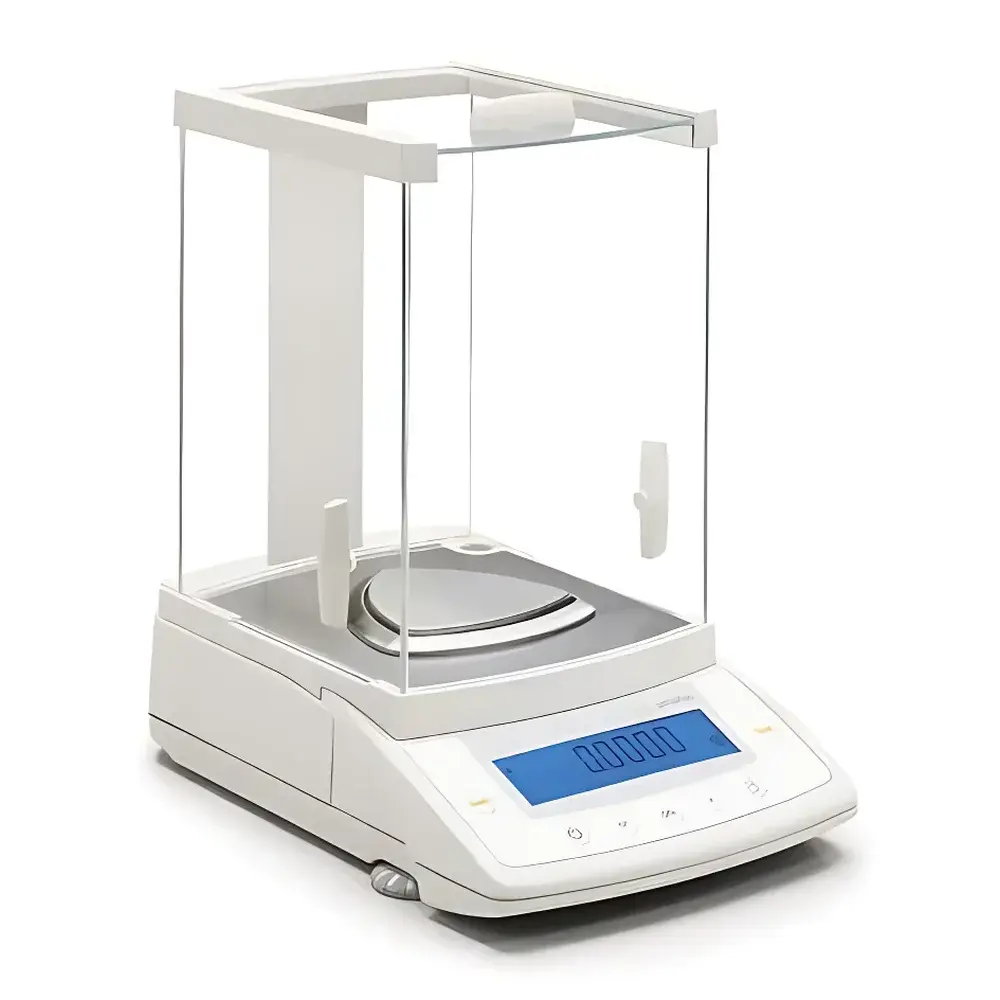
Sartorius CPA225D Analytical Balance
| Brand | Sartorius |
|---|---|
| Origin | Germany |
| Model | CPA225D |
| Readability | 0.01 / 0.01 / 0.1 mg |
| Capacity | 40 / 100 / 220 g |
| Calibration | Internal, isoCAL |
| Repeatability | ≤±0.02 / 0.05 / 0.1 mg |
| Linearity | ≤±0.03 / 0.1 / 0.2 mg |
| Pan Diameter | Ø80 mm |
| Interface | RS-232C |
| Compliance | ISO/GLP-compliant data output |
| Display | Backlit LCD (excluded on CPA225D) |
| Sensor Technology | Monolithic weighing sensor |
Overview
The Sartorius CPA225D Analytical Balance is a high-precision laboratory instrument engineered for demanding quantitative analysis in regulated and research-intensive environments. Based on electromagnetic force compensation (EMFC) principle, it delivers trace-level mass measurement accuracy across three selectable weighing ranges—40 g, 100 g, and 220 g—with corresponding readability of 0.01 mg, 0.01 mg, and 0.1 mg respectively. Designed and manufactured in Germany, the CPA225D integrates Sartorius’ proprietary monolithic weighing sensor architecture, which eliminates mechanical stress points and ensures long-term stability, minimal drift, and superior resistance to environmental perturbations such as vibration and thermal fluctuation. Its robust die-cast aluminum housing and optimized internal damping contribute to consistent performance under continuous operation in QC labs, pharmaceutical development suites, and academic analytical chemistry facilities.
Key Features
- Triple-range capability with automatic range switching: 40 g / 0.01 mg, 100 g / 0.01 mg, and 220 g / 0.1 mg—enabling flexible use without compromising resolution or overload safety.
- isoCAL — fully automated internal calibration and adjustment system with motor-driven calibration weights; initiates temperature-triggered or time-scheduled recalibration to maintain metrological integrity per ISO 9001 and ISO/IEC 17025 requirements.
- Monolithic sensor design: A single-piece, stress-free transducer structure enhances linearity (≤±0.03 mg / 0.1 mg / 0.2 mg across ranges) and repeatability (≤±0.02 mg / 0.05 mg / 0.1 mg), reducing maintenance frequency and validation effort.
- RS-232C bidirectional interface compliant with standard ASCII protocol—supports direct connection to Sartorius YDP03-0CE printers, LIMS, ELN systems, or custom data acquisition software.
- Built-in application modes: Percentage weighing, net/gross summation, animal (dynamic) weighing, piece counting, and unit conversion—all accessible via intuitive menu navigation without external configuration tools.
- Ergonomic draft shield: Extra-wide chamber with smooth, rounded corners and tool-free removable glass panels simplifies cleaning and minimizes static accumulation during microgram-level operations.
Sample Compatibility & Compliance
The CPA225D accommodates standard Ø80 mm stainless-steel weighing pans and is compatible with a broad spectrum of sample types—including powders, crystalline solids, filter papers, crucibles, and small-volume liquid containers—provided they remain within mechanical and electrostatic limits of the draft enclosure. It meets essential regulatory prerequisites for quality-controlled environments: full traceability support for GLP and GMP workflows, audit-ready printouts (with optional YDP03-0CE), and compliance with ISO 17025 clause 6.5.2 on equipment verification. While not inherently 21 CFR Part 11 compliant, its RS-232 output enables integration into validated electronic record systems when paired with appropriate middleware and procedural controls.
Software & Data Management
Data export follows standardized ASCII formatting over RS-232C, allowing seamless ingestion into Excel, LabWare LIMS, or custom Python/Matlab scripts via serial-to-USB adapters. All print outputs include timestamp, operator ID (if entered), balance ID, net weight, unit, and calibration status—fulfilling minimum documentation requirements under ISO/GLP. The balance does not feature onboard storage or Ethernet/Wi-Fi connectivity; however, its deterministic command-response protocol supports reliable automation in scripted weighing sequences using third-party control software.
Applications
- Pharmaceutical formulation: Accurate dispensing of active pharmaceutical ingredients (APIs) and excipients during R&D batch preparation and stability study sampling.
- Reference standard preparation: Gravimetric dilution of certified reference materials (CRMs) for HPLC and ICP-MS calibration curves.
- Materials science: Density determination of ceramic precursors and polymer additives requiring sub-0.1 mg resolution.
- Environmental testing labs: Weighing of pre- and post-incineration filters in TSP/PM2.5 gravimetric analysis per EPA Method 201A.
- Academic research: Teaching quantitative analytical techniques including stoichiometric synthesis, thermogravimetric residue quantification, and moisture content assessment by loss-on-drying.
FAQ
Does the CPA225D support external calibration with traceable weights?
Yes—while isoCAL provides automated internal calibration, the balance accepts external calibration via certified Class E2 or better weights through its dedicated calibration mode.
Is the display backlit on the CPA225D model?
No—the CPA225D features a high-contrast non-backlit LCD display; backlighting is available on other models in the CP series (e.g., CPA1003, CPA224S).
Can the CPA225D be integrated into a networked lab environment?
It lacks native Ethernet or Wi-Fi, but RS-232C output can be routed through serial servers or USB-to-serial gateways for centralized data collection in networked infrastructures.
What is the warm-up time required before first use?
Sartorius recommends a minimum 30-minute stabilization period at constant ambient temperature (18–25 °C, <50% RH) prior to critical measurements.
How often should isoCAL be scheduled?
Default factory setting triggers isoCAL every 2 hours after power-on; intervals may be adjusted between 15 minutes and 24 hours depending on lab environmental stability and SOP requirements.