
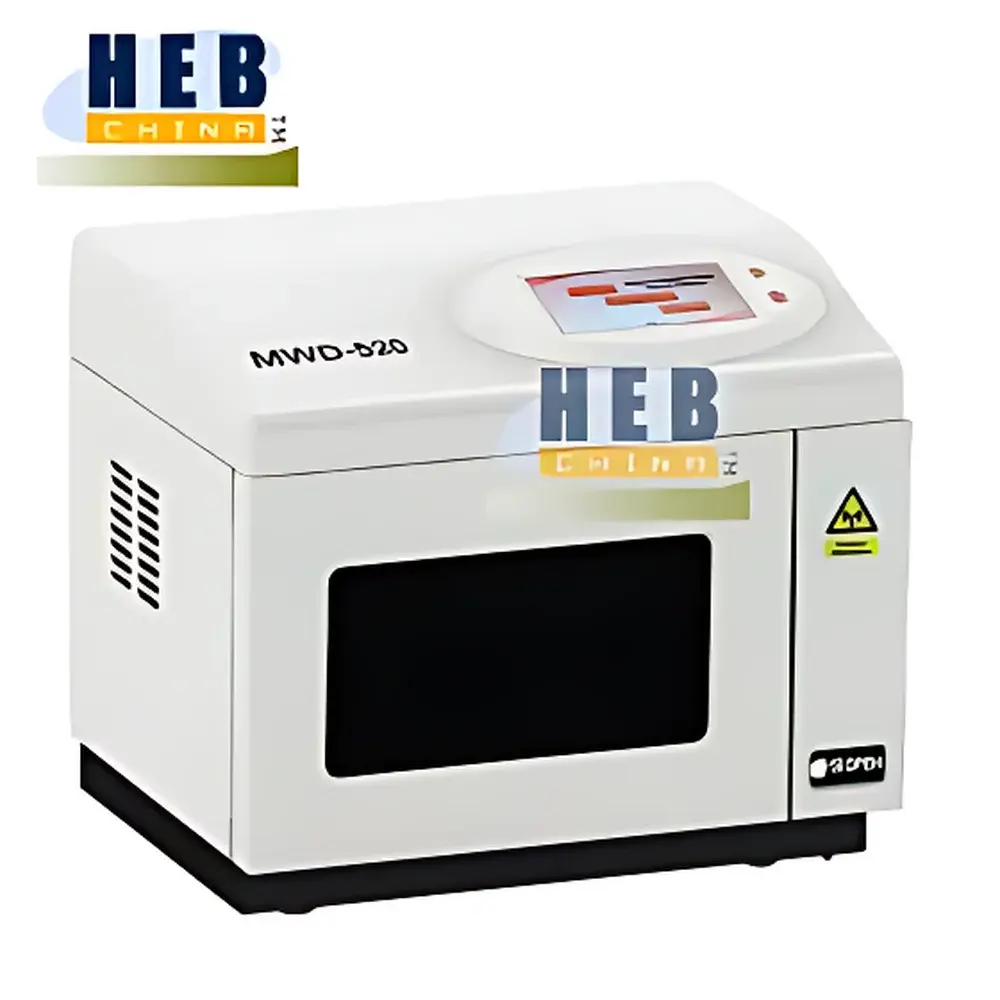
Jihepu MWD-520 Intelligent Microwave Digestion System
| Brand | Jihepu |
|---|---|
| Origin | Shandong, China |
| Model | MWD-520 |
| Sample Capacity | 1–6 vessels |
| Microwave Source | Dual Magnetron |
| Max Operating Temperature | 250 °C (up to 300 °C peak) |
| Max Operating Pressure | 5 MPa (up to 6 MPa burst) |
| Vessel Volume | 60 mL |
| Temperature Accuracy | ±1 °C (range: ambient to 300 °C) |
| Pressure Accuracy | ±0.1 MPa (range: 0–5 MPa) |
| Microwave Power Output | 0–1000 W (2450 MHz) |
| Cavity Ventilation | >5 m³/min corrosion-resistant blower |
| Microwave Leakage | <5 mW/cm² |
| Dimensions (W×D×H) | 520 × 400 × 460 mm |
| Net Weight | ~30 kg |
| Power Supply | AC 220 V, 50/60 Hz, 10 A |
Overview
The Jihepu MWD-520 Intelligent Microwave Digestion System is a benchtop, dual-magnetron microwave-assisted sample preparation platform engineered for high-efficiency, reproducible acid digestion of solid and semi-solid matrices. It operates on the principle of dielectric heating—where microwave energy directly couples with polar molecules (e.g., HNO₃, HCl, HF) to induce rapid, volumetric thermal excitation within sealed reaction vessels. Unlike conductive heating methods (e.g., hot plates or block digesters), this system delivers uniform internal energy deposition, minimizing thermal gradients and volatile element loss—critical for trace metal analysis by ICP-OES, ICP-MS, or AAS. Designed for routine compliance-driven laboratories, the MWD-520 supports method development and standardized workflows across environmental, food safety, geochemical, pharmaceutical, and industrial QA/QC applications. Its architecture adheres to fundamental safety and performance expectations aligned with ISO/IEC 17025 pre-analytical requirements and provides operational transparency essential for GLP documentation.
Key Features
- Self-Restoring TFM Digestion Vessels: Constructed from imported modified polytetrafluoroethylene (TFM), each vessel integrates a pressure-actuated resealing mechanism. Upon transient overpressure events, the seal temporarily releases and autonomously re-engages without requiring consumable rupture discs or sealing bowls—reducing per-run cost and eliminating batch failure due to single-vessel venting.
- Independent Temperature & Pressure Monitoring per Vessel: Each position features dedicated fiber-optic temperature sensors and piezoresistive pressure transducers, fully isolated from the reaction medium. Real-time dual-parameter data acquisition ensures no cross-contamination between samples and enables precise endpoint control based on kinetic or thermodynamic thresholds.
- 360° Continuous Rotation Platform: A motor-driven carousel rotates all vessels synchronously and unidirectionally throughout the entire digestion cycle. This eliminates standing-wave hotspots common in static or oscillating cavity designs and reduces mechanical stress on drive components compared to reciprocating systems—extending mean time between failures (MTBF) for the rotation assembly.
- High-Resolution Touch Interface: A wide-format color LCD displays real-time power, temperature, pressure, and time profiles. Dedicated per-vessel readouts—including dynamic pressure/temperature overlays—support immediate visual verification of method adherence and early anomaly detection.
- Expandable Method Library: Stores up to 255 user-defined digestion protocols, each supporting up to 10 sequential steps. Every step allows independent configuration of target temperature, maximum pressure, ramp rate, hold duration, and microwave power—enabling complex multi-acid or gradient-based digestion schemes.
- Comprehensive Safety Architecture: Includes hardware-level interlocks (door-open suspension, emergency stop button), dynamic fault diagnostics (abnormal acoustic signature detection, power supply anomaly logging), and redundant thermal and pressure cutoffs (over-temperature, over-pressure, and rate-of-rise protection).
Sample Compatibility & Compliance
The MWD-520 accommodates standard 60 mL TFM vessels with reinforced PEEK+glass-fiber outer containment sleeves rated to 10 MPa and 300 °C—providing a ≥2× safety margin against operational limits. It supports common digestion chemistries including HNO₃/H₂O₂, HNO₃/HF, and HCl/HNO₃ mixtures for matrices such as soils, biological tissues, polymers, catalysts, and battery cathode materials. While not certified to IEC 61000-4 or UL 61010-1 as a standalone unit, its electromagnetic leakage (<5 mW/cm²) complies with GB 4706.21–2008 and aligns with general laboratory microwave safety guidance referenced in EPA Method 3051A, ISO 15587-1, and ASTM D5511. All firmware logs—including parameter edits during active runs—are timestamped and non-erasable, supporting audit readiness under basic GLP frameworks.
Software & Data Management
The embedded operating system records full-cycle telemetry (power, temp, pressure, time) at 1-second intervals and saves datasets in CSV format via USB export. Parameter modification during runtime—including dynamic adjustment of setpoints or hold times—is permitted without interrupting digestion, facilitating method optimization without protocol restarts. An integrated help system provides context-sensitive troubleshooting guides covering common error codes (e.g., “E03 – Pressure Sensor Drift”, “E12 – Cavity Resonance Mismatch”) and preventive maintenance schedules. No cloud connectivity or remote access capability is included; data residency remains local to the instrument—ensuring compliance with institutional data sovereignty policies.
Applications
This system is routinely deployed in accredited environmental labs for EPA-compliant digestion of sediment and wastewater sludge prior to heavy metal quantification. In food testing facilities, it enables rapid, low-blank digestion of fortified cereals and infant formula for As, Cd, Pb, and Hg analysis. Geological laboratories use it for silicate rock dissolution using HF-containing reagents, while R&D teams in battery manufacturing apply it to recover Li, Co, Ni, and Mn from spent cathode scrap. Its consistent thermal delivery also supports method validation studies requiring strict repeatability (RSD <3% for triplicate digests across 6 positions).
FAQ
What is the maximum number of samples processed simultaneously?
The MWD-520 supports concurrent digestion of 1 to 6 samples in standardized 60 mL TFM vessels.
Can digestion methods be edited while a run is in progress?
Yes—target temperature, pressure, hold time, and microwave power can be adjusted in real time without terminating the current cycle.
Is the system compatible with hydrofluoric acid (HF)?
Yes, the TFM inner vessels and PEEK+glass-fiber outer sleeves are chemically resistant to HF at concentrations and temperatures typical for geological and metallurgical applications.
How is data integrity ensured during long-term operation?
All telemetry and parameter changes are logged with UTC timestamps in non-volatile memory; logs cannot be altered or deleted without physical firmware reset.
Does the instrument meet international electromagnetic compatibility standards?
It complies with Chinese national standard GB 4706.21–2008 for microwave leakage (<5 mW/cm²); formal CE or FCC certification is not claimed.



