
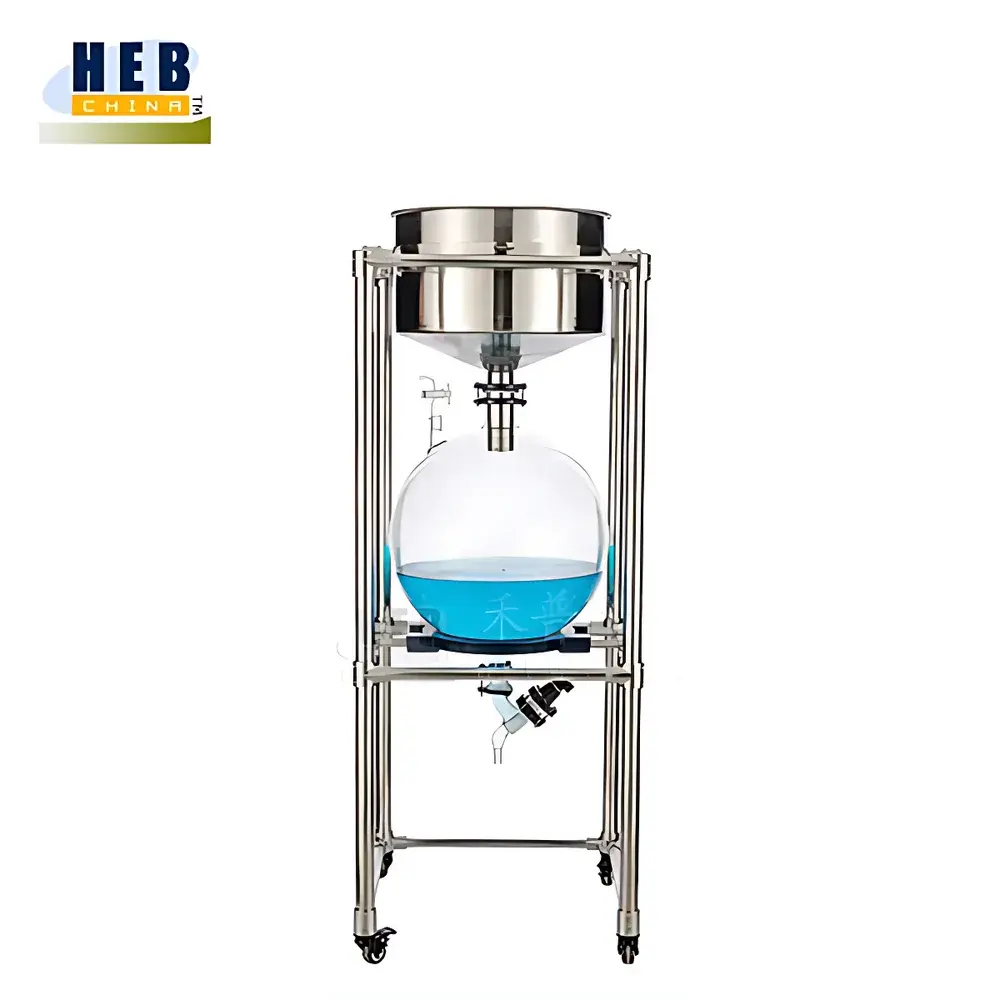
Jihepu ZF-50L Vacuum Filtration Apparatus
| Brand | Jihepu |
|---|---|
| Origin | Shandong, China |
| Manufacturer Type | Authorized Distributor |
| Product Category | Domestic Laboratory Equipment |
| Model | ZF-50L |
| Capacity | 50 L |
| Construction Material | Borosilicate Glass (3.3 expansion coefficient) + 304 Stainless Steel + Aluminum Alloy Frame |
| Operating Pressure Range | Low Vacuum |
| Ultimate Vacuum Level | 0.098 MPa (≈735 Torr, or ~26.5 inHg absolute) |
| Filtration Area | Φ450 mm stainless steel funnel with 4 mm perforated base |
| Dimensions (W×D×H) | 580 × 600 × 1530 mm |
| Net Weight | 38 kg |
| Shipping Volume | 0.64 m³ (Wooden Crate) |
| Shipping Weight | 67 kg |
| Vacuum Port | Standard 24/40 ground glass joint |
| Drain Port | Φ45 mm spherical glass valve with PTFE core (C-type) |
| Filtration Bottle | Spherical, Φ470 mm, three-neck design, 24/40 vacuum inlet and outlet ports |
| Funnel Mounting Flange | Φ80 mm |
| Discharge Outlet | Φ20 mm |
| Mobility | Four swivel casters with locking brakes |
Overview
The Jihepu ZF-50L Vacuum Filtration Apparatus is a bench- to floor-standing, manually operated vacuum-assisted solid–liquid separation system engineered for reproducible, scalable filtration under controlled low-vacuum conditions. It operates on the principle of pressure-driven cross-flow filtration: a vacuum source (externally supplied) creates a pressure differential across a user-selected filter medium—such as woven metal mesh, sintered stainless steel, polymeric membranes, or nonwoven filter cloths—placed atop the perforated 304 stainless steel funnel. This differential drives liquid phase through the medium while retaining suspended solids on the filter surface. The apparatus is not a sealed reactor but a gravity-fed, open-to-atmosphere filtration station designed for batch processing of moderate-volume (up to 50 L total slurry volume) suspensions, slurries, crystallization mother liquors, or post-reaction mixtures requiring rapid phase separation prior to downstream analysis or drying.
Key Features
- Borosilicate glass (Schott Duran / Pyrex-grade, α = 3.3 × 10⁻⁶/K) filtration flask: spherical 50 L capacity, triple-neck configuration (24/40 standard taper joints), chemically inert, thermal shock resistant up to 120 °C, and transparent for real-time process monitoring.
- 304 stainless steel conical funnel (Φ450 × 250 mm H) with uniformly drilled 4 mm apertures; compatible with interchangeable filter supports and retentate scraping tools.
- Modular aluminum alloy and stainless steel support frame: rigid, corrosion-resistant, and height-optimized for ergonomic operation at standing workstations.
- Integrated C-type spherical discharge valve (Φ45 mm) featuring a glass body and PTFE-sealed core—ensuring leak-tight, solvent-compatible, and particle-free material transfer during filtrate collection or cake discharge.
- Full mobility via four 100 mm diameter swivel casters with independent locking brakes—enabling safe relocation between fume hoods, gloveboxes, and drying stations without disassembly.
- Vacuum interface compliant with ISO 3585 and ASTM E2882 standards for ground-glass joint dimensions (24/40), facilitating direct connection to common laboratory vacuum pumps, vacuum manifolds, or oil-free diaphragm systems.
Sample Compatibility & Compliance
The ZF-50L accommodates a broad range of sample types—including aqueous, organic, and mildly corrosive solutions—provided the selected filter medium and gasket materials are chemically compatible. It supports filtration of crystalline precipitates, polymer gels, catalyst residues, biological cell pellets, and fine particulates down to ~10 µm (dependent on filter pore size). The apparatus itself meets general laboratory safety requirements per IEC 61010-1:2010 for electrical equipment used in measurement, control, and laboratory use (when paired with certified vacuum pumps). While not intrinsically rated for hazardous area use, its all-glass fluid path and absence of internal electronics render it suitable for Class I, Division 2 environments when operated with appropriate explosion-proof vacuum sources. No CE, UL, or FDA 21 CFR Part 11 certification is claimed for the unit itself; end-user validation is required for GMP/GLP-regulated applications.
Software & Data Management
This is a purely mechanical, analog filtration system with no embedded electronics, sensors, or digital interfaces. Process parameters—including vacuum level, filtration time, and cake thickness—are monitored externally using standalone vacuum gauges (e.g., Pirani or capacitance manometers), stopwatch timing, and visual inspection. For auditability in regulated environments, users may document operational logs manually or integrate external data acquisition systems (e.g., LabVIEW or DeltaV) via third-party pressure transducers installed on the vacuum line. All glass components bear permanent laser-etched model and serial identifiers to support equipment traceability under ISO/IEC 17025 calibration management protocols.
Applications
- Routine isolation of reaction products from heterogeneous catalytic syntheses (e.g., Pd/C, Ni/Raney, or metal-organic frameworks).
- Crystallization workup: harvesting crystals from antisolvent precipitation or cooling crystallization batches.
- Pretreatment of environmental water samples prior to ICP-MS or GC-MS analysis.
- Cell harvesting in microbiology labs where centrifugation is impractical for large-volume cultures.
- Removal of desiccants (e.g., MgSO₄, Na₂SO₄) or scavenger resins following solution-phase organic synthesis.
- Pre-filtration step before lyophilization or spray drying of heat-sensitive biomolecules.
FAQ
What vacuum pumps are compatible with the ZF-50L?
Any vacuum pump capable of achieving ≥0.098 MPa (735 Torr) ultimate vacuum and equipped with a 24/40 ground-glass vacuum hose adapter or宝塔接头 (12 mm OD) may be used. Oil-lubricated rotary vane pumps, dry scroll pumps, and diaphragm pumps are commonly deployed.
Is the filtration bottle certified for autoclaving?
No. While borosilicate glass withstands thermal cycling, the assembled unit—including PTFE valve seals and aluminum frame—must be disassembled prior to steam sterilization. Only the glass components may be autoclaved at 121 °C for 20 min.
Can the funnel be heated or cooled during operation?
Not directly—the funnel lacks jacketing or thermal coupling. However, pre-chilling or pre-warming of feed slurry is permissible to control crystal morphology or viscosity.
What is the maximum recommended operating temperature?
120 °C for short-term exposure (≤30 min); prolonged use above 80 °C requires verification of gasket integrity and vacuum seal performance.
Does the system include filter media?
No. Filter cloth, sintered metal discs, membrane filters, and supporting filter papers must be selected and supplied by the user based on particle size distribution, chemical compatibility, and throughput requirements.



