
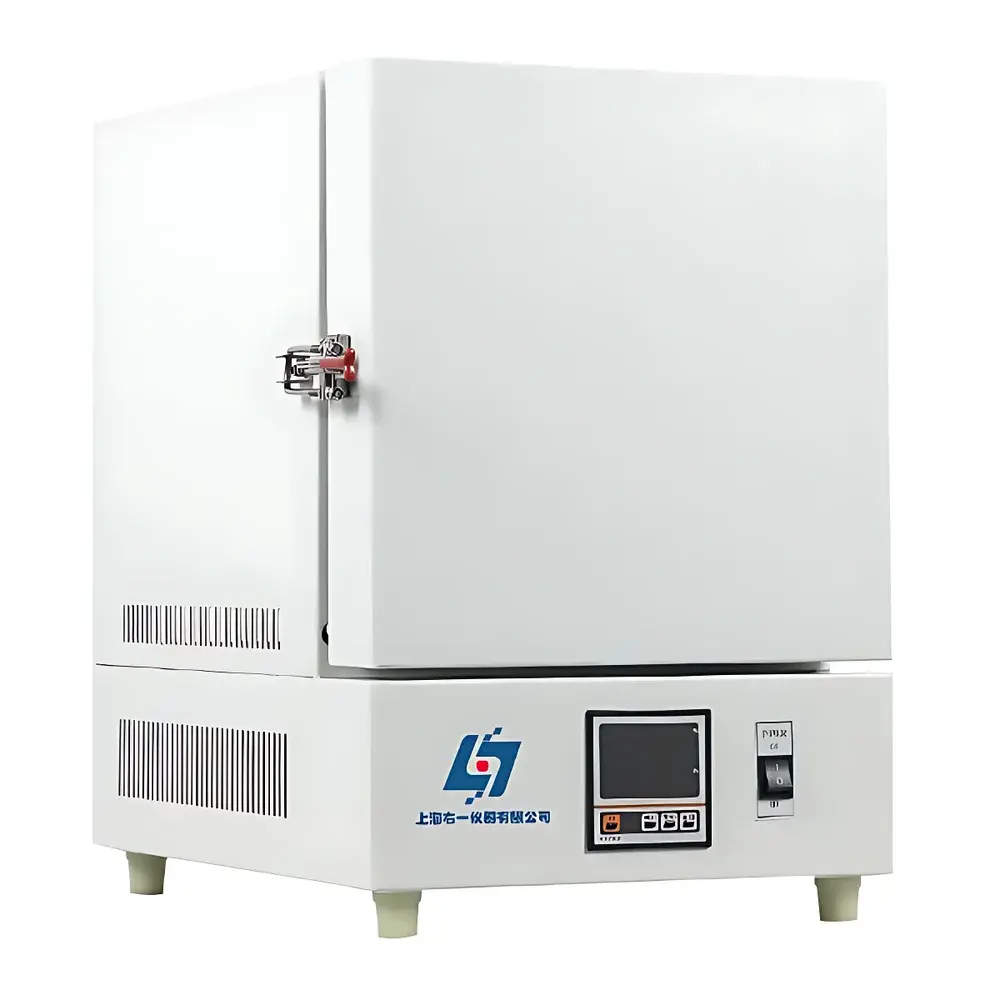
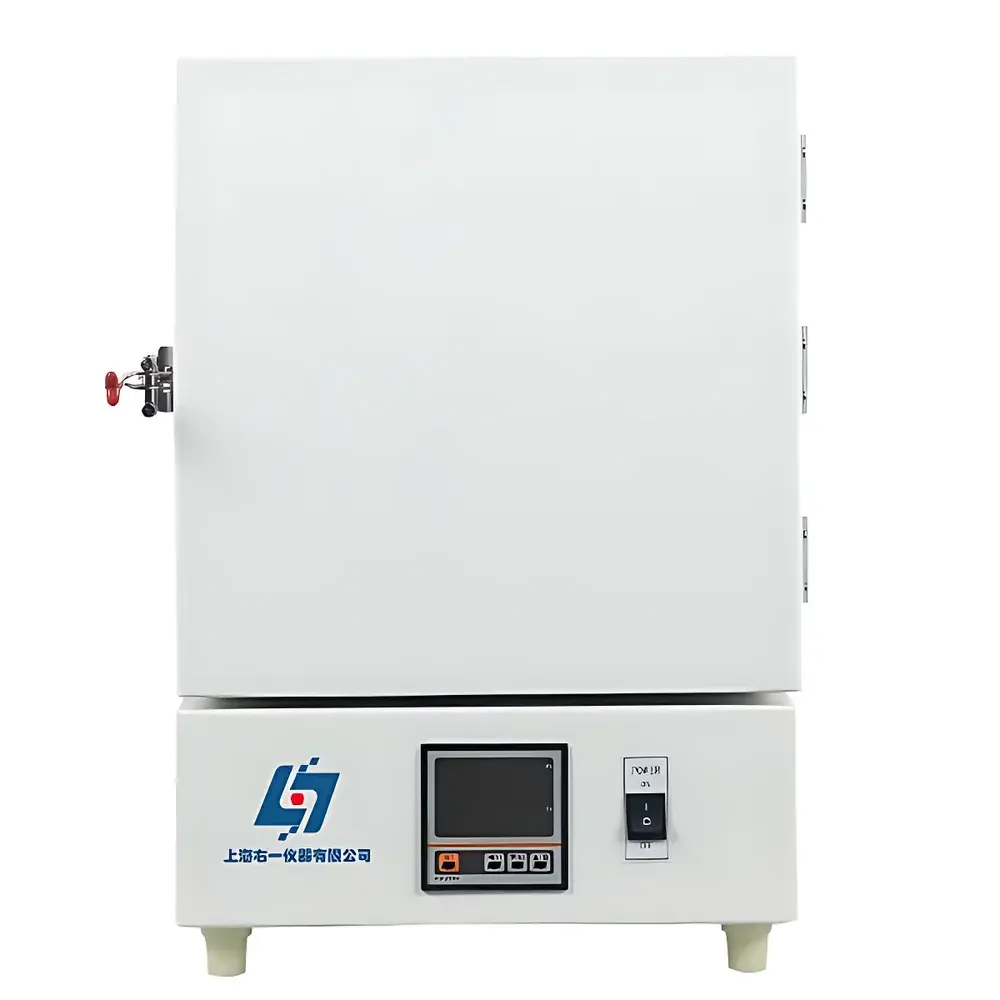
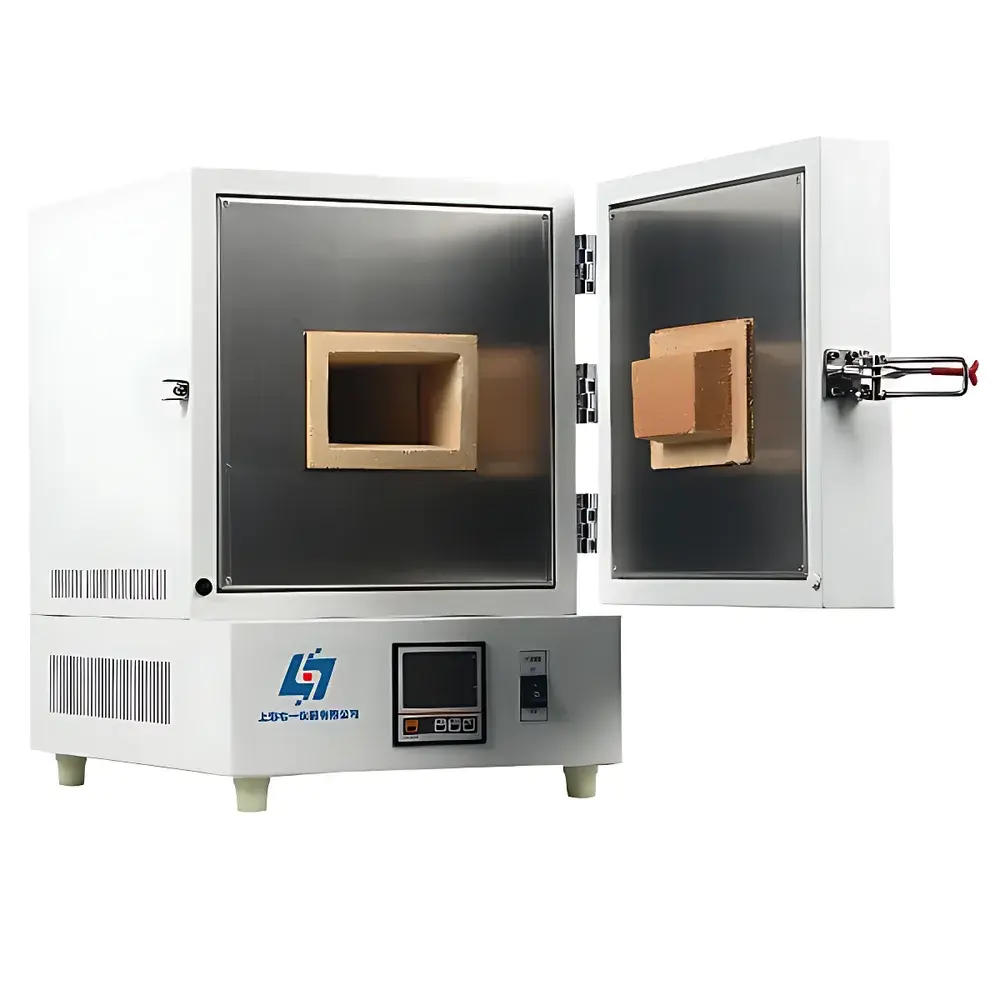
Yoyilab SX2-8-10 Benchtop Muffle Furnace (1000 °C)
| Brand | Yoyilab |
|---|---|
| Origin | Shanghai, China |
| Manufacturer Type | Direct Manufacturer |
| Equipment Type | Box-Type Resistance Furnace |
| Max Temperature | 1000 °C |
| Temperature Control Accuracy | ±3 °C |
| Rated Power | 8 kW |
| Heating Method | Electric Resistance Heating |
| Internal Chamber Dimensions | 250 × 400 × 160 mm |
| Nominal Volume | 16 L |
| Controller | 4.3-inch LCD with PID Algorithm |
| Temperature Resolution | 1 °C |
| Timer Range | 1–9999 min |
| Thermocouple Type | K-type |
| Heating Element | Nickel-Chromium Alloy Wire |
| Chamber Lining | Refractory Brick (Monolithic Construction) |
| Safety Features | Over-Temperature Alarm, Door-Interlocked Power Cut-off, Leakage Current Protection, Over-Current/Over-Voltage Protection |
| Power Supply | 380 V / 50 Hz |
| Compliance | Designed per IEC 61000-6-3 (EMC), IEC 61000-6-2 (Immunity), and GB/T 10066.1–2004 (General Safety Requirements for Industrial Electrothermal Equipment) |
Overview
The Yoyilab SX2-8-10 is a benchtop box-type muffle furnace engineered for precise, repeatable high-temperature thermal processing in research laboratories, quality control facilities, and small-scale production environments. Operating on the principle of resistive heating via embedded nickel-chromium alloy elements, it delivers uniform temperature distribution across its monolithic refractory brick chamber—critical for applications demanding spatial thermal homogeneity, such as ashing, calcination, sintering, and heat treatment of metallic and ceramic samples. With a maximum operating temperature of 1000 °C and a certified control accuracy of ±3 °C, the furnace meets baseline thermal stability requirements for ASTM E1112 (Standard Practice for Calibrating Laboratory Furnaces) and supports GLP-compliant workflows when integrated with validated procedural documentation.
Key Features
- Integrated 4.3-inch LCD interface with menu-driven operation: simultaneous display of setpoint, real-time chamber temperature, elapsed time, and remaining hold duration
- Microprocessor-based PID temperature controller with auto-tuning capability, enabling stable ramp-hold-cool profiles and minimizing overshoot during rapid heating cycles
- Monolithic refractory brick chamber (250 × 400 × 160 mm internal dimensions; 16 L nominal volume) ensures low thermal mass, fast heat-up rates (~20 °C/min from ambient to 800 °C), and long service life under repeated thermal cycling
- Dual-layer cold-rolled steel housing with high-temperature baked enamel finish provides mechanical rigidity, corrosion resistance, and surface durability in shared lab environments
- Comprehensive electrical safety architecture: independent over-temperature cutoff (hardware-limited), door-actuated contactor disengagement, residual-current device (RCD) integration, and dual-stage over-current protection
- Power-fail recovery function retains all active parameters—including setpoint, ramp rate, and hold time—ensuring process continuity after unscheduled outages without manual reconfiguration
Sample Compatibility & Compliance
The SX2-8-10 accommodates standard crucibles (alumina, quartz, stainless steel), ceramic setters, and metal trays up to 200 mm in diameter. Its sealed muffle design isolates samples from combustion by-products and external contaminants, making it suitable for ash content determination per AOAC 923.03 and ISO 2171, as well as pre-treatment steps in ICP-OES sample preparation. The furnace conforms to electromagnetic compatibility standards IEC 61000-6-3 and immunity standard IEC 61000-6-2. While not inherently 21 CFR Part 11 compliant, audit trails and electronic records can be generated via optional RS485 interface and companion software—enabling traceability in regulated QC/QA settings aligned with ISO/IEC 17025 requirements.
Software & Data Management
An optional RS485 serial interface (Modbus RTU protocol) enables bidirectional communication with laboratory information management systems (LIMS) or SCADA platforms. Paired with dedicated PC software, users can define multi-segment thermal programs (up to 30 segments), export timestamped temperature logs in CSV format, and generate PDF reports with operator ID, batch number, and calibration certificate references. Optional accessories include a thermal printer for hard-copy record retention and a programmable controller upgrade supporting soak-and-soak, ramp-and-soak, and cooling-rate modulation—facilitating method transfer from R&D to routine testing.
Applications
- Gravimetric ash analysis of foodstuffs, pharmaceutical excipients, and environmental filter media
- Pre-sintering of oxide ceramics (e.g., Al2O3, ZrO2) and powder metallurgy compacts prior to hot isostatic pressing
- Heat treatment of small-dimension tool steels and stainless components (annealing, stress relieving, tempering)
- Thermal decomposition studies in materials science research, including TGA validation and kinetic modeling
- Controlled atmosphere precursor calcination for battery cathode material synthesis (when used with purge gas manifold add-on)
- Calibration verification of thermocouples and infrared pyrometers against NIST-traceable reference standards
FAQ
What is the typical heating rate from room temperature to 1000 °C?
Under no-load conditions, the SX2-8-10 achieves approximately 20 °C/min average ramp rate up to 800 °C, slowing to ~10 °C/min above 800 °C due to increased thermal inertia and radiation-dominated heat transfer.
Can this furnace operate continuously at 1000 °C?
Yes—rated for continuous operation at maximum temperature, provided ambient conditions remain within 5–40 °C and relative humidity stays below 80% non-condensing, with adequate ventilation around rear and side panels.
Is the K-type thermocouple included and calibrated?
A factory-installed, uncalibrated K-type thermocouple is integrated into the control system; users must perform periodic verification using a secondary reference probe per ISO/IEC 17025 Clause 6.6.
Does the unit support programmable multi-step temperature profiles out of the box?
The base controller supports single-setpoint operation with timer-based hold; multi-segment programming requires the optional programmable temperature controller module.
What maintenance is required for long-term reliability?
Quarterly visual inspection of heating element continuity, annual cleaning of ventilation grilles, and biannual verification of door gasket integrity and contactor response time are recommended per manufacturer’s maintenance schedule.



