
Jingfei FLA7200 LED Fast Photometric, Colorimetric & Electrical Analysis System
| Brand | Jingfei Technology |
|---|---|
| Origin | Zhejiang, China |
| Manufacturer Type | Manufacturer |
| Origin Category | Domestic |
| Model | FLA7200 |
| Pricing | Upon Request |
| Wavelength Range | 380–800 nm |
| Wavelength Resolution & Repeatability | 0.4 nm |
| Wavelength Accuracy | ±1.0 nm |
| Spectral Sampling Interval | 0.4 nm |
| Photometric Repeatability | ±1% |
| Integration Time | 1 ms – 6.5 s |
| Chromaticity Coordinate Accuracy | ±0.001 (under CIE Standard Illuminant A) |
| CCT Range | 1500 K – 25,000 K |
| CCT Accuracy | ±10 K (under CIE Standard Illuminant A) |
| CRI Range | 0–100.0 |
| CRI Measurement Uncertainty | ±(0.3% + 0.5) |
| MacAdam Ellipse (SDCM) Accuracy | ±1.0 |
| Luminous Flux Range | 0.1 lm – 1.9999 × 10⁵ lm |
| Photometric Linearity | ±0.5% |
| Photometric Accuracy Class | Class I (per CIE S 023/E:2018 and GB/T 39820–2021) |
| Programmable Constant-Current Source Output | 1.0 mA – 2.0 A |
| Programmable Constant-Voltage Source Output | 0.1 V – 10.0 V |
| Forward Current (I<sub>F</sub>) Measurement Range | 1.0 mA – 2.0 A |
| Forward Voltage (V<sub>F</sub>) Measurement Range | 0.1 V – 25.0 V |
| Reverse Leakage Current (I<sub>R</sub>) Measurement Range | 0.10 µA – 100.0 µA |
| Zener Voltage (V<sub>Z</sub>) Measurement Range | 2 V – 38.0 V |
Overview
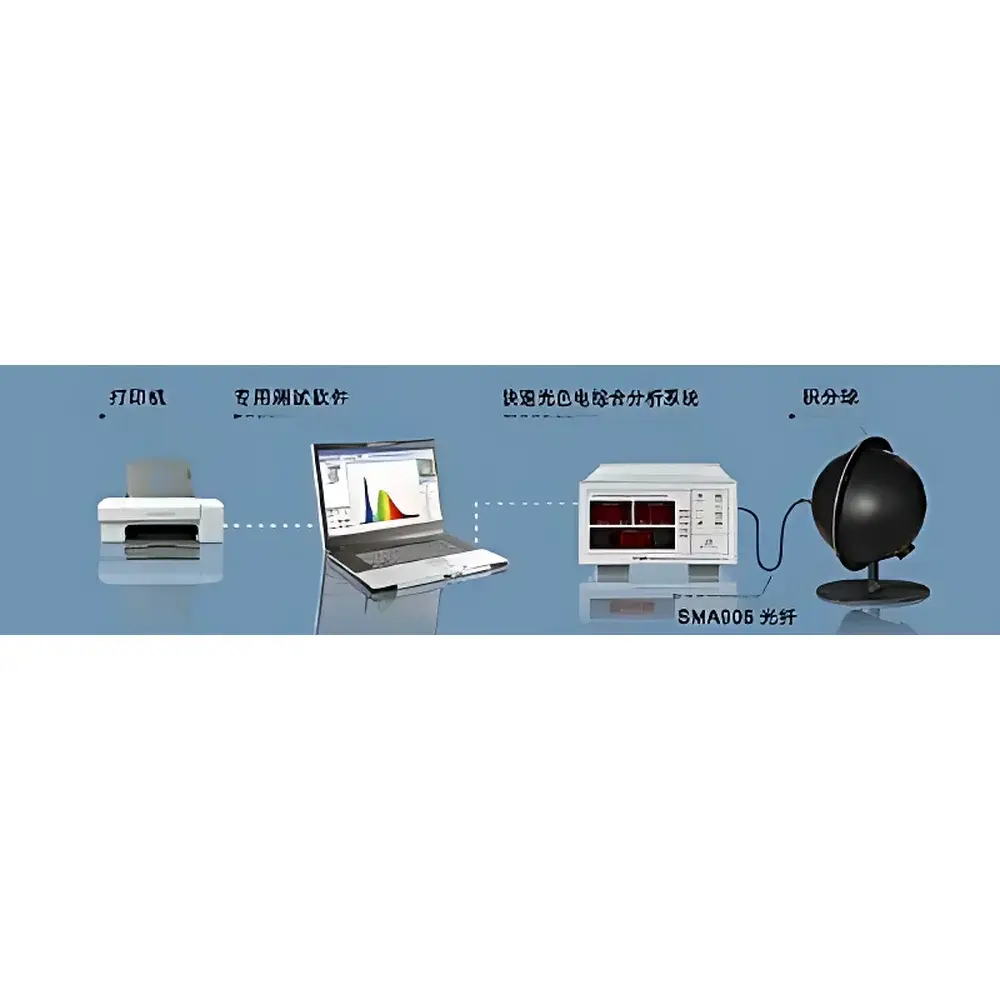
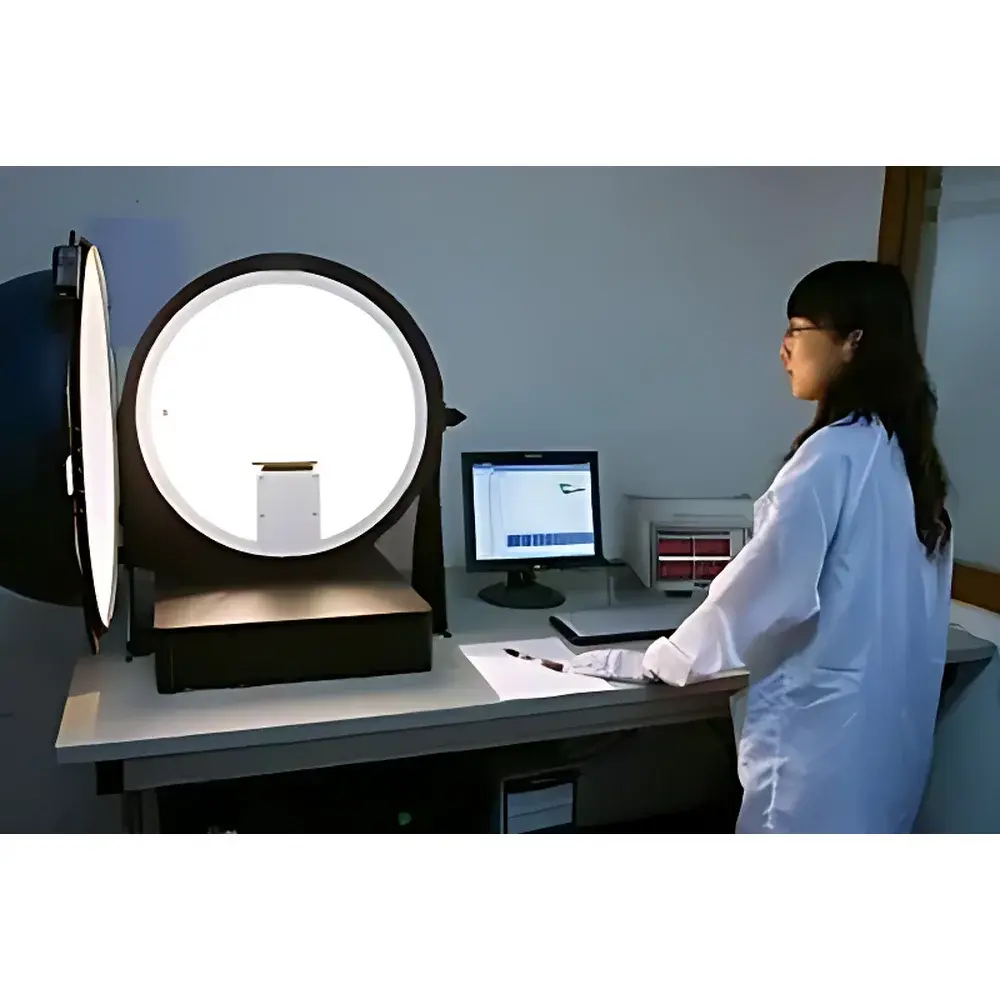
The Jingfei FLA7200 LED Fast Photometric, Colorimetric & Electrical Analysis System is a fully integrated benchtop instrument engineered for high-throughput, traceable characterization of solid-state lighting (SSL) devices—including LEDs, OLEDs, mini-LEDs, and compact fluorescent lamps (CFLs). It implements a fixed-grating spectrometer architecture with a back-thinned, thermoelectrically cooled CCD linear array detector, eliminating mechanical scanning mechanisms entirely. This design enables full-spectrum acquisition (380–800 nm) in a single exposure—typically under 100 ms—while maintaining photometric linearity across six orders of magnitude and colorimetric stability compliant with CIE S 023/E:2018, ISO/CIE 13370:2020, and GB/T 39820–2021. The system integrates a programmable dual-mode power supply (constant-current and constant-voltage), precision voltage/current sensing circuitry, and calibrated optical collection optics (integrating sphere or goniophotometer-compatible interface) into one synchronized measurement platform. All optical and electrical measurements are time-aligned and referenced to NIST-traceable calibration standards, supporting metrological rigor required for R&D validation, production QA/QC, and regulatory compliance reporting.
Key Features
- Fixed-optics spectrometer with high-dynamic-range, TE-cooled CCD detector—no moving parts, zero mechanical wear, and >100,000-hour operational lifetime
- Multi-stage aberration-corrected optical path with holographic grating and order-sorting filters, reducing stray light to <10% of conventional scanning monochromators
- FPGA-based timing controller achieving sub-nanosecond synchronization between integration trigger, analog-to-digital conversion, and power supply ramping
- Class I photometric accuracy per CIE S 023/E:2018; chromaticity coordinate repeatability ≤ ±0.001 (CIE 1931 xy under Illuminant A)
- Simultaneous acquisition of spectral power distribution (SPD), luminous flux (lm), luminous efficacy (lm/W), correlated color temperature (CCT), Duv, CRI (R1–R15), TM-30-20 metrics (Rf, Rg), peak wavelength, dominant wavelength, purity, and half-bandwidth
- Integrated electrical test module supporting forward/reverse bias sweeps, IF/VF curve tracing, leakage current profiling (IR vs. VR), and Zener breakdown analysis—all synchronized with optical readout
Sample Compatibility & Compliance
The FLA7200 accommodates standard LED packages (e.g., SMD 2835, 3030, 5050), COB modules, lamp bulbs (E27, GU10), and bare die mounted on thermal test fixtures. Optional accessories include 0.3 m/0.5 m/1.0 m integrating spheres (with baffle and port correction), near-field goniophotometer adapters, and temperature-controlled stage interfaces (−10 °C to +85 °C). All photometric calibrations are performed using NIST-traceable tungsten-halogen and deuterium reference lamps, validated against CIE Publication 127:2007 and IES LM-79-19 Annex B protocols. Electrical measurement circuits comply with IEC 62384:2016 (DC/AC LED drivers) and JEDEC JESD22-A114 (ESD robustness). Data integrity meets FDA 21 CFR Part 11 requirements when used with optional audit-trail-enabled software licensing.
Software & Data Management
Jingfei’s proprietary SpectraLab v4.x software provides a unified GUI for instrument control, real-time spectral visualization, automated test sequencing, and export-ready reporting. It supports batch mode operation with CSV, XML, and CIE 15:2018-compliant .cie file exports. Calibration data—including spectral responsivity, sphere coating reflectance, and electrical channel gain/offset—are stored in encrypted, versioned databases with SHA-256 checksums. Raw spectral datasets retain full 16-bit resolution and timestamp metadata (UTC-synced via NTP). Audit trails record all user actions, parameter changes, calibration events, and report generations—enabling GLP/GMP-compliant documentation for ISO/IEC 17025 accredited labs. API support (TCP/IP and LabVIEW DLL) allows integration into MES and PLM environments.
Applications
- LED chip and package qualification: binning by CCT, CRI, flux, and VF at multiple drive currents
- Luminaire photobiological safety assessment per IEC 62471:2006 (including blue-light hazard calculation)
- Color consistency monitoring in automated production lines (SPC charts for u’v’, Δu’v’, SDCM)
- Thermal droop characterization via synchronized junction temperature estimation (using VF shift method) and spectral shift tracking
- Driver compatibility testing: ripple-induced flicker analysis (IEEE 1789-2015), THD evaluation, and transient response under PWM dimming
- Research-grade spectral modeling: input for optical simulation tools (LightTools, TracePro) and SPD reconstruction algorithms
FAQ
Does the FLA7200 support spectral irradiance measurements for UV-A/UV-B LED sources?
No—the FLA7200 is optimized for photopic-weighted visible spectrum (380–800 nm) and does not include UV-enhanced coatings or quartz optics. For UV radiometry, Jingfei recommends the FLA-UVX series with calibrated SiC photodiodes.
Can the system perform spatial color uniformity mapping?
Not natively—but when coupled with an optional motorized XY stage and lens-based imaging adapter, it supports discrete-point spectral mapping across planar emitters (e.g., micro-LED arrays). Full-field hyperspectral imaging requires external instrumentation.
Is firmware upgradeability supported in the field?
Yes—firmware updates are delivered via signed .bin files through SpectraLab; all updates preserve calibration coefficients and require dual-user authentication.
What is the recommended recalibration interval?
Annual recalibration is advised for photometric channels; electrical modules should be verified quarterly using certified shunts and voltage references per ISO/IEC 17025 Clause 6.6.
Does the system meet MIL-STD-810G for vibration resistance?
The FLA7200 chassis complies with IEC 60068-2-6 (sinusoidal vibration) and IEC 60068-2-27 (shock), but has not undergone full MIL-STD-810G environmental certification. Custom ruggedized enclosures are available upon request.




