
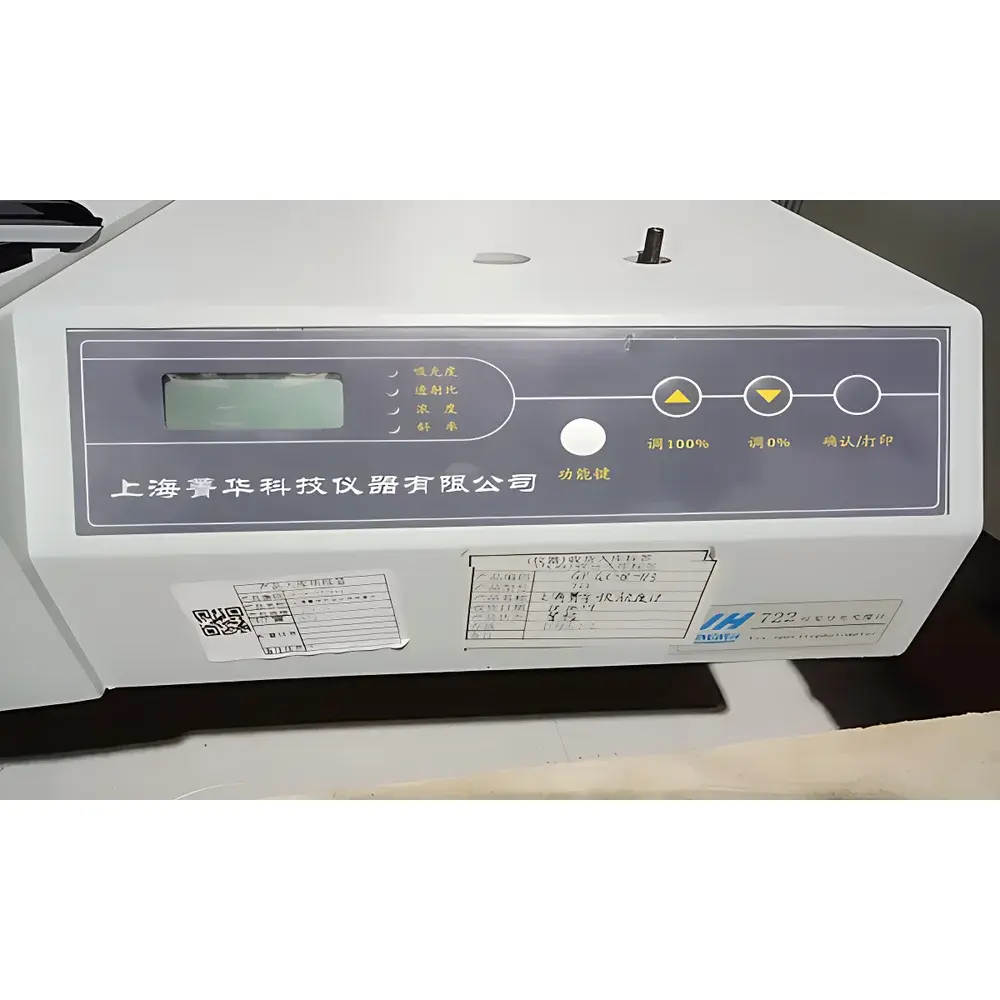
Jinghua 722 Visible Spectrophotometer
| Origin | Shanghai, China |
|---|---|
| Manufacturer Type | Distributor |
| Origin Category | Domestic |
| Model | 722 |
| Price | USD 70 (approx.) |
| Optical Design | Single-beam |
| Detector | Photodiode Array |
| Wavelength Range | 330 nm – 1000 nm |
| Wavelength Adjustment | Manual |
| Spectral Bandwidth | 4 nm |
| Wavelength Accuracy | ±2 nm |
| Stray Light | ≤0.5% T at 360 nm |
Overview
The Jinghua 722 Visible Spectrophotometer is a robust, entry-level single-beam optical instrument engineered for routine quantitative and qualitative analysis in visible light regions. Based on Beer–Lambert law principles, it measures absorbance and transmittance of liquid or solid samples across a defined spectral window (330–1000 nm), enabling concentration determination, kinetic studies, and spectral profiling in academic teaching labs, QC/QA environments, and small-scale industrial R&D settings. Its fixed 4 nm spectral bandwidth ensures adequate resolution for standard colorimetric assays—such as those involving iron(II) phenanthroline, copper(II) neocuproine, or nitrate/nitrite diazotization—while maintaining mechanical simplicity and long-term operational stability. Designed for reliability over decades of use, the 722 integrates a tungsten-halogen lamp source with a precision grating monochromator and photodiode array detection to deliver consistent photometric performance under ambient laboratory conditions.
Key Features
- Single-beam optical architecture optimized for cost-effective, high-reproducibility visible-range measurements
- Manual wavelength selection via calibrated vernier scale, supporting precise targeting of absorption maxima within 330–1000 nm range
- Photodiode array detector offering improved linearity and dynamic range compared to traditional PMT-based systems in this class
- ±2 nm wavelength accuracy certified per ISO 8579-1:2019 guidelines for spectrophotometer verification
- Stray light level ≤0.5% T at 360 nm—meets minimum performance criteria specified in ASTM E275 for visible spectrophotometers
- Compact benchtop footprint (320 × 280 × 160 mm) with integrated sample compartment accommodating standard 10 mm pathlength cuvettes
- No external PC interface required; operation fully self-contained with analog meter display and zero/transmittance/absorbance toggle
Sample Compatibility & Compliance
The 722 accommodates standard quartz, glass, or plastic cuvettes (10 mm pathlength), supporting aqueous, organic, and mildly corrosive solutions typical in environmental testing (e.g., COD, phosphate, ammonia), food analysis (e.g., anthocyanin quantification), and pharmaceutical excipient screening. It complies with core functional requirements outlined in ISO/IEC 17025:2017 for calibration laboratories performing absorbance verification, and its stray light and wavelength accuracy specifications align with national metrological verification规程 JJG 178–2015 (China) for visible spectrophotometers. While not equipped for GLP-compliant electronic audit trails, its manual operation supports traceable paper-based recordkeeping compatible with basic GMP Annex 11 documentation practices.
Software & Data Management
The Jinghua 722 operates without embedded firmware or digital data output ports. All measurements are recorded manually using the front-panel analog meter and calibrated scale. Users may integrate optional third-party USB spectrometer adapters (e.g., Ocean Insight USB2000+) for spectral scanning—if hardware-modified—but such configurations fall outside factory specifications and void warranty. For regulated environments requiring electronic records, the instrument is typically deployed alongside LIMS-integrated data loggers or paired with validated spreadsheet templates compliant with FDA 21 CFR Part 11 Annex A (electronic signatures) when used in non-critical support roles.
Applications
- Educational laboratories: Teaching fundamental spectroscopic concepts including absorbance linearity, calibration curve construction, and Beer’s law validation
- Environmental monitoring: Quantification of heavy metals (e.g., Cr(VI) diphenylcarbazide method), nitrates (cadmium reduction), and total phosphorus (ascorbic acid method)
- Food & beverage QA: Color index assessment (e.g., AOAC 971.25 for tomato paste), antioxidant capacity (DPPH assay), and preservative content (sodium nitrite)
- Pharmaceutical manufacturing: Excipient purity checks, dissolution testing support, and raw material identity confirmation per USP
- Textile & dye industry: Dye concentration control in batch processing and fastness evaluation protocols
FAQ
Is the Jinghua 722 suitable for UV-range measurements?
No. Its optical design and detector sensitivity are limited to 330–1000 nm; it does not support deep-UV wavelengths (<200 nm) or vacuum-UV applications.
Can it be upgraded to automatic wavelength scanning?
Not natively. The 722 lacks stepper motor actuation, encoder feedback, or RS-232/USB interfaces required for automated scanning. Retrofitting is technically infeasible without full optical redesign.
What maintenance is recommended for long-term stability?
Biannual cleaning of the monochromator slit and cuvette holder with lint-free wipes and isopropanol; annual lamp replacement (tungsten-halogen, 12 V/20 W); verification of wavelength accuracy using holmium oxide or didymium filters per ISO 6326-1.
Does it meet international regulatory standards for QC release testing?
It satisfies baseline performance criteria in ISO 8579 and ASTM E275 but lacks electronic data integrity features (e.g., audit trail, user access control) required for full compliance with FDA 21 CFR Part 11 or EU Annex 11 in GMP production environments.
Is technical support available outside mainland China?
Yes—via authorized global distributors who provide localized service contracts, spare parts logistics, and application notes aligned with regional pharmacopoeial methods (e.g., EP 2.2.25, JP 2.05).




