
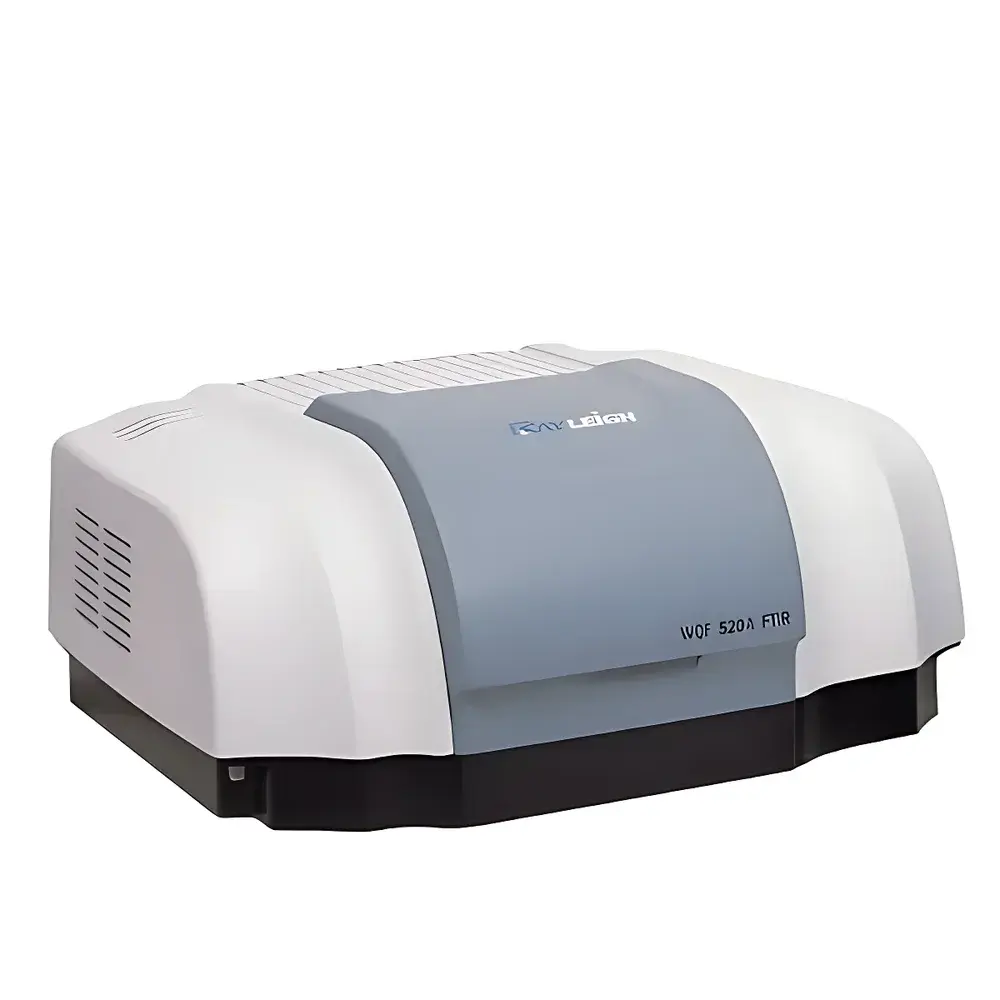
Jingke Ruida WQF-520 Fourier Transform Infrared (FTIR) Spectrometer
| Brand | Jingke Ruida |
|---|---|
| Model | WQF-520 |
| Type | Laboratory FTIR Spectrometer |
| Spectral Range | 400–7800 cm⁻¹ |
| Resolution | <0.85 cm⁻¹ |
| Wavenumber Accuracy | ±0.01 cm⁻¹ |
| Scan Speed | 0.2–2.5 cm/s (motor-controlled, continuously adjustable) |
| SNR | >15,000:1 (RMS, at 2100 cm⁻¹, 4 cm⁻¹ resolution, 60 s acquisition, DTGS detector) |
| Beamsplitter | Ge-coated KBr |
| Detector | Standard DTGS, optional MCT |
| Source | Air-cooled infrared source |
Overview
The Jingke Ruida WQF-520 is a laboratory-grade Fourier Transform Infrared (FTIR) spectrometer engineered for high reproducibility, operational stability, and routine analytical performance in regulated and academic environments. Based on Michelson interferometry, the instrument acquires full-spectrum interferograms via a moving mirror assembly and reconstructs absorbance/transmittance spectra through fast Fourier transformation. Its optical design incorporates a permanently aligned interferometer with velocity-encoded laser control, ensuring long-term wavenumber calibration integrity without manual realignment. The system operates across the mid-infrared range (400–7800 cm⁻¹), covering fundamental vibrational modes of organic functional groups (e.g., C=O stretch at ~1700 cm⁻¹, O–H broad band at 3600–3200 cm⁻¹) and inorganic lattice vibrations, making it suitable for qualitative identification, quantitative analysis, and spectral library matching per ASTM E1421 and ISO 18382 standards.
Key Features
- Robust, permanently aligned Michelson interferometer with He–Ne laser reference for real-time mirror position feedback and intrinsic wavenumber accuracy (±0.01 cm⁻¹).
- Continuously variable scan velocity (0.2–2.5 cm/s), enabling optimization of signal-to-noise ratio (SNR) and spectral resolution trade-offs for diverse sample types and throughput requirements.
- High-stability air-cooled infrared source with optimized output profile across the full spectral range, minimizing thermal drift during extended acquisitions.
- Ge-coated KBr beamsplitter offering broadband transmittance and mechanical durability under standard lab humidity conditions.
- Standard deuterated triglycine sulfate (DTGS) detector with integrated thermoelectric cooling; optional mercury cadmium telluride (MCT) detector available for rapid-scan or low-light applications requiring enhanced sensitivity.
- Modular optical bench design facilitating straightforward maintenance and component replacement—no optical realignment required after detector or source exchange.
Sample Compatibility & Compliance
The WQF-520 supports a wide range of sampling techniques including transmission (KBr pellet, solution cell), attenuated total reflectance (ATR), diffuse reflectance (DRIFTS), and specular reflectance. Its modular interface accommodates commercial ATR accessories with diamond, ZnSe, or Ge crystals. All hardware and firmware comply with IEC 61000-4 electromagnetic compatibility standards. The instrument’s software architecture supports audit trail generation, user access levels, and electronic signature capability—enabling alignment with FDA 21 CFR Part 11 requirements when deployed in GLP/GMP-regulated laboratories. Routine verification protocols align with USP and EP 2.2.24 for infrared spectrophotometers.
Software & Data Management
Bundled with proprietary Jingke Ruida IR Analyst software, the system provides intuitive workflow-driven operation—from experiment setup and real-time interferogram monitoring to baseline correction, peak integration, and multivariate analysis (PCA, PLS). Spectral libraries include NIST, SDBS, and custom user-defined collections. Raw interferogram (.ifg) and processed spectrum (.spa, .jdx) formats are fully exportable. Data files retain embedded metadata (date/time, operator ID, instrument serial number, acquisition parameters), supporting traceability in quality-controlled environments. Batch processing, automated QA/QC flagging, and report generation (PDF/Excel) are natively supported without third-party add-ons.
Applications
- Petrochemical analysis: Hydrocarbon type determination, oxidation product detection (e.g., carbonyl index), and additive quantification in lubricants and fuels.
- Pharmaceutical QC: Polymorph screening, excipient compatibility studies, and raw material identity testing per USP monographs.
- Environmental monitoring: Microplastic identification in water/sediment extracts, VOC fingerprinting in air samples, and soil organic matter characterization.
- Food safety: Adulteration detection (e.g., melamine in dairy, starch substitution in honey), moisture content estimation, and thermal degradation marker tracking.
- Materials science: Polymer crystallinity assessment, surface functionalization verification (e.g., silane coupling agents on silica), and thin-film thickness modeling via interference fringe analysis.
- Academic research: Reaction kinetics monitoring via time-resolved FTIR, catalyst surface intermediate identification, and biomolecular conformational studies (amide I/II band analysis).
FAQ
Is the WQF-520 compliant with pharmacopeial standards for IR identity testing?
Yes—the instrument meets the instrumental performance criteria outlined in USP , EP 2.2.24, and JP 2.07, including resolution, wavenumber accuracy, and photometric linearity verification protocols.
Can the system be integrated into a LIMS environment?
Yes—via configurable ASCII-based data export and optional OPC UA server module for bidirectional communication with laboratory information management systems.
What maintenance is required beyond routine desiccant replacement?
Annual verification of laser alignment and detector response linearity is recommended; no optical recalibration is needed under normal operating conditions due to the self-referencing interferometer design.
Is spectral library search functionality included?
Yes—pre-installed libraries contain over 15,000 reference spectra; users may import additional libraries in JCAMP-DX format and perform similarity matching using correlation coefficient or Euclidean distance algorithms.
Does the system support hyphenated techniques such as GC-FTIR?
No—the WQF-520 is a standalone benchtop FTIR spectrometer; it does not include gas chromatography coupling interfaces or microfluidic ports.





