
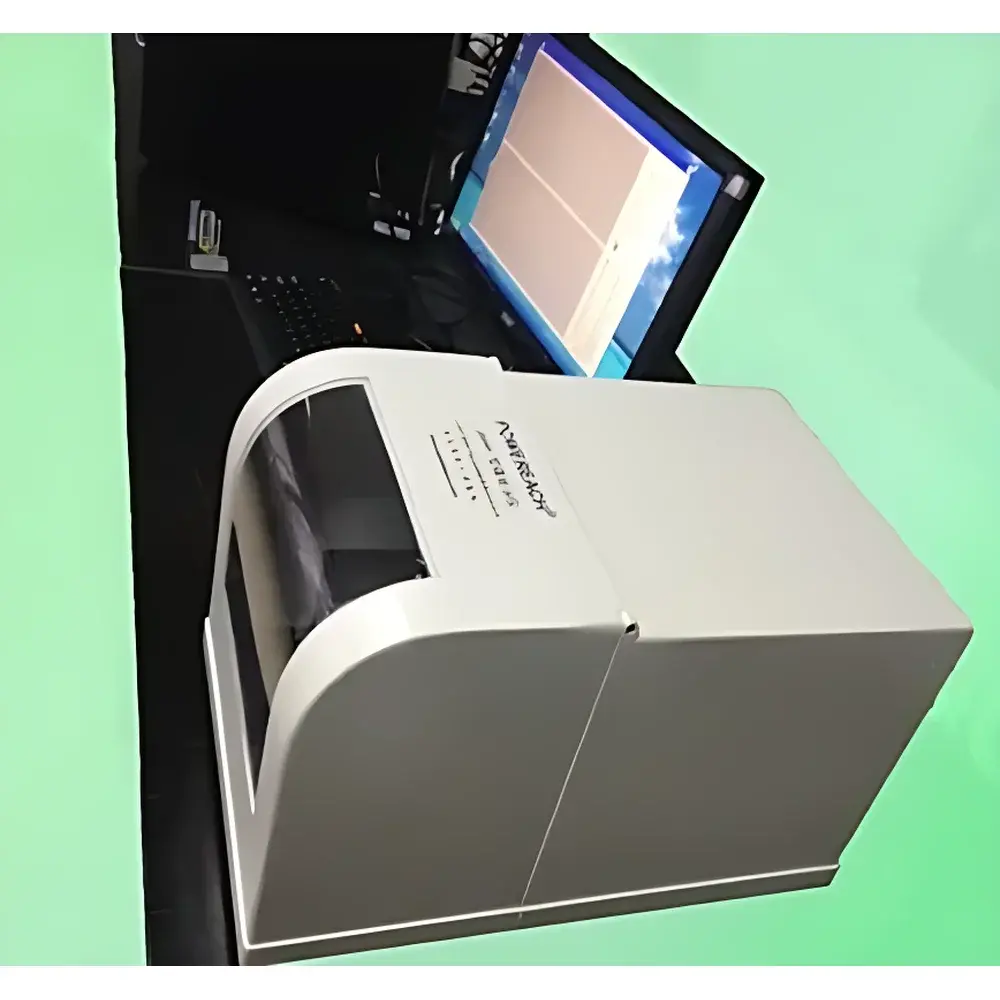
JingSheng JS94 Series Zeta Potential Analyzer (Microelectrophoresis Instrument)
| Origin | Beijing, China |
|---|---|
| Manufacturer Type | Distributor |
| Origin Category | Domestic (China-made) |
| Model | JS94HM / JS94H2M / JS94JM / JS94J2M / JS94KM / JS94K2M |
| Zeta Potential Range | ±3000 mV |
| Measurement Accuracy | ±5% |
| pH Range | 0.000–14.000 (Resolution: 0.1 pH unit) |
| Temperature Range | −5.0 to 105.0 °C (Resolution: 0.1 °C |
| Recommended Operating Range | 5–35 °C) |
| Sample Volume per Measurement | 0.5 mL |
| Optical System | Semiconductor-based near-field illumination (blue/green wavelength), 1200× digital magnification |
| Voltage Polarity Switching Time | 0.30–1.20 s (adjustable) |
| Power Supply | 220 V AC, 50 Hz, 150 W |
Overview
The JingSheng JS94 Series Zeta Potential Analyzer is a precision microelectrophoresis instrument engineered for the quantitative determination of electrophoretic mobility and subsequent calculation of zeta potential (ζ) in colloidal dispersions and emulsions. Based on the principle of laser-assisted microelectrophoresis—where charged particles undergo directed migration under a controlled electric field—the system captures real-time particle motion via high-magnification optical imaging and computes ζ using the Smoluchowski or Henry equation, depending on the dispersion medium’s conductivity and particle size. Designed specifically for laboratory-scale characterization of solid–liquid and liquid–liquid interfaces, it supports both aqueous and non-aqueous systems across a broad particle size range (0.1–50 µm, model-dependent). Its core application lies in surface charge evaluation for stability prediction, formulation optimization, and interfacial reaction mechanism studies—critical parameters in colloid science, pharmaceutical development, and nanomaterial processing.
Key Features
- Proprietary open-cell electrophoresis chamber: 0.5 cm-thick borosilicate glass cuvette with integrated Ag/AgCl, Pt, and Ti electrodes—surface-treated for electrochemical stability and minimal polarization.
- Optimized low-power semiconductor illumination (blue/green spectrum): <50 µW output eliminates thermal convection artifacts and enables high-contrast imaging of submicron particles at up to 1200× effective digital magnification.
- Adjustable bipolar voltage supply: Continuous polarity reversal (0.30–1.20 s cycle time) suppresses electrode polarization while enabling rapid data acquisition (3–10 s per measurement).
- Real-time environmental compensation: Integrated temperature probe continuously feeds ambient and sample temperature data to software for automatic ζ correction per ISO 13099-2:2012 guidelines.
- Modular optical alignment system: Precision crosshair reticle mounted on a motorized XYZ stage ensures reproducible focal positioning—eliminating stagnant layer interference inherent in classical capillary cells.
- Multi-model platform: Six variants (JS94HM, H2M, JM, J2M, KM, K2M) accommodate differing particle size ranges and solvent compatibility requirements—including continuous zoom optics in KM/K2M models for extended sizing flexibility.
Sample Compatibility & Compliance
The JS94 Series accommodates suspensions and emulsions in water, ethanol, isopropanol, toluene, and other low-conductivity organic media—subject to appropriate electrode selection and calibration protocols. All models comply with fundamental principles outlined in ISO 13099 (Parts 1–3) for zeta potential measurement by electrophoretic light scattering and microelectrophoresis. The instrument supports GLP-compliant workflows through timestamped, user-annotated measurement logs and audit-trail-capable software (optional upgrade). While not FDA 21 CFR Part 11-certified out-of-the-box, raw data export (CSV, TXT) and metadata tagging enable integration into validated QA/QC environments per USP , ASTM D6988, and ICH Q5A regulatory frameworks.
Software & Data Management
Acquisition and analysis are performed via proprietary Windows-based software featuring synchronized video capture, frame-by-frame particle tracking, and automated mobility-to-zeta conversion using built-in dielectric constant and viscosity databases. Each session records full experimental metadata—including applied field strength, temperature history, pH (when interfaced with external meter), and image sequences—ensuring traceability. Export formats include CSV for statistical analysis in MATLAB or JMP, PNG/TIFF for publication-grade image archiving, and PDF reports compliant with internal SOP templates. Optional software modules support batch processing, trend analysis across storage conditions, and isoelectric point (IEP) mapping via pH titration series.
Applications
This analyzer serves as a primary tool in R&D and QC labs where colloidal stability governs product performance. In pharmaceuticals, it characterizes nanoparticle drug carriers and protein formulations to assess aggregation risk. In cosmetics, it validates surfactant efficacy and emulsion shelf-life. Materials scientists use it to optimize dispersants for ceramic slurries (e.g., alumina, zirconia), pigment suspensions in inkjet inks, and functionalized carbon nanotubes. Environmental researchers apply it to study clay–contaminant interactions in soil leachates, while marine chemists investigate biopolymer–metal ion binding kinetics. Its pedagogical utility is equally established: the transparent cell design and intuitive interface make it ideal for undergraduate physical chemistry and colloid science laboratories.
FAQ
What particle size ranges does each JS94 model support?
JS94HM/H2M: 0.5–20 µm; JS94JM/J2M: 0.1–10 µm; JS94KM/K2M: 0.2–50 µm—with K-series models incorporating continuous zoom optics for enhanced resolution across bimodal distributions.
Can the instrument measure zeta potential in non-aqueous solvents?
Yes—models ending in “2M” (e.g., JS94H2M, JS94J2M, JS94K2M) are configured with chemically resistant electrodes and optimized voltage profiles for low-dielectric media such as acetone, THF, and hexane.
Is temperature control integrated or optional?
Ambient temperature sensing is standard; active thermostatic control requires the optional −10 to +95 °C Peltier stage, which mounts directly beneath the electrophoresis cell and interfaces with software for closed-loop regulation.
How is measurement accuracy validated?
Accuracy is verified using NIST-traceable latex standards (e.g., Duke Scientific 3000 series) and certified reference materials per ISO 21501-4. Routine calibration includes mobility linearity checks and electrode response validation at multiple pH points.
Does the system support Good Manufacturing Practice (GMP) documentation requirements?
Raw data files contain embedded timestamps, operator ID, instrument serial number, and parameter settings. For full 21 CFR Part 11 compliance, third-party electronic signature and audit trail modules are available upon request.
Related Products



