
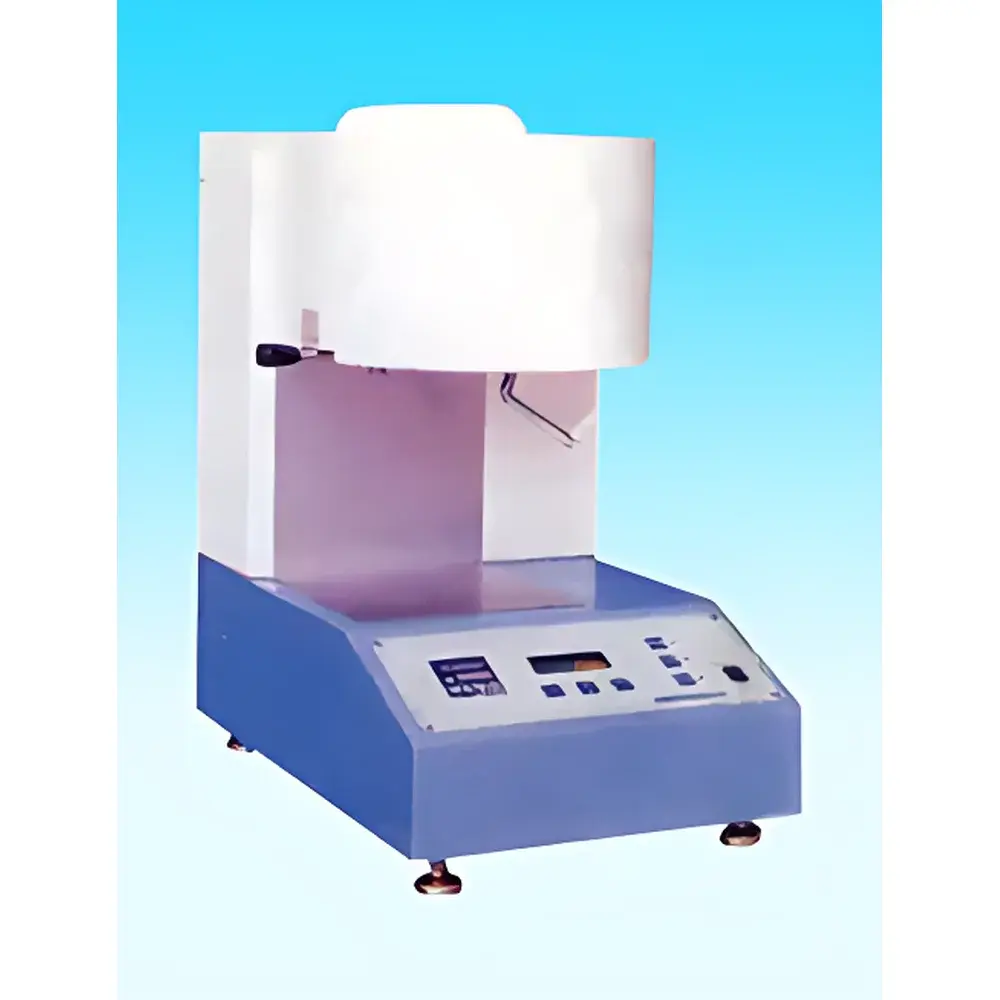
Jinhoo JH Melt Flow Indexer
| Brand | Jinhoo |
|---|---|
| Origin | Shanghai, China |
| Manufacturer Type | Authorized Distributor |
| Country of Origin | China |
| Model | JH |
| Pricing | Available Upon Request |
| Temperature Control Range | Ambient to 400 °C (±0.5 °C accuracy, ±0.5 °C stability) |
| Standard Weights | 0.325 kg, 1.200 kg, 2.160 kg, 3.800 kg, 5.000 kg, 10.000 kg, 21.600 kg |
| Barrel Internal Diameter | 9.55 ± 0.025 mm, Length: 160 mm (Material: Corrosion-resistant high-hardness alloy steel) |
| Die Internal Diameter | 2.095 ± 0.005 mm, Surface Roughness ≤ 0.2 µm, Height: 8.000 ± 0.025 mm (Material: Tungsten Carbide) |
| Sample Cutting Options | Manual or Motorized Automatic Cutter |
| Dimensions (W×D×H) | 420 × 250 × 630 mm |
| Net Weight | 38 kg (excluding weights) |
| Heating Power | 550 W |
| Electrical Supply | 1-phase AC 220 V, 5 A |
Overview
The Jinhoo JH Melt Flow Indexer is a precision benchtop instrument engineered for the standardized determination of melt mass-flow rate (MFR) and melt volume-flow rate (MVR) of thermoplastic polymers under defined temperature and load conditions. It operates in strict accordance with internationally recognized test methods—including ASTM D1238, ISO 1133-1 and ISO 1133-2, GB/T 3682—and delivers reproducible results essential for quality control, material specification verification, and incoming inspection in polymer compounding, extrusion, injection molding, and R&D laboratories. The device employs the fundamental principle of extrusion rheology: molten polymer is forced through a standardized capillary die under controlled thermal and mechanical conditions, and flow rate is quantified via gravimetric or volumetric measurement over fixed time intervals. Its robust architecture integrates high-stability PID temperature regulation, precision-machined tooling, and thermally isolated barrel geometry to minimize axial temperature gradients—ensuring compliance with the stringent dimensional and thermal uniformity requirements specified in ISO 1133 Annex B.
Key Features
- High-accuracy temperature control system with ±0.5 °C setpoint accuracy and ±0.5 °C short-term stability across the full operating range (ambient to 400 °C), validated per ASTM D1238 Annex A calibration procedures
- Seven certified standard weights (0.325–21.600 kg) traceable to national metrological standards, enabling full coverage of common test conditions for polyolefins, engineering plastics, and high-temperature resins
- Barrel fabricated from corrosion-resistant, high-hardness alloy steel with precisely ground internal diameter (9.55 ± 0.025 mm) and 160 mm effective length—designed to maintain dimensional integrity under repeated thermal cycling
- Tungsten carbide capillary die with nominal 2.095 mm bore (tolerance ±0.005 mm), surface roughness ≤ 0.2 µm Ra, and 8.000 ± 0.025 mm land length—minimizing wall slip and shear-induced degradation during extrusion
- Dual-mode sample cutting: manual lever-actuated cutter for operator-controlled timing, or programmable motor-driven automatic cutter with adjustable interval (1–600 s) and repeat cycle capability
- Compact footprint (420 × 250 × 630 mm) and lightweight design (38 kg net) facilitate integration into regulated lab environments without dedicated floor space or structural reinforcement
Sample Compatibility & Compliance
The JH Melt Flow Indexer supports a broad spectrum of thermoplastic materials, including but not limited to polyethylene (PE), polypropylene (PP), polycarbonate (PC), acrylonitrile-butadiene-styrene (ABS), polyamide (PA), polyethylene terephthalate (PET), and high-performance polymers such as polyetheretherketone (PEEK). Its mechanical and thermal specifications meet the physical prerequisites outlined in ISO 1133-1 (MFR by mass) and ISO 1133-2 (MVR by displacement), and it is routinely employed in laboratories maintaining ISO/IEC 17025 accreditation. The instrument’s construction materials and dimensional tolerances are validated against the reference geometries defined in ASTM D1238 Appendix X1, ensuring inter-laboratory comparability. While the base unit does not include electronic data logging, its mechanical design permits seamless integration with external balance systems compliant with USP <41> and EUR Pharm 2.9.36 weighing requirements for GLP/GMP-aligned testing workflows.
Software & Data Management
The JH indexer operates as a stand-alone mechanical-electrothermal platform with no embedded firmware or proprietary software. All measurements are recorded manually or interfaced externally via standard laboratory balances (RS-232 or USB output) and spreadsheet-based or LIMS-integrated calculation templates. This architecture ensures full auditability and eliminates software validation overhead—making it suitable for regulated environments where FDA 21 CFR Part 11 compliance is achieved through procedural controls rather than electronic signature modules. Users may implement custom Excel calculators preconfigured with ASTM D1238 equations for MFR (g/10 min) and MVR (cm³/10 min), incorporating correction factors for melt density and piston displacement. Calibration records—including temperature uniformity mapping, die dimension verification, and weight certification—are maintained separately in accordance with ISO/IEC 17025 clause 6.4.10.
Applications
- Quality assurance of incoming resin batches against supplier certificates of analysis (CoA)
- In-process monitoring of polymer degradation during extrusion or drying cycles via MFR drift analysis
- Correlation of rheological behavior with molecular weight distribution (MWD) trends in R&D settings
- Validation of thermal stability for flame-retardant or filled compounds under high-load test conditions
- Supporting technical documentation for ISO 9001:2015 Clause 8.5.1 production control and AS9100D special process verification
- Teaching core polymer processing principles in university materials science laboratories
FAQ
What standards does the JH Melt Flow Indexer comply with?
It is designed and verified to meet the dimensional, thermal, and mechanical requirements of ASTM D1238, ISO 1133-1, ISO 1133-2, and GB/T 3682.
Can this instrument measure both MFR and MVR?
Yes—MFR is determined gravimetrically using a calibrated analytical balance; MVR requires optional piston displacement measurement with a digital micrometer or laser encoder.
Is the tungsten carbide die supplied with calibration certification?
Each die is individually inspected and supplied with a dimensional compliance report referencing ISO 1133 Annex C tolerances.
What maintenance is required to sustain measurement accuracy?
Routine cleaning of barrel and die with brass brushes and solvent; annual verification of temperature uniformity profile and weight calibration traceable to national standards.
Does the unit support GLP or GMP documentation requirements?
Yes—its mechanical design enables full traceability through manual logbooks, calibrated ancillary equipment, and documented calibration intervals aligned with ISO/IEC 17025 and FDA guidance for non-automated instrumentation.



