
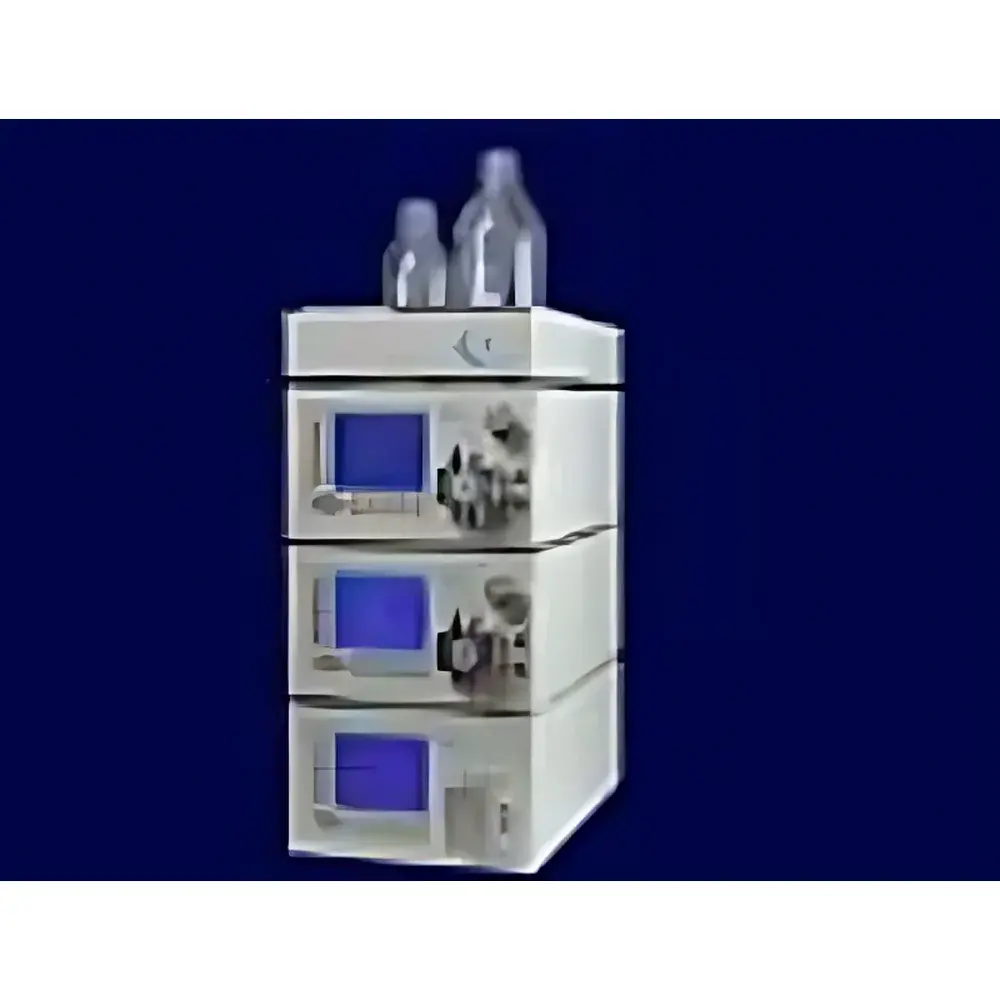
Jinpu LC-3000 Binary High-Pressure Gradient Liquid Chromatography System
| Brand | Jinpu |
|---|---|
| Origin | Shandong, China |
| Model | LC-3000 |
| Maximum Pressure (P3110) | 42 MPa |
| Maximum Pressure (P3120) | 30 MPa |
| Flow Range (P3110) | 0.002–9.998 mL/min |
| Flow Range (P3120) | 0.01–49.99 mL/min |
| Flow Accuracy | ±2% (at 2–5% of full scale, MeOH/H₂O 80:20 v/v) |
| Flow Precision | RSD < 0.1% |
| Wavelength Range (UV3000) | 190–700 nm |
| Wavelength Accuracy | ±2 nm |
| Wavelength Repeatability | 0.4 nm |
| Baseline Noise | 2 × 10⁻⁵ AU/h (254 nm, 1 mL/min, MeOH/H₂O 80:20) |
| Baseline Drift | 15 × 10⁻⁵ AU/h (254 nm, 1 mL/min, MeOH/H₂O 80:20) |
| Detection Range | 0–2 AU |
| Time Constants | 0.1/0.2/0.5/1/2/5/10 s |
| Dimensions (W×H×D) | 398 × 149 × 267 mm |
| Weight | 14 kg |
Overview
The Jinpu LC-3000 Binary High-Pressure Gradient Liquid Chromatography System is a modular, CE-compliant HPLC platform engineered for routine analytical and semi-preparative separations in quality control, pharmaceutical development, agrochemical analysis, and industrial R&D laboratories. Built around dual high-precision reciprocating piston pumps (P3110/P3120), a digitally optimized UV/VIS absorbance detector (UV3000), and integrated gradient control firmware, the system implements classical reversed-phase, normal-phase, and ion-exchange chromatographic methodologies via high-pressure gradient elution. Its architecture adheres to fundamental chromatographic principles—utilizing isocratic or time-programmed binary solvent mixing at pressures up to 42 MPa, with flow delivery governed by closed-loop digital frequency synthesis and real-time pressure feedback. The system operates without proprietary data acquisition hardware, transmitting analog-to-digital converted absorbance signals directly via RS232 serial interface to host computers—a design aligned with legacy instrument integration requirements while maintaining compatibility with modern LIMS and ELN environments.
Key Features
- Binary high-pressure gradient capability with master/slave pump synchronization, enabling precise, reproducible solvent composition programming across defined time segments
- P3000 series dual-piston high-pressure pumps featuring CPLD-based digital motor control, slow-start/stop ramping, user-configurable pressure limits, and automatic parameter retention after power cycle
- UV3000 UV/VIS detector with deuterium lamp (standard) and optional tungsten lamp, supporting wavelength scanning with programmable start/end points and step resolution
- 320 × 240 pixel backlit LCD display on both pump and detector modules, providing real-time monitoring of flow rate, pressure, wavelength, absorbance, and lamp operating hours
- No external data acquisition card required: detector output is digitized internally and transmitted via RS232 to PC-based software, reducing signal degradation and installation complexity
- GLP-compliant operational logging—including total lamp runtime, lamp replacement count, serial number tracking, and system configuration history—stored onboard and exportable via serial interface
Sample Compatibility & Compliance
The LC-3000 supports standard 4.6 mm I.D. analytical columns and 10–21.2 mm I.D. semi-preparative columns packed with silica-based C18, C8, phenyl-hexyl, cyano, amino, or ion-exchange phases. It accommodates common HPLC mobile phases including aqueous buffers (e.g., phosphate, acetate), organic modifiers (acetonitrile, methanol, THF), and low-viscosity additives (e.g., TFA, formic acid). System components meet IP20 environmental protection rating and comply with IEC 61010-1 for laboratory electrical safety. While not pre-certified for FDA 21 CFR Part 11, the architecture supports audit-trail-enabled third-party chromatography data systems (CDS) when deployed under validated SOPs. Instrument performance aligns with ISO 17025 method validation prerequisites and ASTM E2687-10 (Standard Guide for Validation of Chromatographic Methods).
Software & Data Management
The LC-3000 operates in two control modes: standalone front-panel operation and PC-based remote control via RS232. Jinpu-supplied acquisition software (Windows-compatible, x86/x64) provides gradient method setup, real-time chromatogram visualization, peak integration using tangent skim and Gaussian fitting algorithms, calibration curve generation (linear, quadratic, weighted), and report export in PDF, CSV, and XML formats. All raw detector voltage traces and pump status logs are timestamped and stored with metadata (operator ID, method name, injection volume, column lot). Software supports configurable electronic signatures and session-based user access levels—enabling basic GxP alignment when deployed within controlled IT infrastructure. Raw data files retain native 16-bit resolution and are structured for interoperability with open-format parsers (e.g., mzML-compatible wrappers for hybrid workflows).
Applications
- Pharmaceutical QC testing: assay of active pharmaceutical ingredients (APIs), related substances, and residual solvents per USP and EP 2.2.46
- Agrochemical residue analysis in food matrices following AOAC 2007.01 and EN 15662:2018 multi-residue methods
- Polymer additive quantification (e.g., antioxidants, UV stabilizers) in plastics and coatings using reversed-phase separation
- Natural product fingerprinting in herbal extracts via gradient UV profiling at multiple wavelengths (210 nm, 254 nm, 320 nm)
- Semi-preparative purification of synthetic intermediates (5–50 mg scale) with fraction collection triggered by UV threshold or time window
FAQ
Does the LC-3000 support ternary or quaternary gradient mixing?
No—the system is configured exclusively for binary high-pressure gradient operation using two independently controlled P3000-series pumps. Ternary or quaternary gradients require external low-pressure mixing modules not included in the base configuration.
Is the UV3000 detector compatible with post-column derivatization systems?
Yes—its 10-mm pathlength flow cell and 0–2 AU linear dynamic range accommodate typical post-column reaction stream volumes (0.2–0.8 mL/min) and absorbance increases from derivatized analytes such as amino acids or carbamates.
Can the system be integrated into a networked laboratory environment?
While the native RS232 interface does not support Ethernet or USB natively, third-party serial-to-Ethernet converters enable centralized monitoring and remote command execution via TCP/IP, provided firewall policies permit serial tunneling protocols.
What maintenance intervals are recommended for pump seals and check valves?
Under standard use (≤30 MPa, aqueous/organic mobile phases), pump seal replacement is advised every 6 months or after 1,000 hours of operation; sapphire check valves require inspection every 3 months and replacement if baseline noise exceeds 3 × 10⁻⁵ AU/h.
Does the system include compliance documentation for ISO/IEC 17025 accreditation?
Factory calibration certificates (pressure, flow, wavelength, absorbance) are provided with each unit. Full traceable metrological documentation—including uncertainty budgets and equipment verification records—must be generated locally during IQ/OQ/PQ qualification per laboratory-specific validation protocols.




