
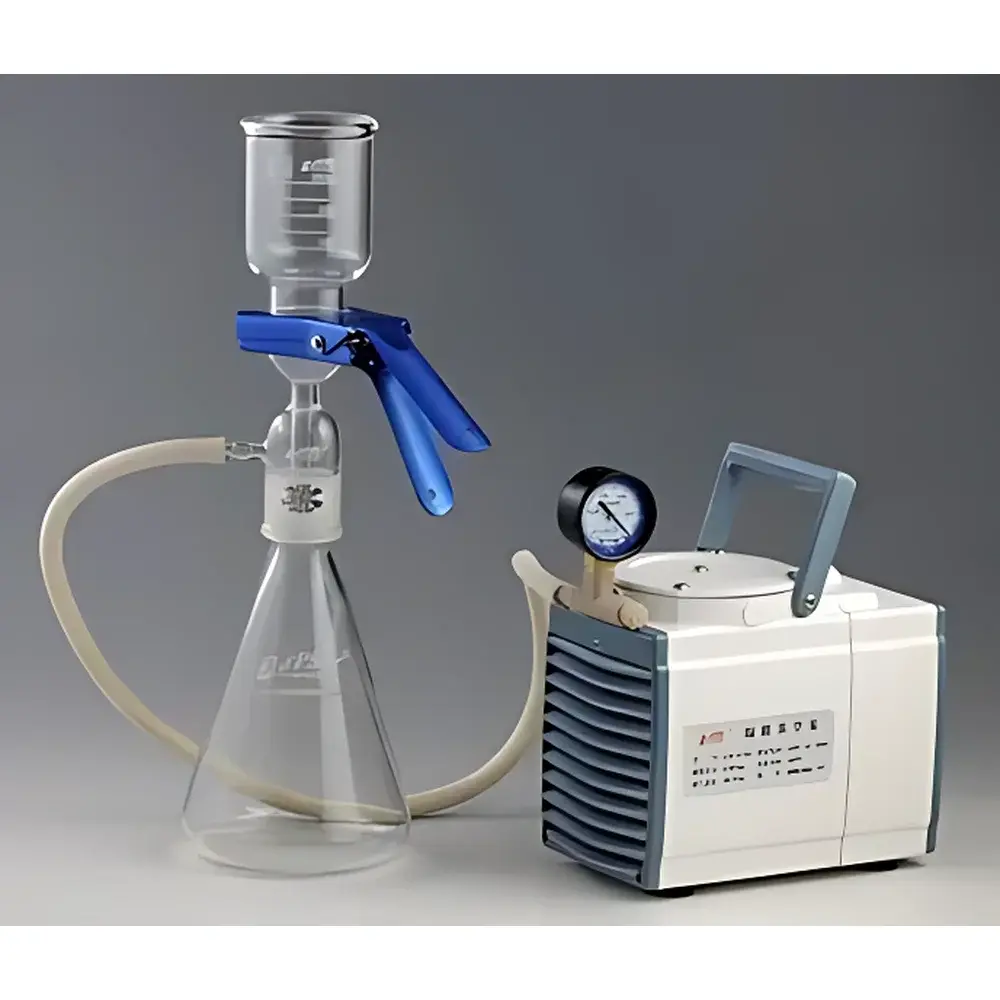
JINTENG GM-0.33A (1L) Solvent Filtration Assembly for HPLC Mobile Phase Preparation
| Brand | JINTENG |
|---|---|
| Origin | Tianjin, China |
| Model | GM-0.33A (1L) |
| Filter Cup Capacity | 300 mL |
| Receiving Bottle Capacity | 1000 mL |
| Filter Head Diameter | 50 mm |
| Pore Size | 10 µm |
| Filter Head Material | High-Borosilicate Glass |
| Filter Membrane Compatibility | φ47 mm or φ50 mm discs |
| Vacuum Pump Flow Rate | 20 L/min |
| Ultimate Vacuum Pressure | ≤200 mbar (≥0.08 MPa) |
| Motor Power | 160 W |
| Noise Level | <55 dB(A) |
| Operating Temperature Range | 7–40 °C |
| Weight | 7.5 kg |
| Dimensions (W×D×H) | 235 × 120 × 215 mm |
| Construction | Ground-Glass Joints, Removable PTFE Frit, Anodized Aluminum Clamp |
Overview
The JINTENG GM-0.33A (1L) Solvent Filtration Assembly is an engineered vacuum-driven filtration system designed specifically for the preparation and purification of HPLC mobile phases. It operates on the principle of negative-pressure (vacuum) filtration, enabling rapid, particle-free clarification of aqueous, organic, and mildly corrosive solvents prior to chromatographic analysis. Unlike gravity or pressure-driven systems, this assembly ensures consistent flow rates and minimal sample disturbance—critical for maintaining solvent integrity in trace-level analytical workflows. Its robust high-borosilicate glass construction supports autoclaving (up to 121 °C, 20 min), making it suitable for GLP-compliant laboratories requiring sterility validation. The integrated vacuum pump delivers stable sub-200 mbar operating pressure, sufficient to achieve efficient deaeration—reducing bubble formation in HPLC lines and mitigating column clogging, pump seal wear, and baseline noise.
Key Features
- Ground-glass joint architecture ensures leak-tight, repeatable assembly across filter cup, fritted head, and receiving bottle—eliminating O-ring dependency and simplifying cleaning and sterilization.
- Removable PTFE frit (20 µm variant available) enables safe filtration of aggressive solvents including concentrated acids, bases, and halogenated organics without material degradation.
- Anodized aluminum clamp provides uniform clamping force with high torsional rigidity; resists deformation during repeated thermal cycling or prolonged vacuum exposure.
- Vacuum pump features oil-free diaphragm technology, low-noise operation (<55 dB(A)), and thermal protection (max. pump body temperature <60 °C), ensuring continuous duty cycle reliability.
- All wetted parts—including filter head, cup, and bottle—are manufactured to ISO 3585 specifications for borosilicate glass 3.3, guaranteeing dimensional consistency and chemical resistance per ASTM E438 Type I, Class A.
Sample Compatibility & Compliance
The GM-0.33A accommodates standard disc-format membranes (φ47 mm or φ50 mm) from major suppliers (e.g., Millipore, Pall, Whatman), supporting a broad range of pore sizes (0.22 µm to 5.0 µm) and chemistries (cellulose acetate, nylon, PVDF, PTFE). It is routinely employed in USP and microbiological testing workflows where solvent clarity directly impacts membrane filtration efficiency. When paired with 0.22 µm sterilizing-grade membranes, the system meets ISO 13408-1 requirements for aseptic processing support. Its design conforms to ICH Q5A guidelines for removal of particulate contaminants in biopharmaceutical buffer preparation, and its autoclavable configuration supports FDA 21 CFR Part 11–aligned documentation when used within validated SOPs.
Software & Data Management
This is a standalone mechanical filtration system with no embedded electronics or digital interface. All operational parameters—including vacuum level, run duration, and membrane lot numbers—are recorded manually in laboratory notebooks or electronic lab notebooks (ELNs) compliant with ALCOA+ principles. For audit readiness, users are advised to log batch-specific filtration records alongside HPLC system suitability test data, per GMP Annex 11 and ISO/IEC 17025:2017 clause 7.5.2. The absence of firmware eliminates cybersecurity risks and simplifies 21 CFR Part 11 compliance when integrated into paper-based or ELN-tracked quality systems.
Applications
- HPLC and UHPLC mobile phase degassing and particulate removal prior to system priming and gradient method development.
- Pre-filtration of LC-MS solvents to prevent ion source contamination and suppress signal drift.
- Clarification of cell culture media, fermentation broths, and protein purification buffers in upstream bioprocessing R&D.
- Preparative filtration of calibration standards and reference materials in environmental and pharmaceutical QC labs.
- Support of ASTM D4176 (clarity of diesel fuel) and ISO 4020 (petroleum product filtration) test methods where visual clarity assessment is required.
FAQ
Can the GM-0.33A be used with acetonitrile or THF?
Yes—when equipped with the optional PTFE frit and compatible hydrophobic membranes, it safely handles common HPLC-grade organic solvents.
Is the glassware certified to ISO 3585?
Yes—filter cup, head, and bottle are fabricated from DIN/ISO 3585-compliant high-borosilicate glass (Borosilicate 3.3), verified via certificate of conformance supplied with each unit.
What maintenance is required for the vacuum pump?
No oil changes or filter replacements are needed; the diaphragm pump requires only periodic external wipe-down and inspection of intake tubing for blockage.
Does the system support sterile filtration under laminar flow conditions?
It is not a classed environment device, but may be operated inside a certified biosafety cabinet when sterility-critical applications demand it.
Can I validate this system for GMP use?
Yes—its fixed geometry, material traceability, and autoclavability allow full IQ/OQ/PQ protocol development aligned with Annex 15 and ASTM E2500-13 guidance.



