
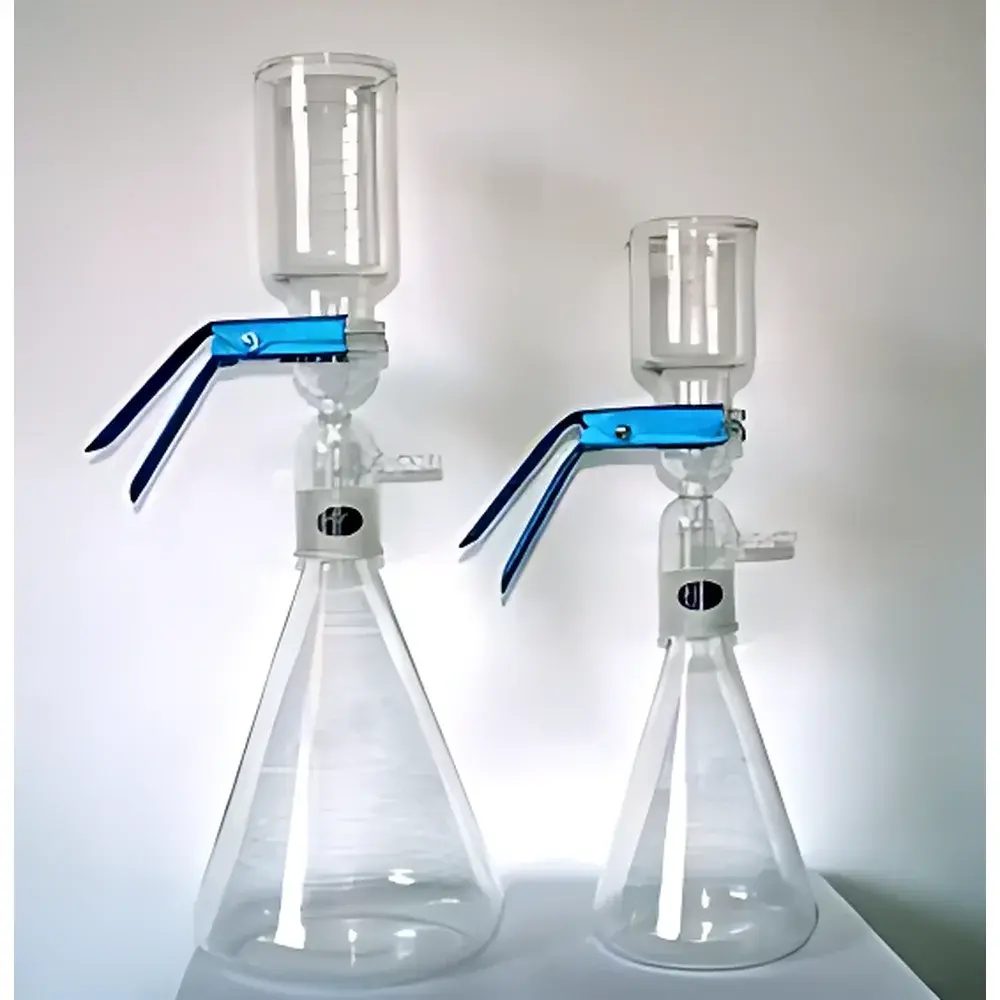
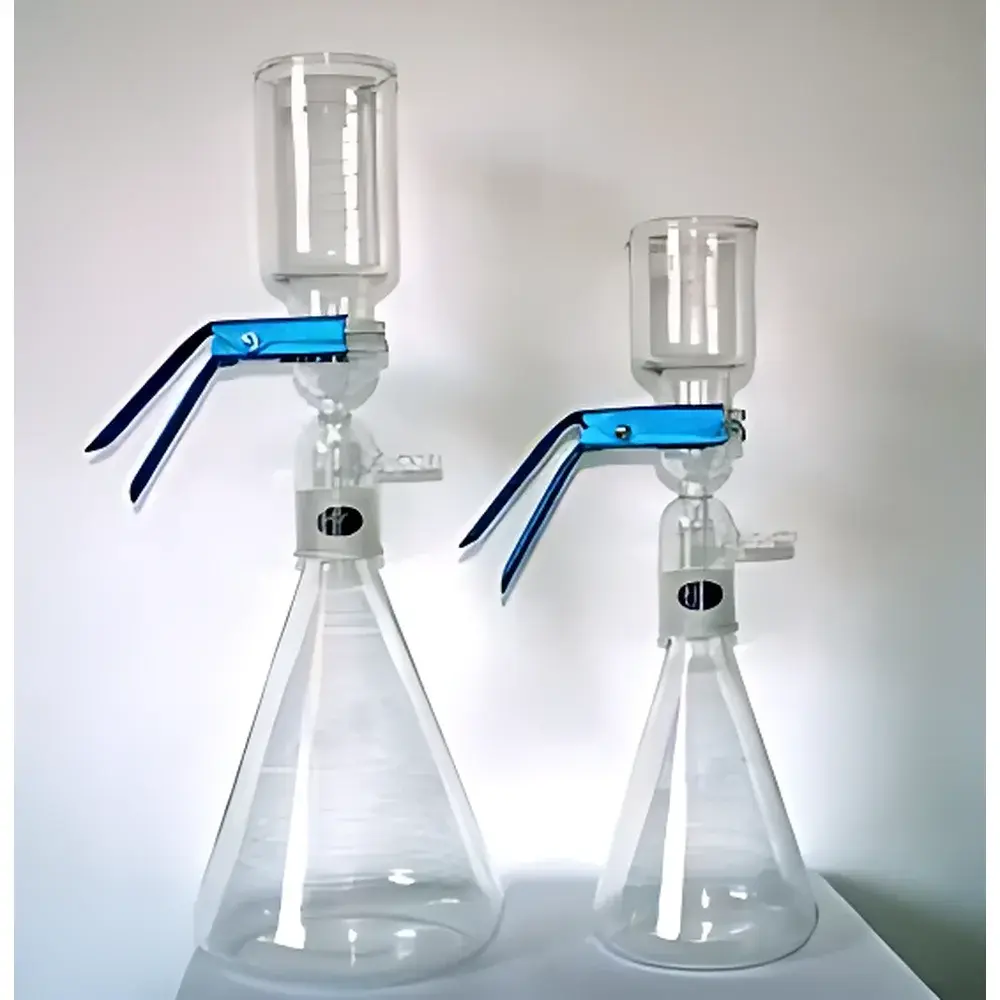
JINTENG Solvent Filtration System T-50
| Brand | JINTENG |
|---|---|
| Origin | Tianjin, China |
| Manufacturer Type | Authorized Distributor |
| Product Origin | Domestic (China) |
| Model | T-50 |
| Price | USD 65 |
| Filter Cup Capacity | 1 L or 2 L |
| Funnel Diameter | 50 mm or 60 mm |
| Screen Plate Pore Size | 10 µm or 20 µm |
| Funnel Material | High-Borosilicate Glass or PTFE |
| Receiving Bottle Volume | 1000 mL or 2000 mL |
| Membrane Support Diameter | φ47 mm, φ50 mm, or φ60 mm |
| Connection Type | Standard Ground-Glass Joint (ISO 2955 / DIN 12232-1) |
| Sterilization Compatibility | Autoclavable at 121 °C, 20 min |
| Clamp Material | Anodized Aluminum Alloy |
| Screen Plate | Removable PTFE for Corrosive Media |
Overview
The JINTENG Solvent Filtration System T-50 is a precision-engineered vacuum-driven filtration assembly designed for rigorous laboratory preparation of analytical-grade solvents and mobile phases. Based on the principle of gravity-assisted vacuum filtration through a rigid, chemically inert support structure, the T-50 system ensures consistent flow dynamics, minimal sample retention, and high reproducibility across diverse solvent matrices—including aqueous, organic (e.g., acetonitrile, methanol, THF), and highly corrosive media (e.g., concentrated acids, alkalis, halogenated solvents). Its primary engineering objective is to eliminate particulate contaminants (>10 µm or >20 µm, depending on screen plate configuration) prior to HPLC, UHPLC, IC, or LC-MS analysis—thereby preventing column fouling, pump seal wear, and detector baseline drift. The system’s integrated design also facilitates partial degassing during filtration, reducing dissolved gas nucleation in downstream liquid chromatography systems and mitigating bubble-related pressure fluctuations.
Key Features
- Modular ground-glass joint architecture compliant with ISO 2955 and DIN 12232-1 standards, ensuring leak-tight sealing under sustained vacuum (≤ −0.095 MPa) and thermal cycling.
- Two standard configurations: T-50-1L (50 mm funnel, 300 mL filter cup, 1000 mL receiving bottle) and T-50-2L (60 mm funnel, 500 mL filter cup, 2000 mL receiving bottle), enabling scalable throughput without compromising filtration integrity.
- Chemically resistant construction options: high-borosilicate glass funnels (linear thermal expansion coefficient α ≈ 3.3 × 10⁻⁶ K⁻¹) for general-purpose use; PTFE screen plates (20 µm pore) for aggressive chemical environments where glass compatibility is limited.
- Removable PTFE screen plate with standardized mounting geometry—enables rapid cleaning, inspection, and replacement without disassembling the entire manifold.
- Anodized aluminum alloy clamping mechanism offering ≥ 250 MPa tensile strength and dimensional stability after repeated sterilization cycles; eliminates plastic deformation or torque-induced misalignment.
- Autoclavable components (glass funnels, PTFE plates, aluminum clamps) validated for 121 °C, 20 min, 100 kPa saturated steam per ISO 17665-1, supporting GLP/GMP-compliant workflows requiring documented sterility assurance.
Sample Compatibility & Compliance
The T-50 system accommodates membrane filters with diameters of φ47 mm, φ50 mm, or φ60 mm—compatible with commercially available cellulose acetate (CA), nylon, polyethersulfone (PES), and hydrophobic PVDF membranes. It supports both aqueous and low-surface-tension organic solvents without wetting failure or membrane collapse. The system meets material compatibility requirements outlined in ASTM D854 (for glassware durability), USP <661.1> (for extractables profiling of polymer components), and ISO 15189:2022 Annex B (for pre-analytical sample integrity in clinical laboratories). All ground-glass interfaces are manufactured to ≤ ±0.02 mm dimensional tolerance, ensuring interchangeability with third-party filtration manifolds and vacuum manifolds adhering to international labware standards.
Software & Data Management
As a manually operated, non-electronic filtration device, the T-50 requires no embedded firmware or software interface. However, its design inherently supports audit-trail–enabled documentation practices required under FDA 21 CFR Part 11 and EU Annex 11. Users may integrate filtration events into electronic lab notebooks (ELNs) such as LabArchives or Benchling by recording batch numbers, membrane lot IDs, vacuum duration, observed flow rate, and post-filtration particle count (via optional inline particle sensor). The system’s mechanical simplicity eliminates firmware validation burden while maintaining full traceability of critical process parameters in regulated environments.
Applications
- HPLC/UHPLC mobile phase preparation and particulate removal prior to system priming.
- Pre-filtration of calibration standards and reference materials in environmental testing (EPA Methods 502.2, 525.3) and pharmaceutical QC (ICH Q5A).
- Clarification of cell lysates and protein solutions prior to ultrafiltration or SEC analysis.
- Removal of catalyst residues from synthetic reaction mixtures before NMR or MS characterization.
- Preparation of electrolyte solutions for electrochemical cell testing where metal ion contamination must be minimized.
- Field-deployable solvent purification in mobile analytical labs operating under ISO/IEC 17025-accredited scopes.
FAQ
Can the T-50 system be used with strong oxidizers such as concentrated nitric acid?
Yes—the PTFE screen plate variant (T-50-PTFE) is fully compatible with nitric acid up to 70 wt%, sulfuric acid up to 98 wt%, and sodium hydroxide up to 50 wt% at ambient temperature. Glass components are not recommended for prolonged exposure to HF or hot phosphoric acid.
Is the ground-glass joint interchangeable with other brands’ filtration manifolds?
Yes—both funnel and receiving bottle joints conform to ISO 2955 Type A (outer diameter 29 mm, taper 1:10), enabling direct compatibility with Buchner-type manifolds from Sartorius, Whatman, and VWR.
What is the maximum recommended vacuum pressure for continuous operation?
The system is rated for sustained vacuum down to −0.095 MPa (95 kPa absolute); exceeding this may compromise seal integrity or induce microfractures in glass components over repeated cycles.
How often should the PTFE screen plate be replaced?
Under routine use with non-particulate-rich solvents, replacement is recommended every 50–100 filtration cycles or when visual inspection reveals permanent deformation, discoloration, or reduced flow rate despite membrane replacement.
Does the system include a vacuum gauge or pressure relief valve?
No—the T-50 is a passive filtration assembly. Users must employ an external vacuum regulator or controller (e.g., KNF N860.3FT.18) to maintain stable differential pressure and prevent sudden pressure equalization that could cause backflow or membrane rupture.




