
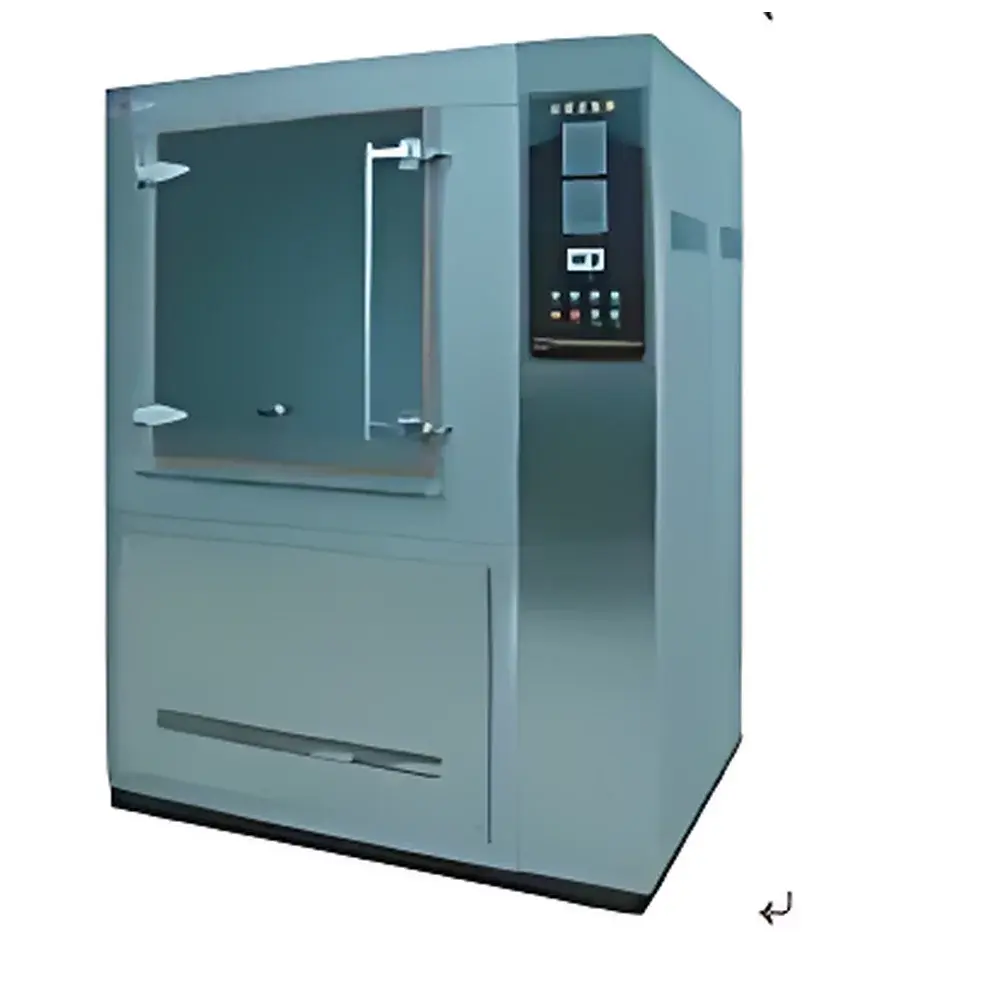
Jiubin JB-220D Programmable Thermal Shock Test Chamber
| Brand | Jiubin |
|---|---|
| Origin | Taiwan |
| Model | JB-220D |
| Internal Chamber Dimensions (W×H×D) | 450–600 × 350–500 × 350–500 mm |
| External Dimensions (W×H×D) | 1500–1900 × 1950–2000 × 1450–1550 mm |
| High-Temperature Zone Range | +80 to +200 °C |
| Low-Temperature Zone Range | −10 to −55 °C / −10 to −65 °C / −10 to −75 °C |
| Test Chamber Operating Range | +60 to +150 °C (hot) / −10 to −40 °C, −10 to −55 °C, or −10 to −60 °C (cold) |
| Heating Rate | +60 to +200 °C in ≈25 min |
| Cooling Rate | +20 to −55 °C <60 min |
| Temperature Recovery Time | ≤30 min (hot soak at 150 °C) |
| Max. Sample Weight | 2.5 / 5 / 10 kg |
| Interior Material | Mirror-finish SUS#304 stainless steel |
| Exterior Material | SUS#304 stainless steel |
| Insulation | High-density glass wool + polyurethane foam |
| Refrigeration System | Cascade-type air-cooled or water-cooled system with imported hermetic or semi-hermetic compressors (EU/US origin) |
| Controller | Touchscreen HMI with programmable logic, real-time curve display, and multi-language UI (English & Chinese) |
| Safety Protections | Compressor overcurrent/overheat, chamber overtemperature/overpressure, heater dry-run, motor overload, refrigerant pressure anomaly |
| Standard Accessories | 2 adjustable stainless steel shelves, 1 Ø50 mm test port |
| Power Supply | AC 3-phase 5-wire, ±10% tolerance, 50 Hz |
Overview
The Jiubin JB-220D Programmable Thermal Shock Test Chamber is an engineered solution for accelerated reliability assessment of electronic components, automotive modules, aerospace assemblies, and polymer-based materials under extreme thermal cycling conditions. It operates on the principle of rapid, controlled transitions between independently regulated high- and low-temperature reservoirs—utilizing a three-zone architecture (hot zone, cold zone, and test chamber)—to subject stationary specimens to abrupt thermal gradients without mechanical movement. This design eliminates vibration-induced artifacts and ensures repeatable thermal stress profiles per IEC 60068-2-14, MIL-STD-810H Method 503.5, and JESD22-A104. The chamber’s cascade refrigeration system, combined with high-efficiency insulation (glass wool + PU foam), enables stable operation across extended temperature extremes while maintaining compliance with ISO 17025 traceability requirements for calibration-critical environments.
Key Features
- Triple-zone configuration with independent hot/cold reservoirs and isolated test chamber for true static thermal shock exposure
- Touchscreen HMI controller with intuitive programming interface, real-time temperature curve visualization, and dual-language (English/Chinese) operational feedback
- Cascade refrigeration architecture using environmentally compliant R23/R507 refrigerants and imported EU/US-sourced hermetic or semi-hermetic compressors
- Mirror-finish SUS#304 stainless steel interior and exterior construction for corrosion resistance, cleanroom compatibility, and long-term dimensional stability
- Comprehensive safety suite including compressor overtemperature/overcurrent protection, refrigerant pressure monitoring, heater dry-run prevention, and motor overload detection
- Configurable thermal transition profiles: selectable dwell times, ramp rates, cycle counts, and up to 999-step programmable sequences
Sample Compatibility & Compliance
The JB-220D accommodates specimens up to 10 kg with internal dimensions configurable between 450 × 350 × 350 mm and 600 × 500 × 500 mm (W×H×D), supporting standard PCB assemblies, sensor housings, battery packs, and encapsulated optoelectronic devices. Its thermal performance meets the repeatability and accuracy criteria outlined in ASTM D5229/D5229M (low-temperature impact), IPC-9701A (thermal cycling reliability), and JEDEC JESD22-A104 (temperature cycling). All control firmware supports audit-ready data logging with timestamped event records, enabling alignment with GLP/GMP documentation workflows and FDA 21 CFR Part 11 electronic record integrity requirements when integrated with validated software platforms.
Software & Data Management
The embedded controller provides native support for USB data export (CSV format), real-time graphing of chamber and specimen temperatures (via optional external thermocouple inputs), and password-protected parameter locking. Optional Ethernet or RS-485 interfaces enable integration into centralized laboratory management systems (LIMS) or MES environments. Firmware includes built-in calibration offset adjustment per sensor channel and supports NIST-traceable probe validation protocols. All test logs include metadata such as operator ID, sequence name, start/stop timestamps, deviation alerts, and environmental condition flags—ensuring full traceability for quality audits and regulatory submissions.
Applications
- Qualification testing of solder joints and interconnects in high-reliability electronics per IPC-A-610 and IPC-J-STD-001
- Validation of thermal expansion coefficient (CTE) mismatch in multi-material packaging (e.g., SiC MOSFET modules, GaN HEMTs)
- Accelerated aging studies of adhesives, conformal coatings, and potting compounds under cyclic thermal stress
- Pre-screening of automotive ECUs and infotainment units prior to climatic chamber validation per ISO 16750-4
- Material phase-change analysis in shape-memory alloys and thermoplastic elastomers
FAQ
What is the maximum allowable sample mass for thermal shock testing in the JB-220D?
The chamber supports three standard load configurations: 2.5 kg, 5 kg, and 10 kg—selected during system specification to ensure thermal mass equilibrium and recovery time integrity.
Does the JB-220D comply with international thermal shock test standards?
Yes—it is designed to execute test profiles conforming to IEC 60068-2-14, MIL-STD-810H Method 503.5, JESD22-A104, and IPC-9701A, with documented temperature uniformity and transition rate verification reports available upon request.
Can the controller be configured for remote monitoring and data archiving?
Standard USB export is included; optional network interfaces (Ethernet/RS-485) support SCADA integration, LIMS synchronization, and automated report generation via third-party middleware.
What refrigerants are used, and are they compliant with current environmental regulations?
R507 and R23 are employed—both zero-ozone-depletion-potential (ODP = 0) HFC blends approved under the Kigali Amendment and EU F-Gas Regulation No. 517/2014.
Is calibration certification provided with delivery?
Each unit ships with a factory-as-built temperature uniformity and transition rate verification report; ISO/IEC 17025-accredited field calibration services are available through authorized Jiubin service partners.



