
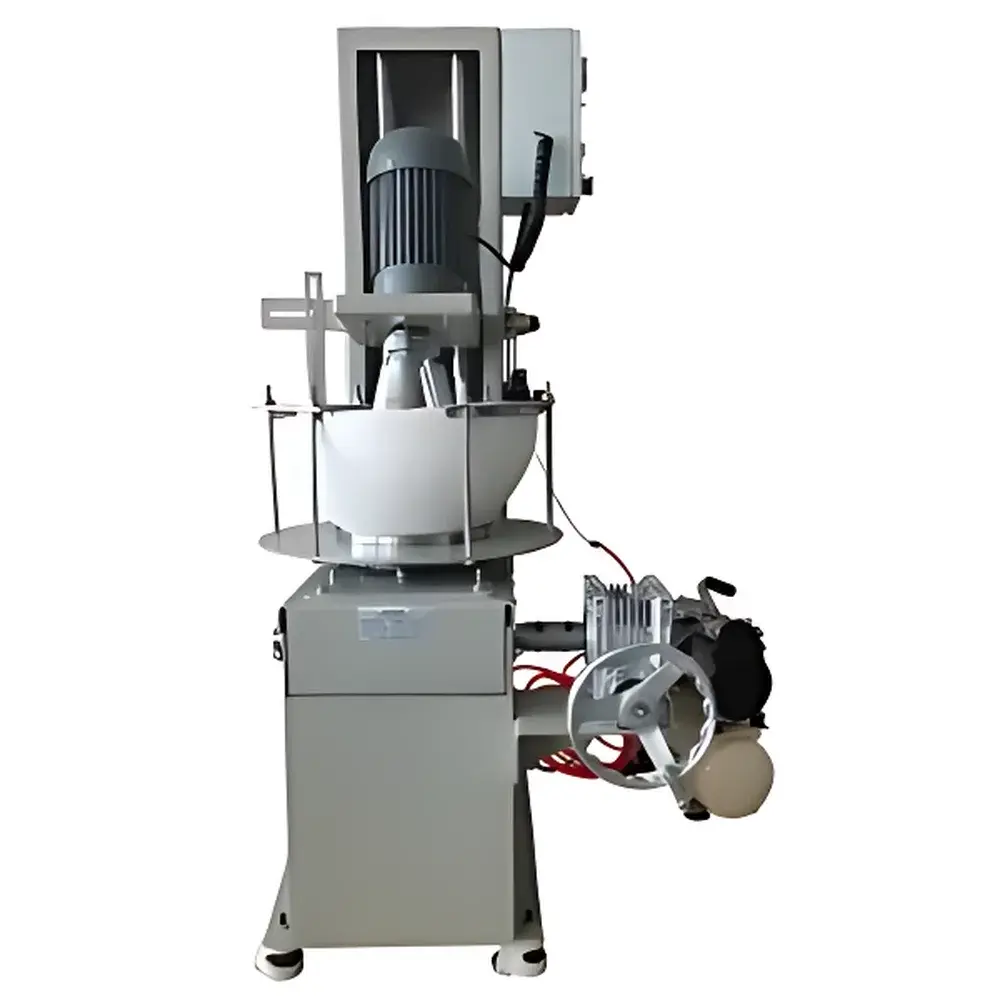
Jiubin JB-400 Pneumatically Actuated Ceramic Mortar Grinder
| Brand | Jiubin |
|---|---|
| Origin | Shanghai, China |
| Manufacturer Type | Authorized Distributor |
| Product Category | Domestic |
| Model | JB-400 |
| Instrument Type | Mortar Grinder |
| Sample Applicability | Hard and Brittle Materials |
| Final Particle Size | < 0.01 mm |
| Batch Capacity | 5 L |
| Drive System | Variable-Speed Motor |
| Grinding Media | Ceramic Mortar & Pestles (3-Pestle Configuration) |
| Actuation | Pneumatic Lift Mechanism |
Overview
The Jiubin JB-400 Pneumatically Actuated Ceramic Mortar Grinder is an industrial-grade laboratory grinding system engineered for high-efficiency, low-thermal-load comminution of hard, brittle, and temperature-sensitive materials. It operates on the principle of controlled mechanical attrition within a fixed ceramic mortar chamber, where three synchronized ceramic pestles rotate and orbit under programmable speed and pressure profiles. Unlike impact-based mills or ball mills, this mortar-grinder design minimizes particle fragmentation variability and suppresses localized heating—critical for preserving crystallinity in pharmaceutical actives, preventing phase transitions in advanced ceramics, and maintaining rheological integrity in膏-like formulations (e.g., dental pastes, pigment dispersions). Its pneumatic lift mechanism enables precise, repeatable vertical positioning of the pestle assembly relative to the mortar base—ensuring consistent contact force and uniform shear distribution across the entire sample bed. The system is purpose-built for R&D labs and QC environments requiring reproducible sub-10 µm particle size distributions without solvent addition or cryogenic assistance.
Key Features
- Triple-ceramic-pestle configuration with independent orbital motion and rotational symmetry—enhancing grinding homogeneity and reducing edge effects.
- Pneumatically driven vertical lift system with adjustable stroke and pressure regulation (integrated oil mist lubricator and precision pressure regulator) for deterministic load control during grinding cycles.
- Ceramic mortar and pestles (Al₂O₃ ≥95% purity) offering exceptional wear resistance, chemical inertness, and negligible metallic contamination—validated for USP particulate matter testing and ISO 13485-compliant medical device material processing.
- Variable-speed AC motor (30–300 rpm range, ±1 rpm repeatability) coupled with digital tachometric feedback for torque-stable operation across viscosity gradients.
- Integrated stainless-steel刮刀 (scraping blade) mounted on the mortar lid—automatically clearing adhered material from pestle shafts and chamber walls between cycles to prevent cross-contamination and ensure mass balance accuracy.
- Manual tilt-and-pour discharge via hand-cranked flip mechanism, enabling full residue recovery without disassembly; mobile casters with locking brakes facilitate repositioning within ISO 17025-accredited lab layouts.
Sample Compatibility & Compliance
The JB-400 accommodates dry powders, semi-solids, and high-viscosity pastes—including pharmaceutical APIs, tungsten carbide precursors, silicon nitride nanopowders, dental composites, conductive inks, and food-grade functional additives. Its ceramic wet-grinding capability supports aqueous and organic solvent systems (e.g., ethanol, acetone, ethyl acetate), with sealed chamber design meeting IP54 ingress protection standards. All wet-contact components comply with FDA 21 CFR §177.2420 (ceramic food-contact surfaces) and EU Regulation (EC) No. 1935/2004. Documentation packages include material traceability certificates, dimensional inspection reports, and CE-conformity declarations per Machinery Directive 2006/42/EC.
Software & Data Management
While the base JB-400 operates via front-panel push-button controls with analog parameter dials, optional RS-485/Modbus RTU interface enables integration into centralized LIMS or MES platforms. Logged parameters—including runtime, average RPM, pneumatic pressure setpoint, and cycle count—are timestamped and exportable as CSV for GLP audit trails. Optional firmware upgrade adds password-protected user profiles, electronic signature capture (per 21 CFR Part 11), and automatic calibration log generation aligned with ISO/IEC 17025 Clause 7.7.
Applications
- Pharmaceutical pre-formulation: micronization of BCS Class II drugs prior to dissolution testing (ASTM D5231).
- Advanced materials R&D: size reduction of sintering-grade powders while retaining stoichiometric ratios and specific surface area (BET ISO 9277).
- Quality control of dental restorative materials: homogenization of zirconia-reinforced resin composites prior to flexural strength evaluation (ISO 4049).
- Electronics manufacturing: dispersion refinement of conductive silver pastes for screen-printed electrodes (IPC-4552A).
- Food science: particle size standardization of functional mineral fortificants (e.g., nano-calcium carbonate) prior to bioavailability assays.
FAQ
What is the maximum allowable feed particle size for optimal performance?
Feed particles should not exceed 5 mm in diameter to ensure uniform loading and avoid pestle jamming; oversized feed requires pre-crushing via jaw crusher (e.g., ASTM C136-compliant).
Can the JB-400 be validated for GMP production environments?
Yes—when equipped with optional IQ/OQ documentation kits and 21 CFR Part 11 firmware, it supports qualification under Annex 15 and ICH Q5C guidelines.
Is cleaning validation supported for multi-product use?
Residue limits can be verified using swab sampling per USP , with ceramic surfaces demonstrating ≤0.1 µg/cm² carryover after validated NaOH/ethanol rinse protocol.
Does the system require compressed air with specific dew point specifications?
Standard operation requires clean, dry air at 0.4–0.6 MPa and ≤−20 °C pressure dew point (ISO 8573-1 Class 2.2.2) to prevent condensation in the pneumatic actuator.



