
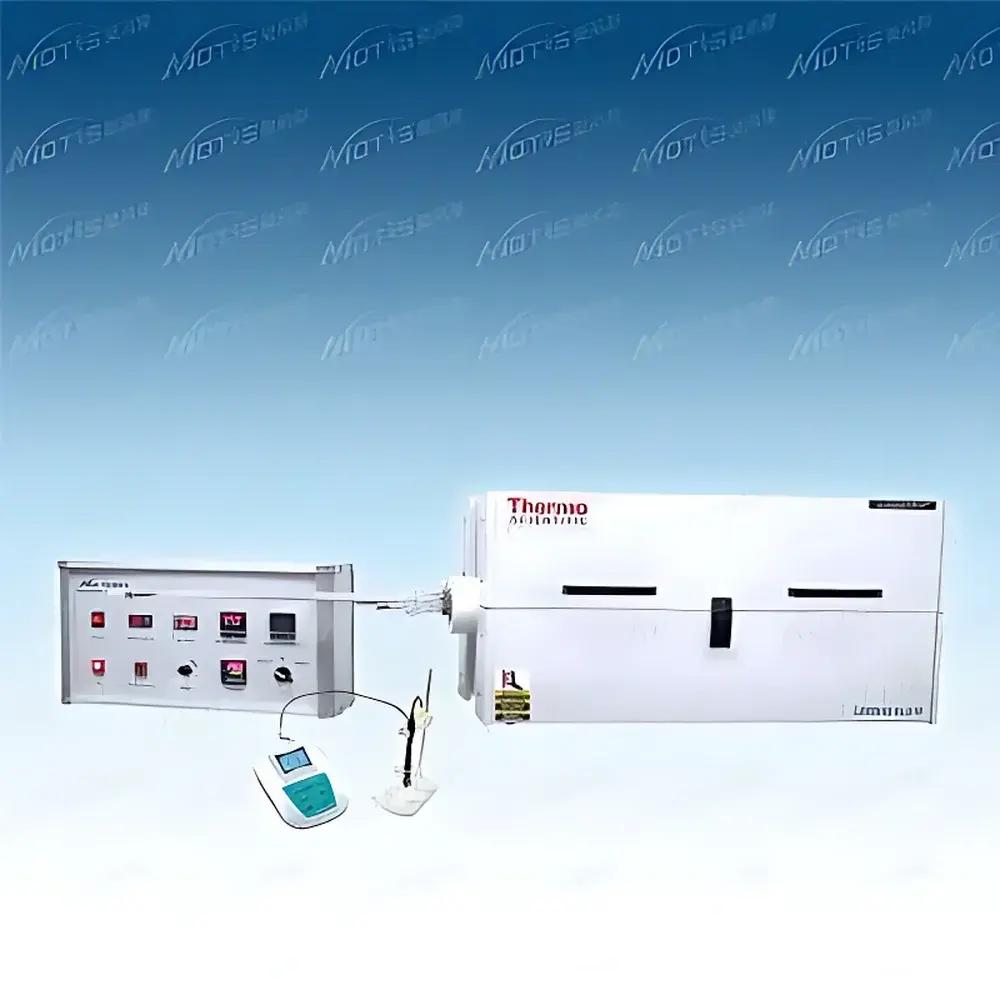
MOTIS CTA Halogen Acid Gas Release Tester
| Brand | MOTIS |
|---|---|
| Origin | Jiangsu, China |
| Model | CTA |
| Air Flow Range | 0–3 L/min (digital display, adjustable in 0.1 L/min increments) |
| Temperature Control | Dual-mode PID (programmable ramping and single-point setpoint) |
| Max Furnace Temperature | 1100 °C with over-temperature cutoff |
| Furnace Type | Openable tubular furnace with imported thermocouple-equipped quartz heating tube |
| Auxiliary Instruments | Magnetic stirrer, pH meter, conductivity meter |
| Air Filtration | Activated carbon + silica gel columns |
| Compliance | GB/T 17650.1–2–1998, IEC 60754-1/2–1994, EN 50305, BS 6853 Annex B |
Overview
The MOTIS CTA Halogen Acid Gas Release Tester is a precision-engineered combustion analysis system designed for quantitative determination of halogen acid gas emissions—primarily hydrogen chloride (HCl), hydrogen bromide (HBr), and other hydrogen halides—evolved during the thermal decomposition of electric cables and wires under controlled fire conditions. Based on the fundamental principle of gravimetric and electrochemical quantification, the instrument thermally decomposes test specimens in a calibrated tubular furnace under defined airflow and temperature profiles, followed by absorption of evolved acidic gases into deionized water. The resulting aqueous solution is then analyzed for pH (indicating H⁺ concentration) and specific conductivity (correlating to total halide ion concentration), enabling calculation of halogen acid gas yield in mg/g of sample as specified in international standards. This method directly supports regulatory compliance assessments for low-halogen or halogen-free (LSOH/LSZH) cable materials used in rail, mass transit, building infrastructure, and data centers where smoke toxicity and corrosion potential are critical safety parameters.
Key Features
- Digitally controlled mass flow meter with 0–3 L/min range and 0.1 L/min resolution ensures reproducible oxidative carrier gas delivery per IEC 60754-2 requirements.
- Dual-mode PID temperature control system supports both programmable thermal ramping (for simulating evolving fire conditions) and stable single-point operation (for standardized 800 °C or 900 °C decomposition per GB/T 17650.1).
- Openable tubular furnace architecture with quick-access quartz heating tube facilitates routine maintenance, residue removal, and calibration verification without disassembly.
- Integrated over-temperature protection cuts power at 1100 °C—exceeding the maximum operational limit (typically 900 °C) while safeguarding furnace integrity and operator safety.
- Dedicated dual-stage air filtration (activated carbon + silica gel) eliminates background CO₂, hydrocarbons, and moisture that could interfere with pH and conductivity measurements.
- Bundled analytical instrumentation includes a calibrated magnetic stirrer for homogeneous absorption, a laboratory-grade pH meter (±0.02 pH accuracy), and a conductivity meter (0.1–20 mS/cm range) with temperature compensation.
Sample Compatibility & Compliance
The CTA tester accommodates solid polymeric cable insulation and sheathing samples up to 1.0 g (as specified in IEC 60754-1), including PVC, LSZH compounds, cross-linked polyolefins, and fluoropolymers. Its configuration meets the physical and procedural requirements of multiple harmonized standards: GB/T 17650.1–2–1998 (Chinese national standard), IEC 60754-1/2–1994 (international baseline), EN 50305 (railway rolling stock), and BS 6853 Annex B (UK rail fire safety). While not a standalone toxicity analyzer, its gas absorption output serves as foundational input for subsequent EN 50305-compliant smoke toxicity evaluation when integrated into broader fire testing workflows.
Software & Data Management
The CTA operates as a hardware-integrated benchtop system without proprietary embedded software. All measurement data—including real-time airflow values, furnace temperature logs, pH readings, and conductivity outputs—are recorded manually or via external lab notebooks compliant with GLP documentation practices. Users may interface the pH and conductivity meters with third-party data acquisition systems supporting ASTM E2500 or ISO/IEC 17025 traceability frameworks. For regulated environments (e.g., certified cable testing labs), full audit trails—including instrument calibration certificates, operator signatures, and raw absorbate analysis records—are required to satisfy FDA 21 CFR Part 11–aligned quality systems.
Applications
- Quantification of halogen acid gas evolution from low-smoke zero-halogen (LSZH) cable compounds during fire exposure simulation.
- Material qualification for compliance with railway specifications (EN 50305, BS 6853) and building codes (IEC 61000-4-11, NFPA 262).
- R&D screening of flame-retardant formulations to optimize halogen content versus char formation and smoke density trade-offs.
- Third-party certification testing for UL 1685, CSA C22.2 No. 0.3, and other North American standards referencing halogen acidity limits.
- Root-cause analysis of corrosion failures in electrical enclosures exposed to cable fire effluents.
FAQ
What standards does the CTA Halogen Acid Gas Release Tester support?
It fully implements GB/T 17650.1–2–1998, IEC 60754-1/2–1994, EN 50305, and BS 6853 Annex B test protocols.
Is the furnace capable of reaching temperatures above 900 °C?
Yes—the maximum rated temperature is 1100 °C, with automatic cut-off activation at that threshold for safety and longevity.
Can the system be used for non-cable polymer materials?
Yes, provided the specimen mass, geometry, and thermal decomposition behavior align with the absorption efficiency and detection limits defined in IEC 60754-1.
Does the system include calibration certificates for auxiliary instruments?
No—pH meters and conductivity meters require user-performed calibration prior to each test series using NIST-traceable buffer solutions and KCl standards.
Is automation or data export capability available?
The base configuration is manual-data-entry; however, analog outputs from the pH/conductivity meters allow integration with SCADA or LIMS platforms via standard 0–10 V or 4–20 mA interfaces.



