
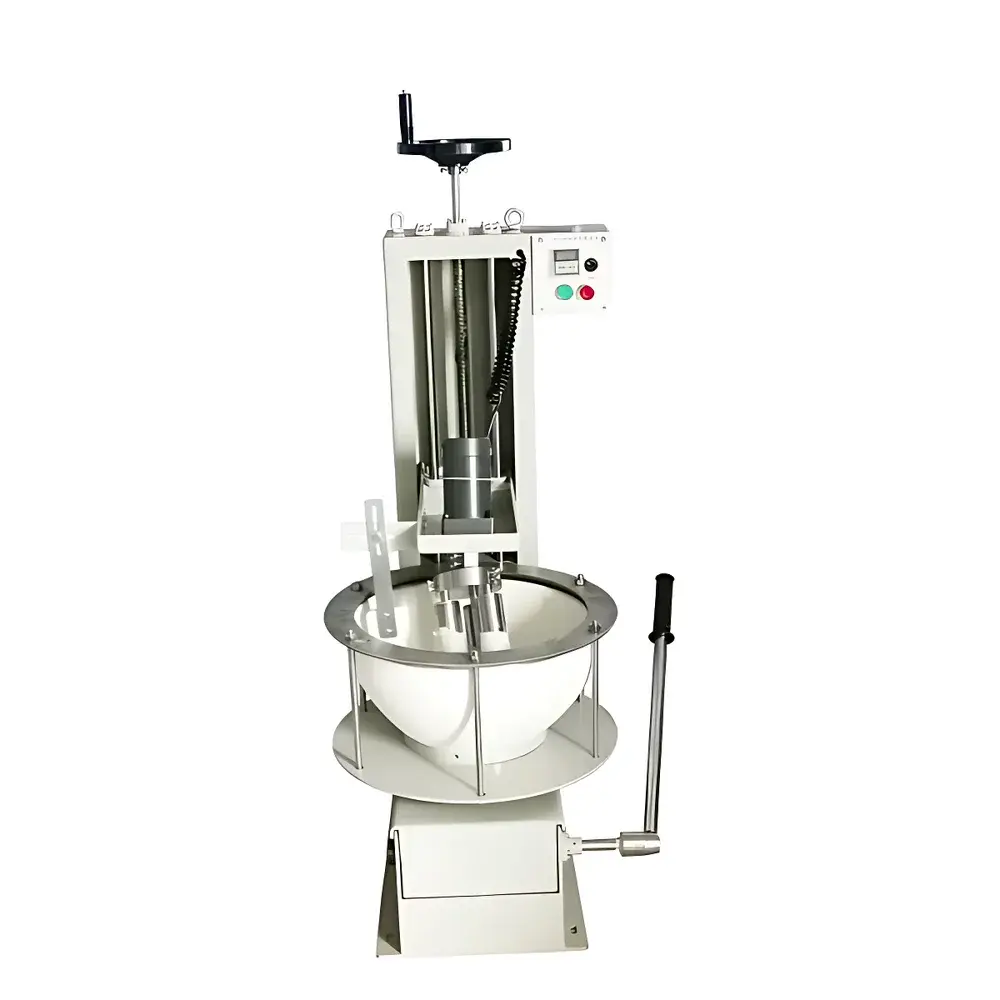
Jiubin JB-400 Triple-Pestle Ceramic Mortar Grinder
| Brand | Jiubin Instruments |
|---|---|
| Origin | Shanghai, China |
| Manufacturer Type | Authorized Distributor |
| Country of Origin | China |
| Model | JB-400 |
| Instrument Type | Mortar Grinder |
| Sample Suitability | Hard & Brittle Solids |
| Output Particle Size | 0.01–0.5 mm |
| Batch Capacity | 5 L |
| Mortar Diameter | 400 mm |
| Mortar Depth | 200 mm |
| Pestle Rotational Speed | 1–180 rpm (adjustable) |
| Grinding Time Range | 1–999 min (programmable) |
| Mortar Material | Alumina Ceramic (99.5% Al₂O₃) |
Overview
The Jiubin JB-400 Triple-Pestle Ceramic Mortar Grinder is a laboratory-scale, programmable grinding system engineered for high-efficiency size reduction of hard, brittle, and temperature-sensitive materials. Unlike conventional ball mills or jaw crushers, the JB-400 employs a controlled mortar-and-pestle principle based on coaxial rotational shearing and compressive impact—mechanisms rooted in classical mechanical comminution theory. Three synchronized alumina pestles rotate within a fixed, high-purity alumina ceramic mortar (99.5% Al₂O₃), generating uniform radial pressure and multi-point shear forces across the sample bed. This architecture minimizes localized overheating and cross-contamination while delivering reproducible sub-500 µm particle distributions. Designed specifically for pharmaceutical R&D, traditional Chinese medicine (TCM) standardization, and advanced material pre-processing, the JB-400 bridges the gap between manual mortar grinding and industrial milling—offering GLP-aligned traceability without sacrificing operator control.
Key Features
- Triple-pestle configuration (vs. single-pestle JB-250 predecessor) increases grinding throughput by ≥2.3× under identical load and time conditions, verified via comparative sieve analysis (ISO 9276-2)
- Alumina ceramic mortar (Ø400 × D200 mm) and matching pestles provide exceptional wear resistance, chemical inertness, and thermal stability up to 1600°C—critical for avoiding metal leaching in pharmacopeial applications
- Digitally adjustable rotational speed (1–180 rpm) enables precise energy input modulation: low rpm for gentle deagglomeration; high rpm for rapid brittle fracture of crystalline APIs or herbal matrices
- Programmable grinding duration (1–999 minutes) with real-time elapsed time display supports method development per USP & ChP monographs requiring defined mechanical stress exposure
- Sealed grinding chamber with optional inert gas purge port (N₂/Ar) mitigates oxidation of labile compounds (e.g., volatile oils in TCM herbs, iodine-based actives)
- Tool-free pestle/mortar assembly and smooth internal geometry facilitate full residue recovery (>98% mass yield) and simplify cleaning validation per GMP Annex 15 requirements
Sample Compatibility & Compliance
The JB-400 is validated for consistent processing of materials with Mohs hardness ≤9, including but not limited to: crystalline active pharmaceutical ingredients (APIs), dried botanical extracts (e.g., Ginseng radix, Scutellaria baicalensis), semiconductor-grade silicon powders, diamond abrasives, epoxy resin granules, roasted coffee beans, and iodine tablets. Its all-ceramic wetted path eliminates metallic contamination—a prerequisite for ICH Q3D elemental impurity controls. The device complies with CE machinery safety directives (2006/42/EC) and meets electrical safety standards IEC 61010-1 for laboratory equipment. While not FDA-listed as a medical device, its design supports 21 CFR Part 11-compliant data integrity when paired with external audit-trail-enabled logging software.
Software & Data Management
The JB-400 operates via an integrated membrane keypad interface with non-volatile parameter memory (retains last 10 methods). Though it lacks embedded networking, all operational parameters—including start time, rpm setpoint, duration, and stop confirmation—are logged to internal EEPROM with timestamping. Users may export method records via USB-C (optional adapter) for integration into LIMS or electronic lab notebooks (ELN). For regulated environments, the system supports IQ/OQ documentation packages aligned with ASTM E2500 and ISPE GAMP5 guidelines, including calibration certificates for speed and timer accuracy (±0.5% full scale).
Applications
- Preparation of homogenized herbal powder batches for HPLC fingerprinting and quantitative assay per Chinese Pharmacopoeia (ChP) Vol. I
- Size reduction of brittle excipients (e.g., microcrystalline cellulose, lactose monohydrate) prior to direct compression tablet formulation
- Generation of reference standards with certified particle size distributions (PSD) for laser diffraction instrument calibration (ISO 13320)
- Processing of heat-labile nutraceuticals where cryogenic milling introduces moisture or solvent residues
- R&D-scale grinding of piezoelectric ceramics and battery cathode precursors requiring phase-purity preservation
FAQ
Can the JB-400 achieve sub-10 µm particles?
No—its mechanical design targets the 10–500 µm range. Sub-10 µm requires fluid-energy or planetary ball milling.
Is the alumina mortar resistant to hydrofluoric acid cleaning?
No—HF etches alumina. Use only neutral pH detergents or ethanol; avoid strong acids and alkalis.
Does the unit support continuous feed operation?
No—it is strictly batch-mode. Continuous feeding would compromise pestle synchronization and PSD reproducibility.
What maintenance intervals are recommended?
Inspect pestle alignment and mortar surface integrity every 200 operating hours; lubricate drive shaft bearings annually with food-grade silicone grease.
Can grinding parameters be locked to prevent unauthorized changes?
Yes—administrator mode requires a 4-digit code to modify rpm or time settings, supporting SOP enforcement in QC labs.



