
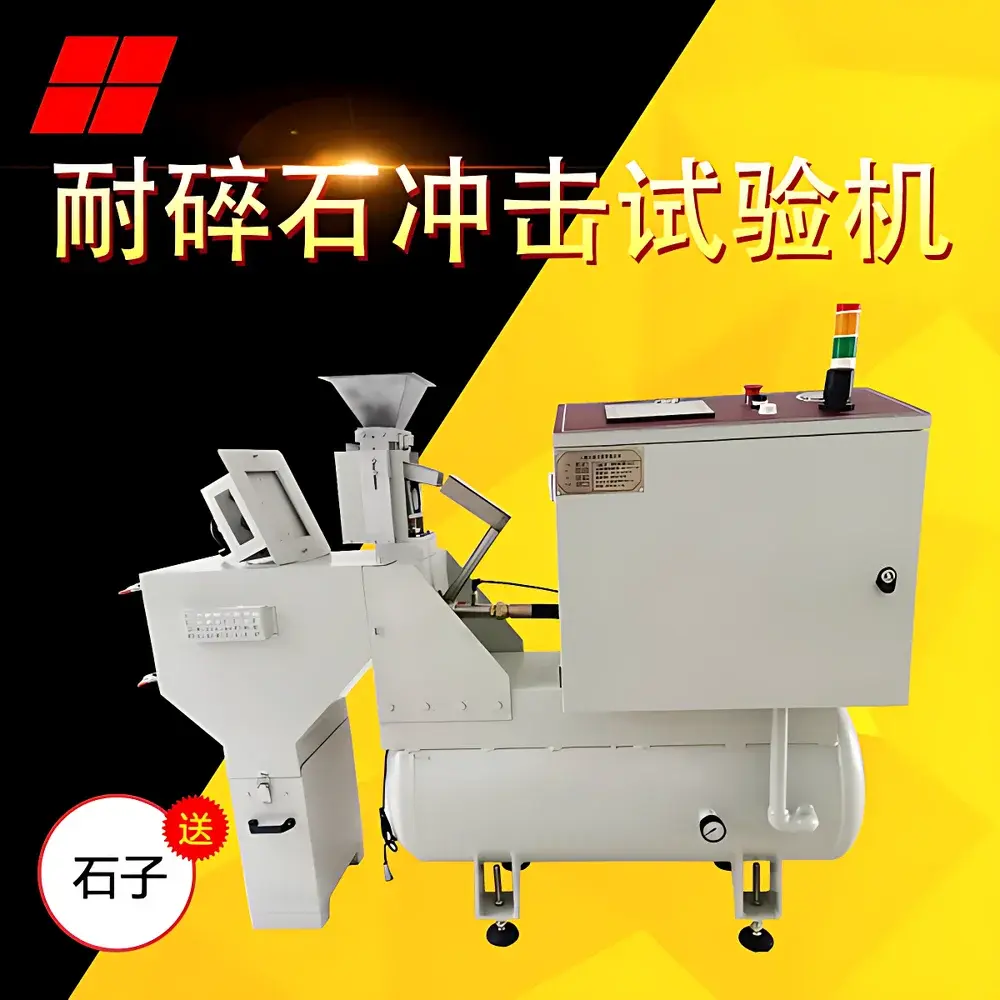
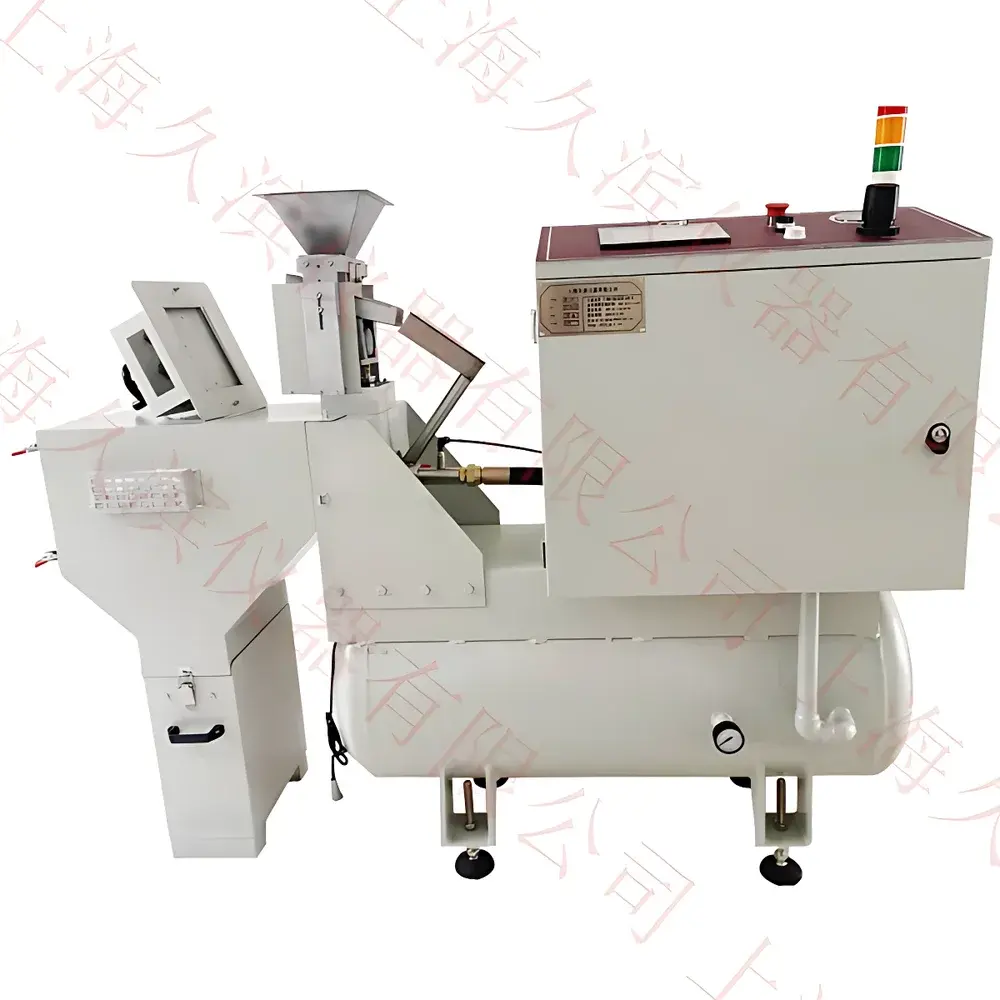
Jiubin JB-JM5 Gravel Impact Resistance Tester
| Brand | Jiubin Instruments |
|---|---|
| Origin | Shanghai, China |
| Manufacturer Type | Authorized Distributor |
| Country of Origin | China |
| Model | JB-JM5 |
| Instrument Type | Gravel Impact Resistance Tester |
| Operating Pressure Range | 0–0.8 MPa (adjustable) |
| Test Temperature | Ambient (optional low-/high-temperature chamber available) |
| Air Hose Internal Diameter | 20 mm / 15 mm |
| Air Reservoir Volume | 136 L |
| Nozzle Tube Internal Diameter | 30 mm / 53 mm |
| Specimen Orientation | 45°, 54°, or 90° for flat panels |
| Sound Pressure Level | ≤120 dB(A) |
| Operation Mode | Continuous duty cycle |
| Impact Media | Gravel, crushed stone, calibrated abrasive particles |
| Feed Rate Control | Electromagnetic vibratory feeder |
| Airflow Pressure Regulation | Manual needle valve |
| Required External Compressor | ≥2 m³/min at 0–0.8 MPa |
Overview
The Jiubin JB-JM5 Gravel Impact Resistance Tester is an engineered solution for simulating and quantifying the mechanical degradation caused by high-velocity gravel and stone impact—commonly encountered in automotive underbody coatings, aerospace composite surfaces, protective polymer films, and architectural cladding systems. Based on controlled pneumatic acceleration principles, the instrument propels standardized abrasive media through a calibrated nozzle at precisely regulated pressure and flow conditions, enabling reproducible simulation of real-world road-debris impact events. Unlike generic impact testers, the JB-JM5 integrates configurable specimen orientation (45°, 54°, and 90° angles), dual-nozzle options (30 mm and 53 mm ID), and a volumetric air reservoir (136 L) to ensure stable pressure delivery during extended test cycles—critical for evaluating coating adhesion failure modes such as interfacial delamination, cohesive fracture, and substrate exposure.
Key Features
- Pneumatically driven impact mechanism with adjustable operating pressure (0–0.8 MPa), enabling correlation with field-relevant impact energy levels per ISO 20567-1 and SAE J400 standards.
- Dual-nozzle configuration (30 mm and 53 mm internal diameter) supports both localized and broad-area impact assessment across diverse sample geometries.
- Electromagnetically regulated vibratory feeder ensures consistent, metered delivery of gravel or crushed stone—minimizing feed-rate drift and improving inter-test repeatability.
- Modular 3D test chamber accommodates non-planar specimens (e.g., curved body panels, molded composites), eliminating the need for sectioning or artificial flattening that compromises structural integrity.
- Robust 136 L air reservoir mitigates pressure fluctuations during continuous operation, supporting ASTM D3170-compliant multi-cycle testing without compressor duty-cycle interruption.
- Acoustically isolated enclosure design limits operational noise to ≤120 dB(A); compliant with OSHA 29 CFR 1910.95 hearing protection requirements when used with appropriate PPE.
Sample Compatibility & Compliance
The JB-JM5 accepts rigid and semi-rigid substrates up to 600 × 600 mm, including steel, aluminum, fiber-reinforced polymers (FRP), tempered glass, and coated plastic panels. Its angular flexibility (45°, 54°, 90°) aligns with OEM specifications for under-hood and undercarriage component validation. The system meets functional requirements of ISO 20567-1 (Paints and varnishes — Determination of resistance to chipping by gravel), SAE J400 (Chipping Resistance of Painted Surfaces), and GB/T 20623–2006 (Chinese national standard for automotive coating impact resistance). While not inherently certified to GLP or ISO/IEC 17025, its pressure regulation, feed control, and angle positioning mechanisms support audit-ready test documentation when integrated into validated laboratory workflows.
Software & Data Management
The JB-JM5 operates as a hardware-controlled benchtop system with manual parameter adjustment (pressure via needle valve, feed rate via vibratory amplitude control). It does not include embedded software or digital data logging. However, its analog interface architecture allows integration with external PLCs or DAQ systems for time-synchronized recording of pressure, cycle count, and environmental conditions. Users may document test parameters—including media type, particle size distribution (per ASTM E11), nozzle-to-sample distance, and post-test evaluation criteria (e.g., ASTM D3359 cross-hatch adhesion rating)—in accordance with 21 CFR Part 11–compliant electronic lab notebooks (ELNs) when paired with qualified metadata capture protocols.
Applications
- Quantitative evaluation of chip resistance in OEM automotive basecoat/clearcoat systems.
- Comparative assessment of interlayer adhesion strength in multi-layer thermal barrier coatings (TBCs) and anti-corrosion primers.
- Determination of critical brittle thickness in laminated safety glass and polycarbonate glazing.
- Validation of erosion resistance in wind-turbine blade leading-edge protectors and marine antifouling topcoats.
- Development screening of elastomeric sealants and impact-dissipating undercoatings subjected to gravel-laden airflow environments.
FAQ
What compressed air supply is required to operate the JB-JM5?
A dedicated industrial-grade air compressor delivering ≥2 m³/min at pressures up to 0.8 MPa is mandatory. Moisture and oil filtration (ISO 8573-1 Class 2.2.2) is strongly recommended to prevent nozzle clogging and ensure long-term valve reliability.
Can the JB-JM5 be used for low-temperature impact testing?
Yes—though the base configuration operates at ambient temperature, optional climate-controlled test chambers (−40 °C to +80 °C) are available as accessories and integrate seamlessly with the 3D test enclosure.
Is calibration traceable to national standards?
Pressure transducers and feed-rate meters can be calibrated using NIST-traceable references; Jiubin provides calibration certificates upon request for individual components, though full-system certification requires third-party validation per ISO/IEC 17025.
What gravel specifications are recommended for compliance testing?
For ISO 20567-1 conformance, use granite or basalt gravel graded to 6–10 mm particle size, with hardness ≥7 Mohs and angularity index >65%, as verified per ASTM D5821.
Does the system include safety interlocks or emergency stop functionality?
Yes—the JB-JM5 features a dual-channel hardwired emergency stop circuit, door-position sensing, and pressure-relief redundancy to meet CE machinery directive (2006/42/EC) requirements for operator protection.



