
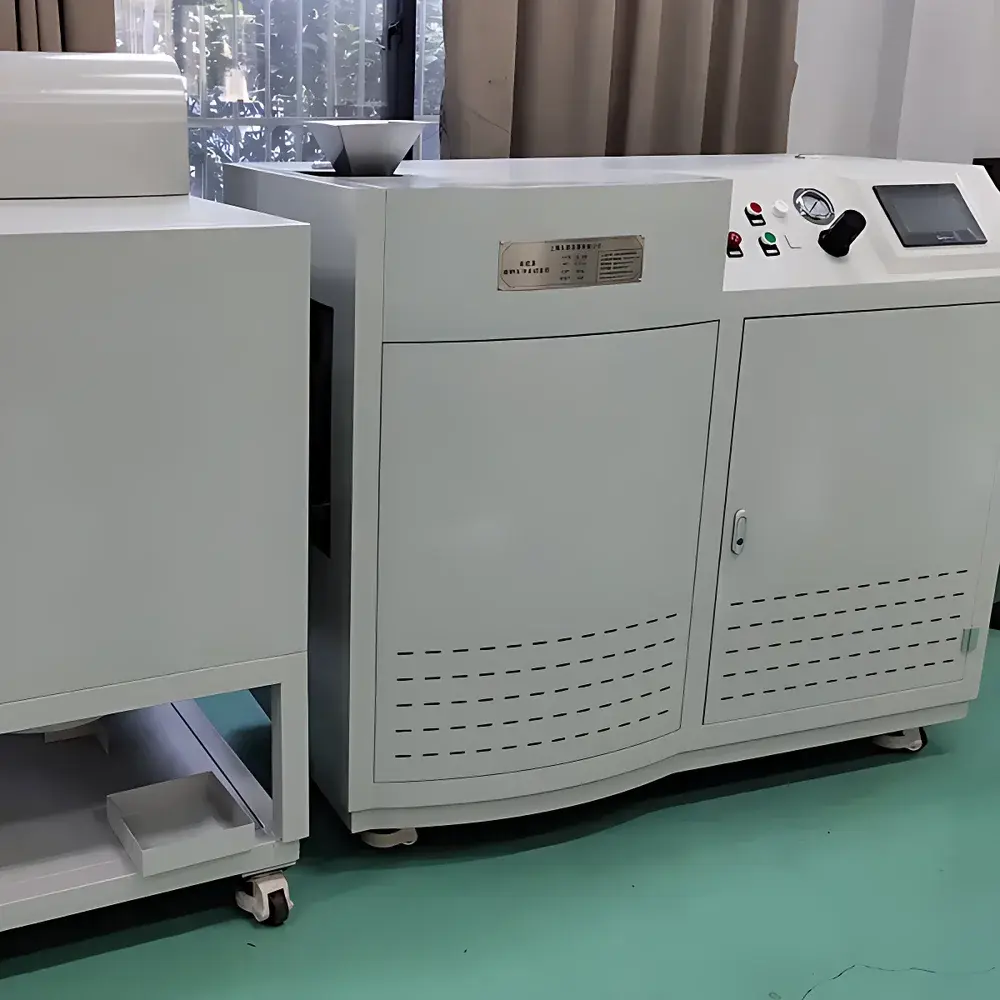
Jiubin JB-JM6 High-Low Temperature Gravel Impact Tester
| Brand | Jiubin Instruments |
|---|---|
| Origin | Shanghai, China |
| Manufacturer Type | Authorized Distributor |
| Country of Origin | China |
| Model | JB-JM6 |
| Price Range | USD 14,000 – 42,000 (FOB Shanghai) |
| Instrument Type | Gravel Impact Resistance Tester |
| Operating Temperature Range | −20 °C to −70 °C (optional cryogenic configuration) |
| Impact Window Dimensions | 300 mm × 300 mm |
| Air Reservoir Volume | 170 L |
| Adjustable Impact Angle | 0°–180° continuous |
| Compliance Standards | SAE J400, ASTM D3170, VDA 233-202, GMW 14872, Ford CETP 00.00-L-467, Mazda MHT-103, JIS D 0205, Nissan NES M0139, Toyota TSL 0601G |
Overview
The Jiubin JB-JM6 High-Low Temperature Gravel Impact Tester is an engineered solution for evaluating the resistance of automotive coatings, substrates, and composite laminates to mechanical impact under controlled thermal conditions. It operates on the principle of pneumatic propulsion: calibrated gravel particles (typically 0.5–2.0 mm angular basalt or granite) are accelerated through a precision-machined nozzle using compressed air, striking the test specimen at defined velocity, angle, and temperature. The system replicates real-world road debris impact events—such as stone chipping on vehicle underbodies, wheel arches, and front-end components—under accelerated laboratory conditions. Unlike generic impact testers, the JB-JM6 integrates cryogenic environmental control (down to −70 °C) to assess coating brittleness, interlayer adhesion loss, and substrate fracture behavior at low temperatures where polymer matrices exhibit reduced ductility and increased susceptibility to delamination.
Key Features
- Continuous 0°–180° impact angle adjustment via a universal kinematic mount—enabling precise simulation of oblique impacts encountered during high-speed driving or cross-wind conditions.
- Integrated 300 mm × 300 mm transparent impact window with reinforced polycarbonate shielding, permitting real-time visual observation and high-speed imaging without compromising operator safety or pressure integrity.
- Monolithic impact chamber design fully encloses the projectile delivery system, specimen holder, and nozzle assembly—eliminating leakage paths and ensuring consistent gravel trajectory even with curved or contoured samples (e.g., fenders, bumpers).
- 170-liter high-capacity air reservoir maintains stable discharge pressure (±1.5% variation) across sequential impact cycles, critical for reproducible kinetic energy delivery per ASTM D3170 and VDA 233-202 protocols.
- Modular architecture based on ISO-standardized mechanical interfaces allows rapid reconfiguration between SAE J400, GMW 14872, and Toyota TSL 0601G test modes without tooling changes.
- Cryogenic chamber with dual-stage refrigeration (cascade compressor system) achieves and stabilizes −70 °C at specimen surface within ≤45 minutes, verified by embedded PT100 sensors traceable to NIST standards.
Sample Compatibility & Compliance
The JB-JM6 accommodates flat, convex, and concave specimens up to 400 mm in diameter or 500 mm in length, secured via vacuum chuck or clamping frames compatible with ISO 1514 and ASTM D6600 substrate preparation guidelines. It supports multi-layer systems—including e-coat/EDP, primer-surfacer, basecoat, clearcoat, and hydrophobic topcoats—as well as thermoplastic polyolefins (TPO), polypropylene composites, and tempered automotive glass. Regulatory alignment includes full traceability to SAE J400 (gravelometer method), ASTM D3170 (chipping resistance), VDA 233-202 (stone chip resistance at low temperature), GMW 14872 (cold-temperature gravel impact), and OEM-specific requirements from Volkswagen Group (PV3952), Stellantis (PF-9620), General Motors (GMW14872), Nissan (NES M0139), and Toyota (TSL 0601G). All calibration procedures follow ISO/IEC 17025:2017 requirements for testing laboratories.
Software & Data Management
The system operates via a Windows-based control interface compliant with IEC 62443-3-3 cybersecurity standards. Test parameters—including impact pressure, cycle count, dwell time, temperature ramp rate, and angle setting—are programmable and stored with digital signatures. Audit trails record operator ID, timestamp, parameter modifications, and calibration events in accordance with FDA 21 CFR Part 11 and EU Annex 11 requirements. Export formats include CSV, XML, and PDF reports containing raw impact counts, post-test digital image analysis (via optional integrated macro lens + LED ring lighting), and pass/fail determination against preloaded OEM acceptance criteria (e.g., maximum allowable chip area per SAE J400 Class C).
Applications
- Quantitative evaluation of coating system cohesion and interfacial adhesion strength under thermal stress.
- Determination of optimal film thickness for minimum chipping susceptibility in multi-layer paint systems.
- Comparative benchmarking of new resin chemistries (e.g., acrylic-urethane hybrids vs. polyaspartic clearcoats) under sub-zero impact conditions.
- Validation of anti-chip undercoating performance on steel, aluminum, and CFRP substrates per VW PV3952.
- Supporting GLP-compliant R&D documentation for OEM Tier-1 supplier qualification submissions.
FAQ
What gravel specifications does the JB-JM6 support per SAE J400?
Standardized 0.5–2.0 mm angular basalt gravel meeting SAE J400 Annex A particle size distribution; alternative media (e.g., crushed granite per ASTM D3170) can be qualified upon user validation.
Is the −70 °C capability validated across the full impact window area?
Yes—temperature uniformity is ±1.2 °C across the 300 × 300 mm zone per VDA 233-202 Annex B, confirmed during factory acceptance testing with 9-point thermocouple mapping.
Can the system be integrated into an automated test cell with MES/SCADA?
Yes—the controller provides Modbus TCP and OPC UA server interfaces for bidirectional communication with manufacturing execution systems.
Does the JB-JM6 include calibration certification?
Each unit ships with a UKAS-accredited calibration certificate covering pressure transducers, temperature sensors, and angle encoder, valid for 12 months from commissioning.
What maintenance intervals are recommended for the pneumatic system?
Air filter elements require replacement every 500 operating hours; the 170 L reservoir undergoes annual hydrostatic pressure verification per ASME BPVC Section VIII.



