
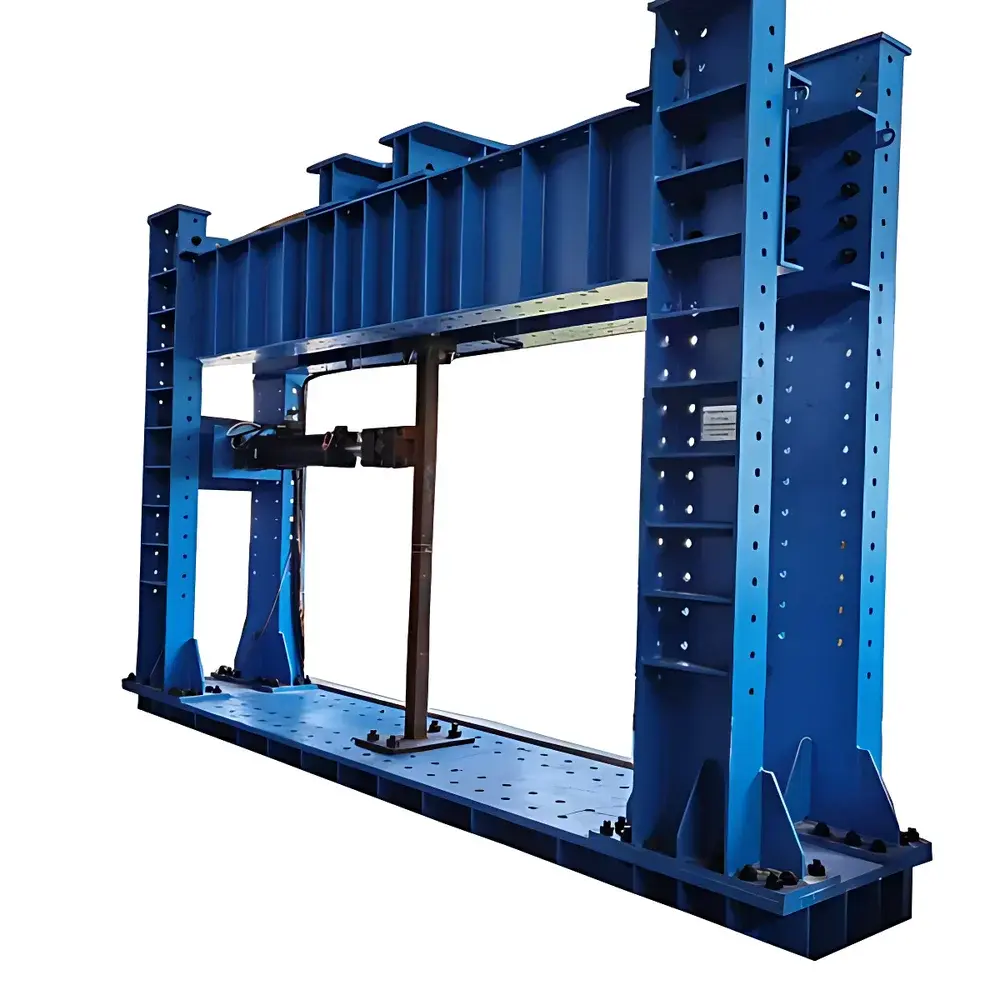
Jiubin JB Multi-Channel Electro-Hydraulic Servo Fatigue Testing System
| Brand | Jiubin / JByq |
|---|---|
| Origin | Shanghai, China |
| Model | JB |
| Static Load Capacity | ±300 kN |
| Dynamic Load Capacity | ±300 kN |
| Actuator Stroke | ±100 mm (accuracy ≤ ±0.5% FS) |
| Frequency Range | 0.1–50 Hz (2 Hz at ±80 mm |
| Force Measurement Range | 1–100% FS, unsegmented |
| Force Accuracy | ≤ ±1% FS |
| Displacement Measurement Range | 200 mm |
| Displacement Accuracy | ≤ ±0.5% FS |
| Control Modes | Constant-Force Fatigue, Constant-Displacement Fatigue, Pre-Load + Constant-Force/Constant-Deformation Protocols, Durability Testing with Real-Time Pass/Fail Logic (e.g., force decay or displacement drift thresholds) |
| Waveforms | Sinusoidal, Triangular, Square, Ramp, and Composite Profiles |
| T-Shaped Loading Platform | 3200 × 1600 mm |
| Reaction Frame Clearance | 3200 mm span × 1500 mm vertical test height, ≥30 kN structural capacity |
| Overall Dimensions (L×W×H) | ~3200 × 1600 × 2500 mm |
| Custom Fixturing | Designed per user-supplied component drawings |
Overview
The Jiubin JB Multi-Channel Electro-Hydraulic Servo Fatigue Testing System is a high-fidelity, multi-axis structural durability platform engineered for rigorous mechanical characterization of automotive and heavy-duty vehicle components under combined static and dynamic loading conditions. Based on closed-loop electro-hydraulic servo actuation, the system applies precisely controlled axial, bending, and torsional loads using high-bandwidth hydraulic servovalves and low-hysteresis load cells—enabling accurate replication of real-world service spectra including road-induced vibrations, suspension kinematics, and cyclic structural stresses. Its dual-capacity architecture supports both quasi-static mechanical property evaluation (tensile, compressive, flexural stiffness, yield strength) and high-cycle fatigue testing (HCF) up to 50 Hz, making it suitable for validation against OEM durability targets and regulatory test protocols such as those defined in GB/T 19844–2005 and GB/T 16826–2008.
Key Features
- True multi-channel synchronization: Independent control of up to four servo actuators with phase-coherent waveform generation for complex coupled loading (e.g., simultaneous vertical + lateral + rotational inputs).
- Full-range force measurement: ±300 kN static and dynamic capacity with 1–100% full-scale linearity and ≤±1% FS accuracy across the entire range—no range switching required.
- High-fidelity displacement control: ±100 mm actuator stroke with ≤±0.5% FS dynamic positioning accuracy, validated per ISO 25178-6 and ASTM E2368 Annex A2.
- Configurable test envelopes: Programmable amplitude-frequency limits ensure safe operation at elevated frequencies (e.g., 5 Hz at ±30 mm stroke), preserving actuator life and signal fidelity.
- Structurally integrated reaction frame: Rigid T-shaped loading platform (3200 × 1600 mm) paired with a 3.2 m-span龙门架 supporting ≥30 kN vertical preload and accommodating large-format assemblies such as axle subframes, air spring modules, and multi-link suspension systems.
- Real-time pass/fail logic engine: Embedded condition monitoring triggers automated test termination upon detection of predefined failure criteria—including force decay exceeding 5% over N cycles, displacement drift >0.2 mm/cycle, or sudden stiffness reduction >8%—ensuring compliance with internal durability standards and GLP-aligned reporting requirements.
Sample Compatibility & Compliance
The JB system accommodates structural components ranging from compact elastomeric bushings to full-width rear axles and multi-point mounted stabilizer bars. Standardized mounting interfaces align with SAE J2947 and ISO 12107 fixture geometry conventions. All hardware and firmware comply with electromagnetic compatibility (EMC) directives IEC 61000-6-2/6-4 and safety standard EN 60204-1. Mechanical verification follows GB/T 2611–2007 (general requirements for testing machines) and GB/T 16825.1–2008 (static calibration of uniaxial testing systems). Fatigue control algorithms are traceable to ISO 10816-3 for vibration severity assessment and support audit-ready data logs compliant with FDA 21 CFR Part 11 when paired with optional electronic signature modules.
Software & Data Management
Control and analysis are performed via Jiubin’s proprietary TestMaster v4.2 software suite—a Windows-based platform featuring deterministic real-time kernel scheduling (≤1 ms loop jitter), synchronized analog/digital I/O acquisition at 20 kHz, and native support for ASTM E466-compliant test sequence scripting. Raw channel data (force, displacement, strain, temperature) are stored in HDF5 format with embedded metadata (test ID, operator, calibration date, environmental conditions). Export options include CSV, MATLAB .mat, and MDF4 for integration with third-party CAE tools (e.g., nCode DesignLife, FE-SAFE). Audit trails record all parameter modifications, start/stop events, and manual overrides with time-stamped user IDs—meeting GLP/GMP documentation integrity requirements.
Applications
- Automotive suspension component validation: Vertical bending fatigue of leaf springs (per GB/T 19844–2005), torsional endurance of anti-roll bars, and hysteresis mapping of air springs under pressure-coupled load cycling.
- Chassis subsystem durability: Multi-axis road-load simulation on control arms, trailing links, and knuckle assemblies using measured wheel force transducer (WFT) data replay.
- Railway and commercial vehicle testing: Fatigue life assessment of bogie frames, drawbars, and secondary suspension elements under ISO 10791-7 harmonic loading profiles.
- Material-level characterization: Strain-controlled low-cycle fatigue (LCF) of high-strength steels and aluminum alloys using extensometer feedback, with automatic Δε/Δσ tracking per ASTM E606.
- Quality assurance screening: High-throughput durability verification of production batches with auto-generated compliance reports referencing OEM-specific acceptance thresholds (e.g., Ford WSS-M1A392-A, GM GMW14872).
FAQ
What standards does this system support for automotive component testing?
It fully implements GB/T 19844–2005 (leaf spring bench testing), GB/T 16826–2008 (electro-hydraulic universal testers), and JB/T 8612–1997, with configurable test templates for SAE J2947 and ISO 12107 fatigue classification.
Can the system perform closed-loop strain control during fatigue tests?
Yes—when equipped with clip-on or bonded extensometers (optional), it supports true strain-controlled LCF testing with real-time Δε regulation and automatic hold-time insertion per ASTM E606.
Is remote monitoring and diagnostics available?
Standard Ethernet/IP connectivity enables secure remote access via TLS-encrypted VNC or OPC UA server integration for factory-wide test fleet monitoring.
How is calibration traceability maintained?
Each system ships with NIST-traceable calibration certificates for load cells and displacement transducers, renewed annually per ISO/IEC 17025 requirements.
What level of customization is supported for fixturing?
All fixtures are manufactured to dimensional drawings provided by the user, with FEA-supported design review and modal analysis to ensure rigidity above 200 Hz and minimal parasitic resonance interference.



