
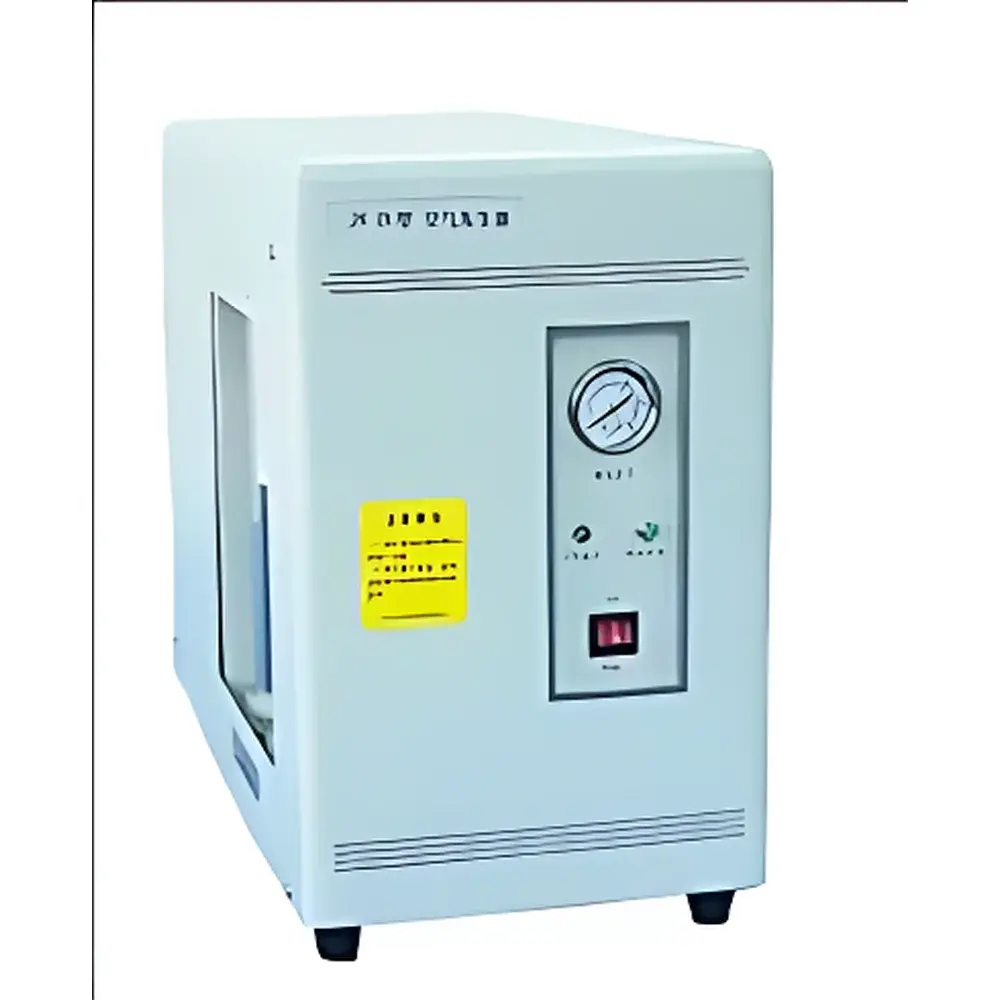
JK-2L Low-Noise Air Generator (2 L/min Output Capacity)
| Brand | Jingke Ruida (Kyocera-branded distribution) |
|---|---|
| Origin | Beijing, China |
| Manufacturer Type | Authorized Distributor |
| Country of Manufacture | China |
| Model | JK-2L (2 L/min) / JK-5L (5 L/min) |
| Air Purity | Oil-Free, Triple-Stage Purification |
| Output Flow Rate | 0–2 L/min (JK-2L) / 0–5 L/min (JK-5L) |
| Output Pressure | 0–0.4 MPa (for GC instruments) or 0–0.5 MPa (for air inlet of nitrogen generators) |
| Noise Level | ≤42 dB(A) |
| Power Supply | 220 V, 50 Hz |
| Operating Temperature | 15–40 °C |
| Relative Humidity | ≤70% RH (non-condensing) |
| Rated Power | 150 W |
| Dimensions (L×W×H) | 490 × 240 × 380 mm |
| Weight | 23 kg |
| Safety Features | Dual-stage pressure relief protection, thermal cut-off control, manual drain valve |
| Filtration Stages | Pre-filter + activated carbon chamber + color-indicating silica gel chamber |
| Regulatory Compliance | Designed for GLP-compliant laboratory environments |
Overview
The JK-2L Low-Noise Air Generator is an engineered solution for laboratories requiring continuous, oil-free, and ultra-clean compressed air supply for gas chromatography (GC), flame photometry, and auxiliary gas inputs to nitrogen or hydrogen generators. Unlike conventional high-pressure cylinders, this generator employs a precision low-noise scroll-type compressor coupled with a three-stage purification architecture—comprising particulate pre-filtration, activated carbon adsorption, and moisture removal via color-changing silica gel—to deliver air meeting ISO 8573-1 Class 2 specifications (≤0.1 mg/m³ total hydrocarbons, ≤0.1 µm particulates, dew point ≤−40 °C). Its dual-pressure output configuration (0–0.4 MPa for direct GC instrument connection; 0–0.5 MPa for feeding air-dependent nitrogen generation systems) ensures operational flexibility across multi-instrument setups. The unit operates silently at ≤42 dB(A)—comparable to library ambient noise—enabling safe integration into shared analytical labs without acoustic interference.
Key Features
- Low-noise scroll compressor with integrated vibration damping mount, engineered for long-term reliability and minimal acoustic emission
- Dual independent pressure regulation circuits with mechanical precision regulators, ensuring stable output pressure within ±0.01 MPa under variable flow demand
- Triple-stage purification system: graded particulate filter (5 µm), high-capacity activated carbon bed (removes hydrocarbons, odors, and volatile organics), and desiccant chamber with visual humidity indicator (blue-to-pink transition signals saturation)
- Comprehensive safety architecture including dual overpressure relief valves (mechanical + electronic), thermal cut-off switch (activated at ≥75 °C), and manually operated condensate drain valve for routine maintenance
- Energy-efficient design with 150 W nominal power draw, compliant with IEC 61000-3-2 harmonic current emission standards
- Compact footprint (490 × 240 × 380 mm) and ergonomic weight distribution (23 kg) facilitate benchtop installation and mobility within regulated lab spaces
Sample Compatibility & Compliance
The JK-2L is validated for use with all major GC platforms—including Agilent, Thermo Fisher Scientific, Shimadzu, and PerkinElmer models—as well as flame photometers and catalytic combustion detectors. Its output air quality conforms to ASTM D6299 guidelines for instrumental air in hydrocarbon analysis and satisfies the baseline air purity requirements outlined in USP and EP 2.2.42 for residual solvent testing. While not certified to ISO/IEC 17025, the generator supports GLP/GMP workflows through traceable maintenance logs, filter replacement records, and pressure/temperature monitoring capability. It is not intended for medical, breathing-air, or cleanroom process applications.
Software & Data Management
This is a standalone hardware-only air generation system with no embedded firmware, touchscreen interface, or digital connectivity. All operational parameters—including pressure, temperature, and runtime—are monitored via analog gauges and thermal indicators. Maintenance scheduling (e.g., filter replacement every 6–12 months depending on ambient conditions) follows documented lab SOPs. For audit readiness, users are advised to retain service logs aligned with FDA 21 CFR Part 11 principles when integrated into regulated analytical workflows—though the device itself does not provide electronic audit trails or user access controls.
Applications
- Carrier and detector gas supply for packed and capillary column gas chromatographs
- Air source for flame ionization detectors (FID), nitrogen-phosphorus detectors (NPD), and flame photometric detectors (FPD)
- Compression air feed for membrane-based or PSA-type nitrogen generators requiring consistent inlet air quality
- Support gas for atomic absorption spectroscopy (AAS) air-acetylene flames and ICP-OES plasma support systems
- General-purpose clean air supply in QC/QA labs performing environmental, pharmaceutical, or petrochemical analyses per EPA Method 8260, ISO 11843, or ASTM D3612
FAQ
Can the JK-2L be used with mass spectrometry (MS) detectors?
No. This generator is not rated for MS-grade air purity (which requires hydrocarbon levels <0.01 mg/m³ and particle counts <0.01 µm); it is optimized for FID/NPD/FPD and GC oven purge applications only.
How often must the silica gel and activated carbon filters be replaced?
Under standard lab conditions (25 °C, 50% RH), replace the silica gel when >70% turns pink and the carbon cartridge every 12 months—or after 2,000 hours of cumulative operation—whichever occurs first.
Is the output pressure adjustable during operation?
Yes. Both pressure outlets feature calibrated needle valves allowing real-time adjustment between 0–0.4 MPa and 0–0.5 MPa ranges without interrupting gas flow.
Does the unit require external cooling or ventilation?
No dedicated forced-air cooling is needed, but ambient airflow around the rear heat-exchange fins must remain unobstructed; maintain ≥10 cm clearance from walls or cabinets.
Can multiple instruments be connected simultaneously to one JK-2L?
Only if total combined flow demand remains ≤2 L/min and pressure drop across the distribution manifold stays within ±0.02 MPa; consult application engineering for manifold design validation.



