
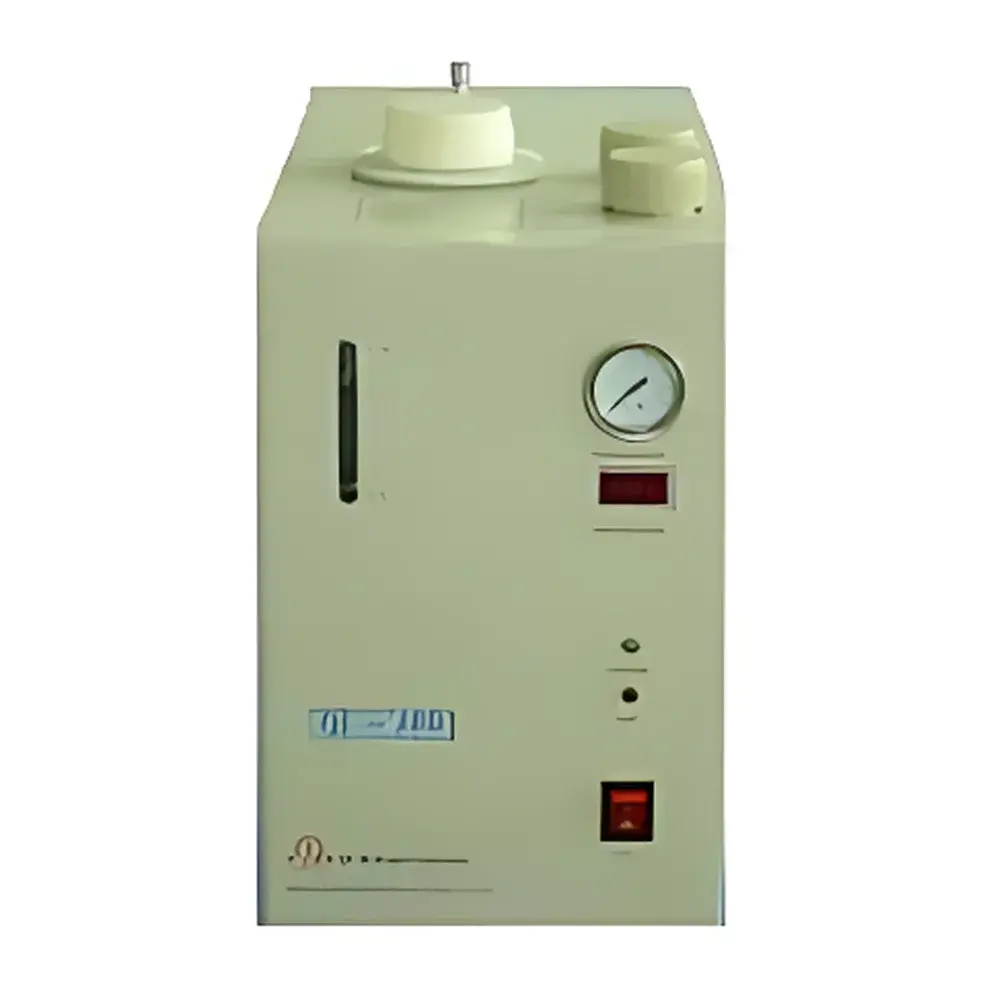
JK-300H / JK-500H Series High-Purity Hydrogen Generator by Jingke Ruida (Kyocera)
| [Brand | Jingke Ruida (Kyocera) |
|---|---|
| Origin | Beijing, China |
| Model | JK-300H / JK-500H |
| Purity | ≥99.999% H₂ (O₂-equivalent basis) |
| Output Pressure | 0.3 MPa (factory-set, non-adjustable in field) |
| Flow Rate | 0–300 mL/min (JK-300H) / 0–500 mL/min (JK-500H) |
| Power Supply | AC 220 V, 50 Hz |
| Max. Power Consumption | 180 W |
| Operating Temperature | 0–40 °C |
| Relative Humidity | <85% RH (non-condensing) |
| Dimensions (L×W×H) | 360 × 190 × 380 mm |
| Weight | 7 kg (JK-300H) / 8 kg (JK-500H) |
| Electrolyte | Deionized or distilled water only] |
Overview
The JK-300H and JK-500H Series High-Purity Hydrogen Generators are on-demand electrolytic gas generators engineered for continuous, reliable hydrogen supply to analytical instrumentation—primarily gas chromatographs (GC), including flame ionization detectors (FID), thermal conductivity detectors (TCD), and pulsed discharge helium ionization detectors (PDD). These units employ alkaline water electrolysis via a proprietary cylindrical electrolytic cell architecture, eliminating the need for compressed gas cylinders and associated safety, logistics, and regulatory burdens. Unlike conventional plate-type electrolyzers, the tubular electrolysis chamber enables simultaneous electrolyte storage, hydrogen generation, and oxygen separation—resulting in lower operational cell temperature, reduced thermal stress on membranes and electrodes, and extended service life. The system delivers hydrogen with a certified purity of ≥99.999% (on an O₂-equivalent basis), meeting ASTM D1945 and ISO 8573-1 Class 1 requirements for trace-level hydrocarbon and moisture content in carrier and fuel gases used in high-resolution GC analysis.
Key Features
- Integrated tubular electrolysis cell with large effective electrode area and passive thermal management—maintains stable cell temperature below 45 °C under full-load operation.
- Non-return liquid design prevents backflow of electrolyte into gas lines, eliminating risk of detector contamination or column damage—a critical safeguard for capillary GC systems.
- Digital LED flow display (0–300 mL/min or 0–500 mL/min) provides real-time, linear output monitoring without external calibration.
- Factory-set fixed output pressure of 0.3 MPa (43.5 psi), optimized for compatibility with standard GC pneumatic control modules; no user-adjustable pressure regulator required.
- Low-maintenance operation: only deionized or distilled water replenishment is needed—no KOH or other caustic electrolytes, no consumable filters, no periodic membrane replacement.
- Over-pressure cut-off circuit automatically interrupts power if internal pressure exceeds 0.35 MPa, complying with IEC 61010-1 safety requirements for laboratory equipment.
Sample Compatibility & Compliance
These generators are validated for use with all major GC platforms requiring ultra-high-purity hydrogen as carrier, make-up, or detector fuel gas—including Agilent, Thermo Fisher Scientific, Shimadzu, PerkinElmer, and Waters systems. The delivered gas meets ISO 8573-1:2010 Class 1 specifications for particulate, water, and oil content, and satisfies USP residual solvent testing prerequisites for pharmaceutical QC labs. While not certified to FDA 21 CFR Part 11 out-of-the-box, the instrument’s stable output, non-volatile operation, and built-in hardware interlocks support integration into GLP/GMP environments when paired with validated data logging systems. No hazardous chemicals are stored onboard; the sole consumable is Type I or II deionized water per ASTM D1193.
Software & Data Management
The JK-300H/500H operates as a standalone analog device with no embedded microcontroller, firmware, or digital communication interface (e.g., RS-232, USB, or Ethernet). All controls are hardwired: a single ON/OFF switch initiates electrolysis, and pressure stabilization occurs passively via mechanical back-pressure regulation. Flow rate is displayed via calibrated LED digits; no software installation, configuration, or audit trail is generated. This architecture ensures electromagnetic compatibility (EMC) compliance per EN 61326-1 and eliminates cybersecurity vulnerabilities—making it suitable for secure analytical laboratories where network isolation is mandated. For regulated environments, external flow/pressure dataloggers may be connected downstream for 21 CFR Part 11-compliant record retention.
Applications
- Carrier gas for capillary GC-FID analysis of volatile organic compounds (VOCs) in environmental air, drinking water, and soil extracts.
- Fuel gas for FID and TCD in petrochemical refinery stream analysis per ASTM D1319 and D5186.
- Make-up gas for electron capture detectors (ECD) in pesticide residue testing (AOAC 996.09, EPA Method 8081B).
- Hydrogen source for portable GC systems deployed in field-based forensic or customs screening applications.
- Lab-scale hydrogen supply for catalytic hydrogenation studies requiring inert, low-oxygen atmospheres.
FAQ
What type of water must be used?
Only Type I or II deionized water (resistivity ≥15 MΩ·cm) or distilled water meeting ASTM D1193 specifications. Tap water, tap-deionized water, or water containing additives will cause rapid electrode fouling and void warranty.
Can output pressure be adjusted after installation?
No. The 0.3 MPa output pressure is factory-calibrated and mechanically fixed. Custom pressure configurations require OEM modification prior to shipment.
Is this generator compatible with GC-MS systems?
Not recommended as primary carrier gas for mass spectrometry due to lack of integrated hydrocarbon and moisture scrubbing stages. Suitable only as auxiliary fuel gas for FID-based detection in hybrid GC-MS/FID setups.
How often does the unit require maintenance?
Under normal operation (8 h/day, 5 days/week), only monthly visual inspection and quarterly water top-up are required. No scheduled servicing, filter changes, or electrolyte replacement is necessary.
Does the generator produce oxygen as a byproduct?
Yes—oxygen is vented separately through a dedicated exhaust port. The unit must be installed in a well-ventilated area per OSHA 1910.103 and local fire codes to prevent O₂ accumulation.



