
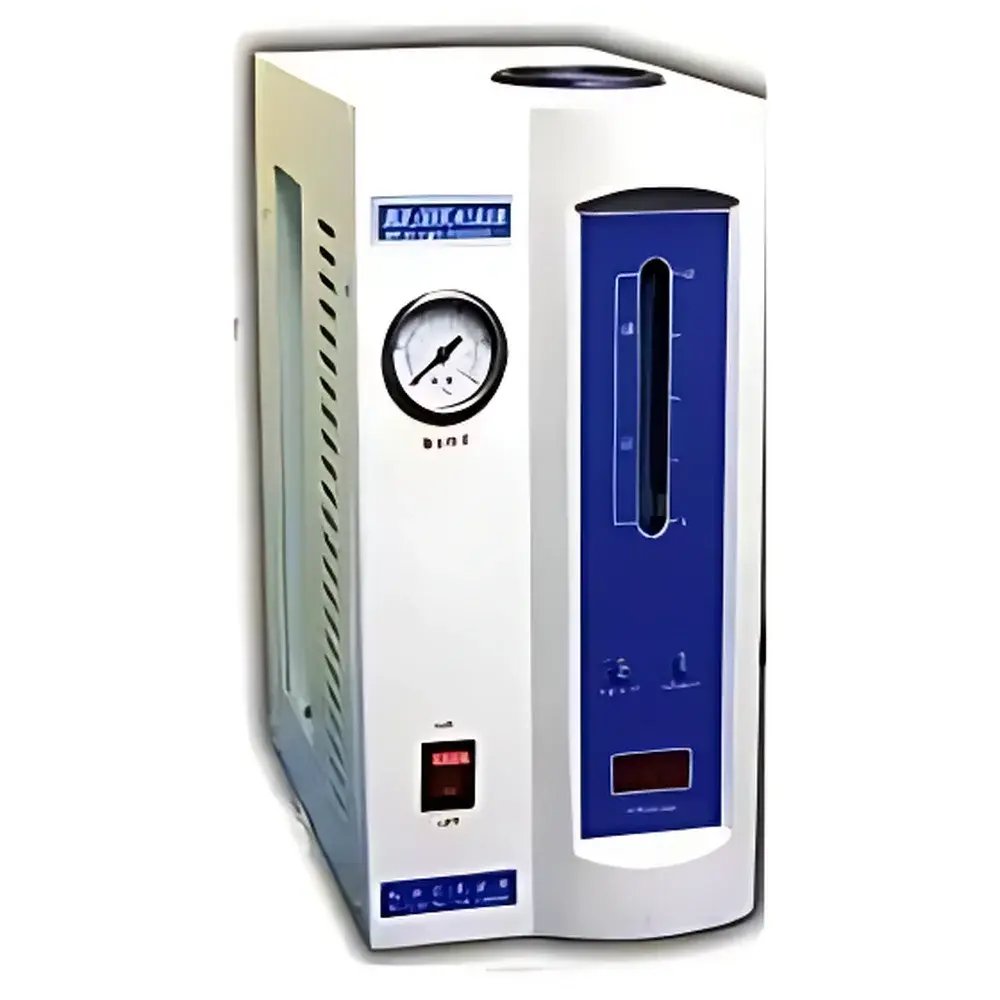
JK-300N / JK-500N High-Purity Nitrogen Generator
| Brand | Jingke Ruida (Kyocera-branded distribution) |
|---|---|
| Origin | Beijing, China |
| Model | JK-300N / JK-500N |
| Nitrogen Generation Principle | Pressure Swing Adsorption (PSA) from Compressed Air |
| Output Flow | 0–300 mL/min (JK-300N) / 0–500 mL/min (JK-500N) |
| Output Pressure | 0.4 MPa |
| Nitrogen Purity | 99.9994% (v/v, O₂-equivalent basis) |
| Dew Point | –10 to –40 °C |
| Input Air Pressure | ≥ 0.5 MPa |
| Power Supply | 220 V AC, 50 Hz |
| Max. Power Consumption | 80 W (JK-300N) / 100 W (JK-500N) |
| Dimensions (L×W×H) | 360 × 190 × 380 mm |
| Weight | 15 kg (JK-300N) / 16 kg (JK-500N) |
| Operating Ambient | 10–40 °C, RH < 85%, non-corrosive, low-dust environment |
Overview
The JK-300N and JK-500N High-Purity Nitrogen Generators are compact, PSA-based (Pressure Swing Adsorption) gas generation systems engineered for continuous or intermittent on-demand nitrogen supply in analytical laboratories. Designed to replace high-pressure nitrogen cylinders, these units intake clean, oil-free compressed air (≥ 0.5 MPa) and separate nitrogen via carbon molecular sieve (CMS) beds—leveraging differential adsorption kinetics of O₂, CO₂, and H₂O under pressure. The resulting nitrogen stream achieves a certified purity of 99.9994% (v/v), equivalent to ≤ 0.6 ppm residual oxygen—a specification validated per ISO 8573-1:2010 Class 2:2:2 for particulates, water, and oil content. This level of purity meets stringent requirements for electron capture detection (ECD) in gas chromatography, carrier gas applications in GC-MS, and inert purge environments in FTIR, TGA, and glovebox integration. The system operates without consumables beyond periodic CMS bed maintenance and requires no external cooling or water supply.
Key Features
- Two scalable models: JK-300N (0–300 mL/min) and JK-500N (0–500 mL/min), enabling flexible deployment across single-instrument or multi-port lab setups.
- Integrated auto-purge startup sequence: purges adsorption beds upon power-on to eliminate residual moisture and contaminants, ensuring stable output within ≤ 20 minutes.
- Fail-safe gas-path management: automatic shut-off valve engages during power loss to isolate CMS beds and prevent backflow or pressure decay.
- No liquid electrolyte design—eliminates risk of electrolyte carryover, corrosion, or maintenance downtime associated with membrane or PEM electrolytic systems.
- Non-return liquid trap: prevents condensate migration into downstream instrumentation, critical for protecting sensitive ECD detectors and GC injectors.
- Low thermal load architecture: maximum power draw of 100 W (JK-500N) minimizes heat dissipation and supports placement inside enclosed instrument cabinets or benchtop enclosures.
Sample Compatibility & Compliance
The JK-300N/500N is compatible with all laboratory instruments requiring ultra-high-purity nitrogen as carrier, make-up, or purge gas—including Agilent, Thermo Fisher, Shimadzu, and PerkinElmer GC and GC-MS platforms. Its output meets ASTM D6349-22 specifications for trace-gas analysis carrier gases and aligns with USP guidance for pharmaceutical gas purity. While not inherently 21 CFR Part 11 compliant (as a standalone hardware device), the generator supports GLP/GMP workflows when integrated with audit-trail-enabled LIMS or instrument control software. All units undergo factory verification per ISO/IEC 17025-accredited protocols for flow stability (±2% full scale), pressure regulation (< ±0.02 MPa hysteresis), and purity consistency over 1000-hour operational cycles.
Software & Data Management
These generators operate as embedded hardware systems with no onboard microprocessor or digital interface. Status monitoring is performed via front-panel LED indicators (power, ready, alarm) and mechanical pressure gauges. For automated lab environments, optional analog 0–5 V or 4–20 mA output signals (available on request) enable integration with building management systems (BMS) or centralized gas monitoring dashboards. Raw operational data—including runtime hours, cumulative flow volume, and pressure deviation logs—must be recorded manually or via external flow/pressure transducers calibrated to NIST-traceable standards.
Applications
- Carrier gas for capillary GC and GC-MS analyses requiring baseline stability and low detector noise.
- Make-up gas for electron capture detectors (ECD), where sub-ppm oxygen and hydrocarbon contamination directly impact sensitivity and linear dynamic range.
- Inert purge gas for thermogravimetric analyzers (TGA), differential scanning calorimeters (DSC), and X-ray diffractometers (XRD).
- Benchtop nitrogen blanket for solvent evaporation stations, Schlenk lines, and low-oxygen synthesis workstations.
- Zero-air generator feed gas for ozone scrubbers and catalytic converters in ambient air monitoring calibrations.
FAQ
Is this generator suitable for use with an ECD detector?
Yes—provided the unit is specified at time of order for ECD compatibility. This ensures pre-installation validation of oxygen and hydrocarbon residuals below 1 ppm, plus inclusion of an additional coalescing filter stage.
What compressed air quality is required?
Oil-free, desiccated air meeting ISO 8573-1 Class 2:2:2 (≤ 0.1 µm particles, ≤ 0.1 mg/m³ oil aerosol, dew point ≤ –40 °C) is mandatory. A dedicated refrigerated dryer + activated carbon + particulate filtration train is strongly recommended upstream.
How often does the carbon molecular sieve require replacement?
Under typical lab conditions (8 hrs/day, 5 days/week), CMS beds maintain specification performance for ≥ 20,000 operating hours (~5 years). Replacement is indicated only when purity drops below 99.999% or flow declines >10% at rated pressure.
Can the generator be mounted vertically or in a rack?
No—units must be operated horizontally on a stable, level surface to ensure proper condensate drainage and CMS bed packing integrity. Rear ventilation clearance of ≥ 50 mm is required.
Does it comply with CE or UL safety standards?
The JK-300N/500N conforms to IEC 61010-1:2010 for electrical safety in laboratory equipment and carries CCC certification (China Compulsory Certification). CE marking is not applied, as the unit is distributed under Kyocera’s OEM agreement for markets outside the EU.



