
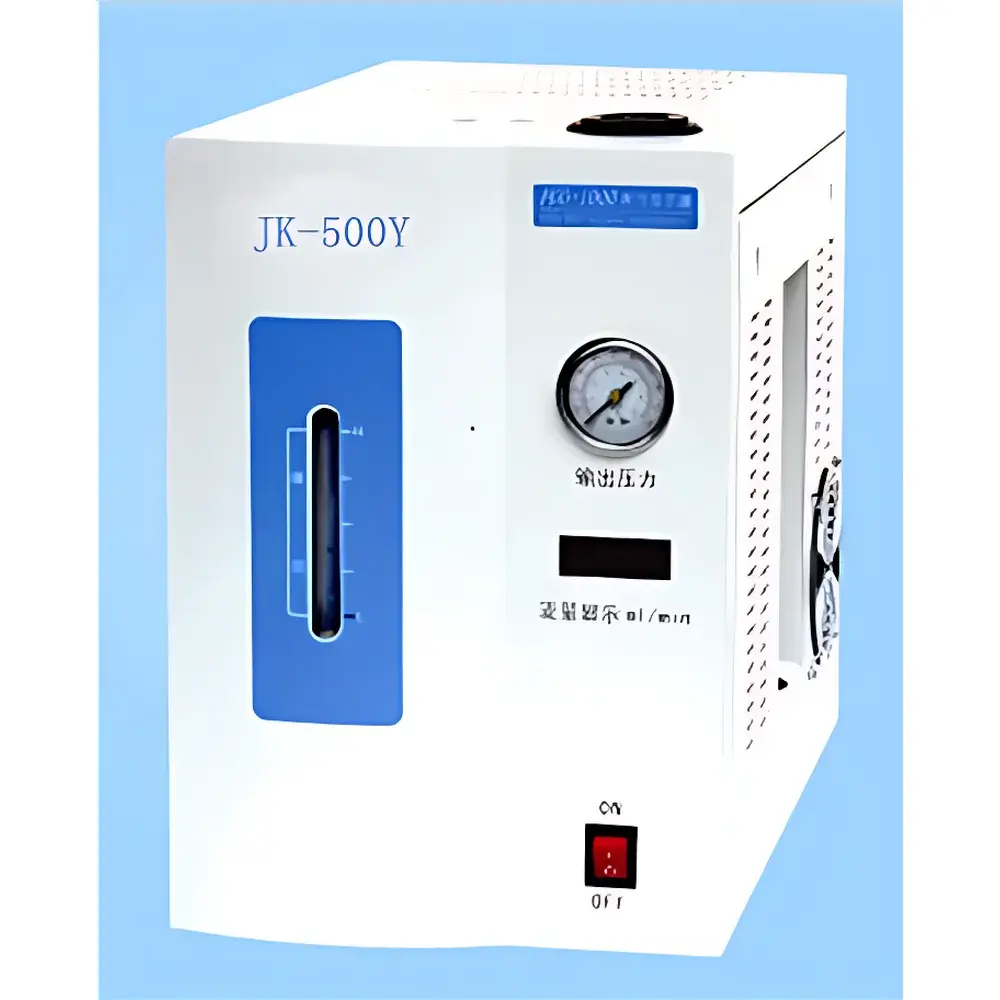
JK-500Y High-Purity Oxygen Generator
| Origin | Beijing, China |
|---|---|
| Manufacturer Type | Distributor |
| Origin Category | Domestic (China) |
| Model | JK-500Y |
| Price | USD 420 (approx.) |
| Input Voltage | 220 V AC, 50/60 Hz |
| Oxygen Purity | 99.995 % |
| Output Flow Rate | 0–800 mL/min |
| Output Pressure | 0.4 MPa (customizable upon order) |
| Max Power Consumption | 500 W |
| Operating Temperature | 0–40 °C |
| Relative Humidity | <85 % RH |
| Dimensions (L×W×H) | 520 × 280 × 400 mm |
| Weight | ~35 kg |
| Electrolyte | Deionized/Distilled Water |
| Electrolysis Voltage | <2.3 V per cell |
| Cooling | Passive thermal management via low-voltage high-current electrolysis architecture |
| Safety | Integrated one-way valve to prevent backflow/liquid carryover |
| Gas Drying | Built-in desiccant-based drying chamber |
Overview
The JK-500Y High-Purity Oxygen Generator is an electrolytic gas generation system engineered for continuous, on-demand production of ultra-high-purity oxygen (99.995 %) in laboratory environments. It operates on the principle of alkaline water electrolysis—where deionized water is decomposed into oxygen and hydrogen gases at nickel-plated stainless steel electrodes under controlled DC voltage (<2.3 V per cell). Unlike pressure swing adsorption (PSA) or membrane-based systems, this generator delivers inherently high-purity O₂ without reliance on consumable molecular sieves or external purification cartridges. Its modular multi-cell stack design increases effective electrode surface area, enabling stable output across the full 0–800 mL/min flow range while maintaining low thermal load and high current efficiency. The system integrates a sealed liquid reservoir, cascaded electrolytic cells with intercell fluid and gas routing, and a post-electrolysis drying chamber—ensuring consistent dew point control and eliminating moisture carryover into downstream instrumentation.
Key Features
- Stable, pressure-regulated oxygen delivery up to 0.4 MPa (adjustable pre-shipment for specialized applications)
- Real-time digital LED display for precise flow rate monitoring (0–800 mL/min resolution ±10 mL/min)
- Low-voltage, high-efficiency switching power supply optimized for <2.3 V/cell operation—reducing Joule heating and extending electrolyzer service life
- Integrated anti-backflow protection: stainless steel check valve installed downstream of the gas–liquid separator prevents condensate or electrolyte ingress during shutdown or pressure transients
- Passive thermal management architecture—no external cooling fans or chillers required; suitable for quiet lab environments
- Minimal maintenance protocol: only periodic replenishment of deionized water (no catalyst replacement, no filter changes)
- Compact footprint (520 × 280 × 400 mm) with robust sheet-metal chassis and vibration-damped mounting feet
Sample Compatibility & Compliance
The JK-500Y is designed for use with analytical instruments requiring carrier, purge, or support gas—including gas chromatographs (GC), elemental analyzers (CHNS/O), combustion analyzers, and oxidation reactors. Its 99.995 % O₂ purity meets ASTM D6866–22 specifications for isotopic analysis support gas and satisfies minimum inlet gas requirements for ISO 17025-accredited testing laboratories. While not certified to UL/CE or IEC 61010–1 out-of-the-box, the unit complies with general electrical safety principles for Class I laboratory equipment operating within ambient conditions (0–40 °C, <85 % RH, non-corrosive, low-dust environments). Users integrating the generator into GLP or GMP workflows should validate output consistency per internal SOPs and document calibration against traceable NIST-certified gas standards.
Software & Data Management
The JK-500Y is a standalone analog-controlled instrument with no embedded microprocessor, firmware, or digital communication interface (e.g., RS-232, USB, or Ethernet). All operational parameters—including flow rate and pressure—are monitored locally via front-panel LED indicators and mechanical pressure gauges. As such, it does not generate electronic audit trails, nor does it support FDA 21 CFR Part 11-compliant data logging. For regulated environments requiring electronic records, integration with third-party data acquisition systems (e.g., LabVIEW, DeltaV, or custom SCADA) is feasible via optional 4–20 mA analog output modules (available as aftermarket accessories). Routine performance verification should be conducted using calibrated thermal mass flow meters and oxygen analyzers traceable to national metrology institutes.
Applications
- Carrier gas supply for GC-FID, GC-TCD, and GC-MS systems requiring inert, moisture-free O₂
- Oxidant source in coal, petrochemical, and cement sample combustion analysis (e.g., LECO-type determinators)
- Calibration and challenge gas generation in environmental air quality monitoring labs
- Controlled-atmosphere reaction studies in catalysis, corrosion science, and battery material research
- Support gas for laser cutting test benches and plasma etching R&D setups where cylinder logistics are impractical
- Backup or primary O₂ source in university teaching labs conducting electrochemistry, thermogravimetric analysis (TGA), or differential scanning calorimetry (DSC)
FAQ
What type of water must be used for electrolyte replenishment?
Only freshly prepared deionized or distilled water (resistivity ≥15 MΩ·cm, TOC <50 ppb) is acceptable. Tap water, tap-deionized blends, or bottled drinking water will cause rapid electrode fouling and premature stack failure.
Can the output pressure be increased beyond 0.4 MPa?
Yes—but only if specified prior to factory shipment. Modifying pressure rating post-delivery voids warranty and may compromise seal integrity and safety relief function.
Is hydrogen gas vented separately?
Yes. The JK-500Y includes a dedicated H₂ exhaust port routed to a fume hood or external vent line. Hydrogen is not mixed with oxygen output and must never be recirculated or confined.
How often should the electrolyte level be checked?
Daily visual inspection is recommended for continuous operation (>8 hrs/day); weekly for intermittent use. Refill when level drops below the “MIN” mark on the sight gauge.
Does the unit require annual certification or recalibration?
No formal recalibration is defined by the manufacturer. However, users in accredited labs must establish and follow internal verification protocols—at minimum, quarterly validation of flow accuracy and purity using independent reference methods.



