
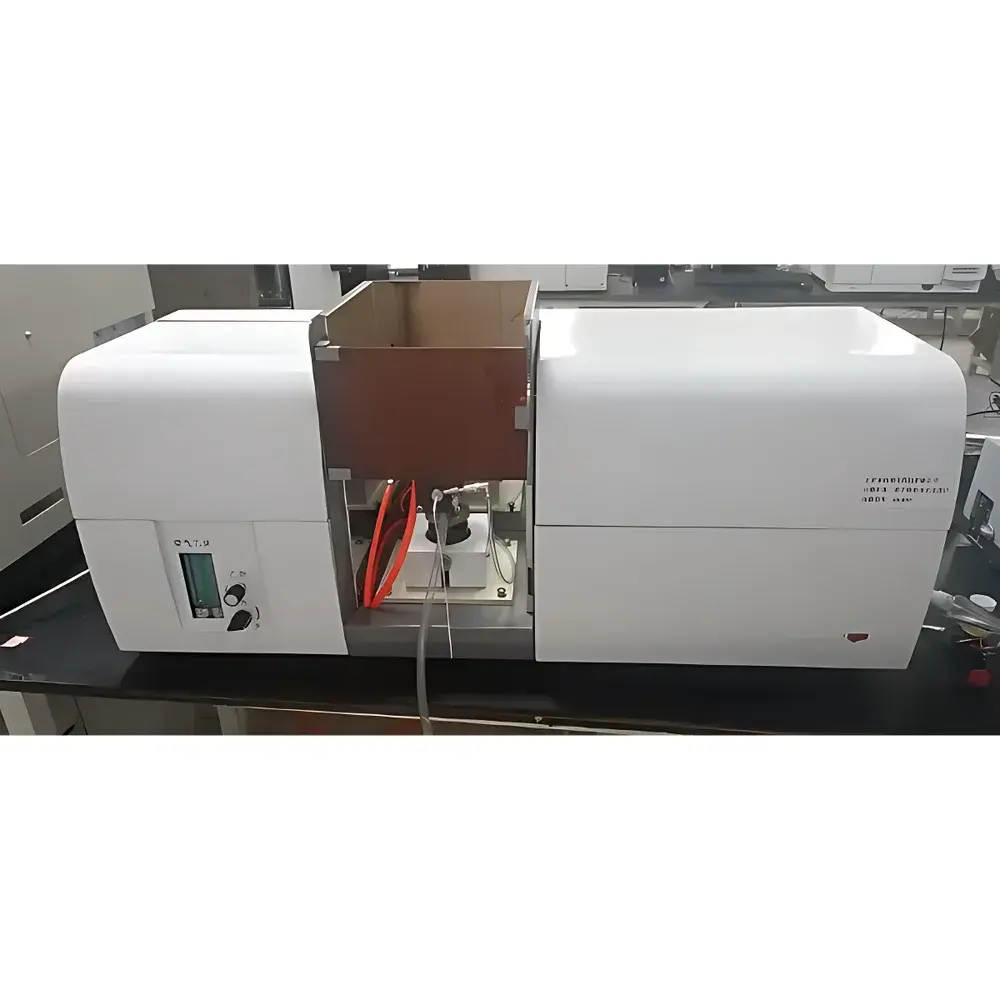
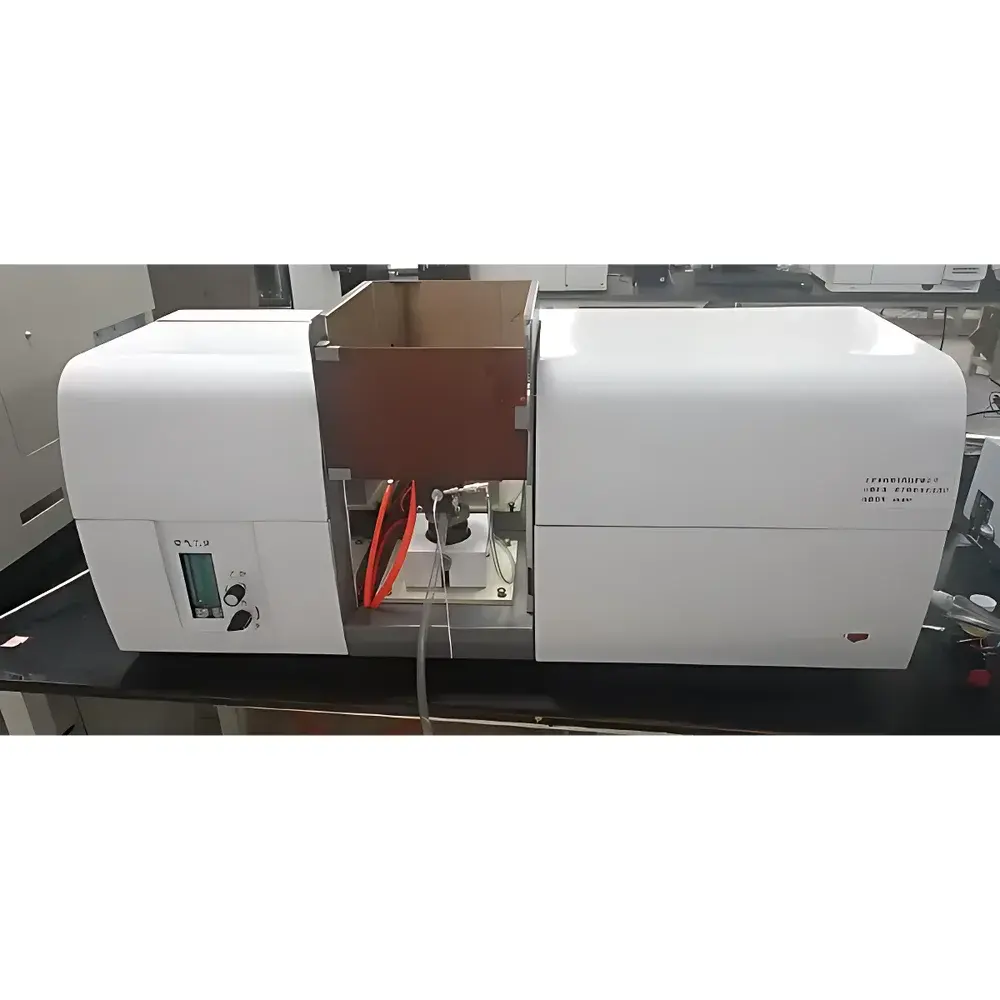
JKRD AA800 Flame Atomic Absorption Spectrometer
| Brand | JKRD |
|---|---|
| Model | AA800 |
| Type | Flame AAS |
| Origin | Beijing, China |
| Detector | Photomultiplier Tube (PMT) |
| Wavelength Range | 180–900 nm |
| Grating Density | 1800 lines/mm |
| Monochromator | Czerny-Turner |
| Spectral Bandwidths | 0.2 / 0.4 / 1.0 / 2.0 nm (auto-switching) |
| Wavelength Accuracy | ≤ ±0.1 nm |
| Wavelength Repeatability | ≤ ±0.025 nm |
| Baseline Drift | ≤ 0.003 ABS/30 min (static), ≤ 0.005 ABS/15 min (dynamic) |
| Resolution (Cu 324.7 nm, 0.2 nm BW) | ≤ 0.2 ± 0.01 nm |
| Characteristic Concentration (Cu) | 0.025 µg/mL / 1% |
| Detection Limit (Cu) | 0.006 µg/mL |
| Burner Head | Titanium, 0.5 mm × 100 mm |
| Nebulizer | High-efficiency glass-in-metal |
| Atomization Chamber | Corrosion-resistant all-plastic |
| RSD (repeatability) | ≤ 0.5% |
| Safety Features | Auto-shutoff on acetylene leak detection, flame-out protection, gas flow monitoring |
| Power Supply | AC 220 V / 50 Hz, 150 W |
| Dimensions | 1000 × 400 × 470 mm (L×W×H) |
| Weight | 70 kg |
| Software | Windows XP/Vista/7 compatible, Chinese-language AAS control & quantitation suite with linear regression calibration, multi-point standard curve fitting, statistical reporting, and RS232/USB connectivity |
Overview
The JKRD AA800 Flame Atomic Absorption Spectrometer is a benchtop analytical instrument engineered for precise, routine quantitative determination of trace metal elements in liquid samples using flame atomic absorption spectroscopy (FAAS). Based on the fundamental principle of atomic absorption—where ground-state free atoms in a flame absorb characteristic wavelengths of light emitted by a hollow cathode lamp—the AA800 enables highly selective elemental analysis across a broad spectral range (180–900 nm). Its optimized optical architecture, featuring an 1800-line/mm grating and a Czerny-Turner monochromator, delivers high wavelength fidelity and resolution, critical for distinguishing closely spaced spectral lines (e.g., Cu 324.7 nm at ≤0.2 ± 0.01 nm full width at half maximum). Designed for laboratories requiring regulatory-compliant trace metal testing—including environmental monitoring, food safety screening, agricultural feed analysis, academic research, and third-party contract testing—the AA800 meets foundational performance criteria aligned with ASTM D1688, ISO 11885, and EPA Method 7000B for flame-based metal quantification.
Key Features
- Four-position automated hollow cathode lamp turret with microprocessor-controlled positioning, enabling rapid multi-element method switching without manual realignment.
- Intelligent single-board controller with non-volatile memory for method recall, instrument parameter archiving, and user-defined protocol storage.
- Automated optimization of photomultiplier tube (PMT) high voltage, lamp current (0–10 mA average), and lamp spatial alignment to maximize signal-to-noise ratio and energy throughput.
- Dedicated titanium alloy burner head (0.5 mm × 100 mm) ensuring rapid thermal equilibrium, uniform flame geometry, and resistance to corrosion from acidic or saline matrices.
- Integrated safety architecture including real-time acetylene leak detection, automatic gas cutoff upon flame extinction, and continuous flame monitoring—fully compliant with OSHA 1910.102 and CGA G-1 guidelines for fuel gas handling.
- Multi-bandwidth selection (0.2 / 0.4 / 1.0 / 2.0 nm) with motorized slit control, allowing bandwidth optimization per element to balance sensitivity and spectral selectivity.
Sample Compatibility & Compliance
The AA800 supports aqueous and dilute acid-digested samples (e.g., HNO₃, HCl) suitable for flame atomization of over 60 metallic elements—including Na, K, Ca, Mg, Fe, Zn, Cu, Mn, Pb, Cd, and Cr. Its all-plastic雾化室 (atomization chamber) and metal-sheathed glass nebulizer ensure long-term resistance to halogen- and sulfur-containing digestates. The system operates within defined environmental limits (10–35 °C, ≤80% RH) and conforms to electromagnetic compatibility (EMC) standards IEC 61326-1 for laboratory instrumentation. While not certified under FDA 21 CFR Part 11 out-of-the-box, audit trails, electronic signature support, and data integrity features can be implemented via validated software configuration for GLP/GMP environments.
Software & Data Management
The native Windows-compatible software provides full instrument control, spectral acquisition, and quantitative analysis. It implements linear regression-based calibration with up to 99 replicate measurements per sample, automatic calculation of mean concentration, standard deviation (SD), and relative standard deviation (RSD). Data export is supported in CSV, TXT, and PDF formats; reports include full metadata (wavelength, bandwidth, lamp current, integration time, date/time stamp). USB and RS232 interfaces enable direct connection to LIMS or centralized data servers. The software architecture supports method validation documentation, including limit of detection (LOD = 0.006 µg/mL for Cu) and characteristic concentration (CC = 0.025 µg/mL / 1%) verification per ISO 8288.
Applications
- Environmental labs: Quantification of heavy metals (Pb, Cd, Ni, As) in wastewater, soil extracts, and drinking water per EPA 200.7 and ISO 17294-2.
- Food & agriculture: Monitoring essential (Fe, Zn, Cu) and toxic (Cd, Pb) elements in cereals, dairy, infant formula, and animal feed in accordance with EU Regulation (EC) No 1881/2006 and GB 5009 series standards.
- Academic research: Teaching FAAS fundamentals, method development for complex matrices, and inter-laboratory proficiency testing.
- Contract testing: High-throughput screening for regulatory compliance where cost-effective, robust flame-based analysis suffices—complementing graphite furnace or ICP-MS workflows.
FAQ
What sample preparation is required for optimal AA800 performance?
Samples must be liquid, clear, and free of particulates. Acid digestion (typically with HNO₃/H₂O₂ or HCl) is recommended for solid matrices. Final solutions should be ≤5% v/v acid concentration and filtered through 0.45 µm membrane filters prior to aspiration.
Can the AA800 be upgraded to support hydride generation or graphite furnace atomization?
Yes—the AA800 platform is mechanically and electronically compatible with optional JKRD hydrogenation (HG-AFS) and graphite furnace (GFAAS) modules, enabling sub-ppt detection limits for As, Se, Sb, Hg, and Cd without replacing the core optical system.
Is the software compliant with 21 CFR Part 11 for regulated pharmaceutical or clinical labs?
The base software does not include electronic signatures or audit trail logging by default; however, validated add-on modules are available for qualified installations requiring ALCOA+ data integrity principles.
What maintenance intervals are recommended for routine operation?
Nebulizer cleaning every 8–10 hours of runtime; burner head inspection after each 50 analyses; PMT voltage recalibration quarterly; annual optical alignment verification using certified holmium oxide or didymium filters.
Does the AA800 support sequential multi-element analysis?
No—it performs single-element analysis per lamp and wavelength setting. Multi-element capability requires method reconfiguration between elements; simultaneous multi-element analysis is not supported.





