
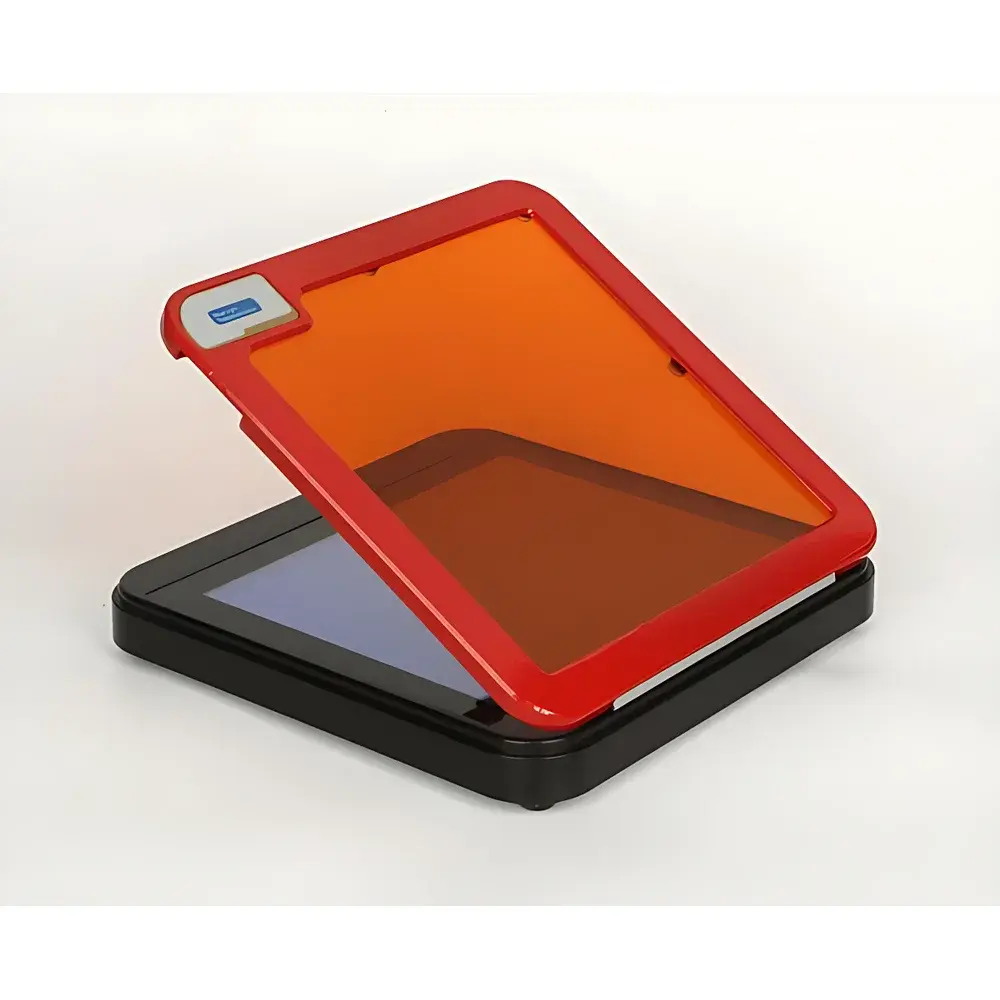
JP-BL100 Blue Light Transilluminator and Gel Cutter
| Brand | JiaPeng |
|---|---|
| Origin | Shanghai, China |
| Model | JP-BL100 |
| Instrument Type | Benchtop |
| Wavelength | 470 nm (Blue LED) |
| Viewing Area | 190 × 112 mm |
| Filter Material | Amber Acrylic with Metal Frame |
| Filter Tilt Angle | 0–145° Adjustable |
| LED Lifetime | >60,000 h |
| Power Supply | AC 220 V, 50/60 Hz |
| DC Output | 12 V, 2 A |
| Dimensions (L×W×H) | 220 × 220 × 35 mm |
| Weight | 1 kg |
| Compatible Stains | GeneGreen, GelRed, GelGreen, SYBR Green I, SYBR Safe, GoldView, SYBR Gold, SYPRO Ruby, SYPRO Orange, SYPRO Tangerine, eGFP, Cy2, FITC, Ethidium Bromide (EB) |
Overview
The JP-BL100 Blue Light Transilluminator and Gel Cutter is an engineered benchtop instrument designed for safe, high-contrast visualization and precise excision of nucleic acid and protein bands in fluorescently stained gels. Unlike conventional UV transilluminators that emit 254 nm or 302 nm ultraviolet radiation—known to induce DNA strand breaks, crosslinking, and photodamage—the JP-BL100 utilizes narrow-band 470 nm blue light emission from high-efficiency LEDs. This wavelength selectively excites common blue-light–compatible nucleic acid and protein dyes while minimizing phototoxicity to both biological samples and laboratory personnel. Its optical architecture incorporates a uniformly illuminated matrix-emitting LED array beneath a precisely calibrated amber acrylic filter, ensuring optimal signal-to-background ratio and consistent band intensity across the entire 190 × 112 mm viewing surface. The device operates without ozone generation, thermal load accumulation, or hazardous UV exposure—making it suitable for routine use in teaching labs, core facilities, and GLP-compliant molecular biology workflows where operator safety and sample integrity are primary concerns.
Key Features
- Biologically Safer Illumination: 470 nm blue LED emission eliminates UV-associated risks—including corneal photokeratitis, skin erythema, and direct DNA damage—while maintaining high sensitivity for modern fluorescent dyes.
- Optimized Optical Design: Uniform bottom-transmitted illumination via a tightly controlled LED matrix, combined with an amber acrylic filter housed in a rigid metal frame, delivers low-autofluorescence background and enhanced band contrast.
- Ergonomic & Adjustable Viewing: The amber filter panel rotates continuously from 0° to 145°, enabling optimal viewing angles for both upright observation and angled gel cutting under ambient lab lighting.
- Compact & Space-Efficient Form Factor: At only 35 mm in height and weighing just 1 kg, the JP-BL100 fits within standard lab drawers or laminar flow hoods—ideal for shared instrumentation spaces with limited benchtop real estate.
- Long-Term Operational Reliability: Industrial-grade LED chips and gold-wire bonding ensure >60,000 hours of stable output (L70 rating), eliminating frequent lamp replacements and associated calibration drift.
- Low-Power DC Operation: Internal switching power supply converts AC 220 V input to regulated 12 V / 2 A DC output, minimizing electromagnetic interference and supporting stable performance in electrically noisy environments.
Sample Compatibility & Compliance
The JP-BL100 is validated for use with a broad spectrum of commercially available fluorescent nucleic acid and protein stains, including but not limited to GeneGreen, GelRed, GelGreen, SYBR Green I, SYBR Safe, GoldView, SYBR Gold, SYPRO Ruby, SYPRO Orange, SYPRO Tangerine, eGFP, Cy2, FITC, and ethidium bromide (EB). Its 470 nm excitation profile aligns with the absorption maxima of these dyes, enabling detection at sub-nanogram DNA loading levels on agarose and polyacrylamide gels. No UV shielding or personal protective equipment (e.g., UV-blocking goggles or gloves) is required during operation—reducing procedural overhead and improving workflow continuity. While not certified to IEC 61000-4 or ISO 13845, the unit complies with general electrical safety standards for Class I laboratory equipment (GB 4793.1–2007 equivalent) and supports adherence to institutional biosafety protocols governing non-ionizing radiation exposure (ACGIH TLV® guidelines for blue light radiance).
Software & Data Management
The JP-BL100 is a standalone hardware platform with no embedded microprocessor, firmware, or digital interface. It requires no software installation, driver configuration, or network connectivity—ensuring zero cybersecurity attack surface and full compatibility with air-gapped systems. All operational parameters are fixed at manufacture; no user-adjustable settings exist beyond manual filter angle positioning. This design prioritizes reliability, reproducibility, and audit readiness: no electronic logs, timestamps, or data export functions are present, eliminating requirements for FDA 21 CFR Part 11 compliance, electronic signature validation, or ALCOA+ data integrity documentation. As such, it is ideally suited for environments where simplicity, traceability, and regulatory minimalism are valued—such as undergraduate teaching labs, QC release testing per USP , or pre-analytical sample preparation steps in ISO/IEC 17025-accredited facilities.
Applications
- Visualization and excision of DNA/RNA fragments from agarose and native or denaturing polyacrylamide gels
- Preparative gel purification prior to cloning, sequencing library construction, or mass spectrometry analysis
- Qualitative assessment of PCR amplification efficiency, restriction digest completeness, and RNA integrity
- Monitoring of protein expression and purification via SDS-PAGE stained with SYPRO dyes or Coomassie alternatives
- Teaching laboratory instruction in molecular biology techniques where UV hazard mitigation is mandated by institutional EHS policy
- Field-deployable or mobile lab applications requiring low-power, lightweight, and maintenance-free imaging support
FAQ
Does the JP-BL100 require UV-blocking eyewear or gloves during operation?
No. The 470 nm blue light emission falls outside the UV-C and UV-B spectral ranges and does not pose acute photobiological hazards to skin or ocular tissue under normal usage conditions.
Can ethidium bromide (EB)-stained gels be visualized effectively on this system?
Yes. Although EB exhibits peak excitation at ~300 nm under UV, it also demonstrates measurable fluorescence quantum yield under 470 nm blue light—particularly in high-concentration or thick-gel applications. Sensitivity is lower than with UV transilluminators, but sufficient for routine band identification and excision.
Is the amber filter replaceable or serviceable?
The amber acrylic filter is permanently mounted within a corrosion-resistant metal frame and is not designed for end-user replacement. Should optical degradation occur after extended use (>5 years), contact JiaPeng technical support for authorized recalibration or field service.
What is the recommended maximum exposure time for live-cell or sensitive protein samples?
For live-cell imaging applications (e.g., GFP-expressing cultures on agarose pads), limit exposure to ≤2 minutes per sample to prevent blue-light–induced photostress or ROS generation. For fixed samples, no time limitation applies.
Does the JP-BL100 generate heat during prolonged use?
No measurable thermal rise occurs at the gel surface (<0.5 °C increase after 30 minutes continuous operation), due to the high luminous efficacy and passive thermal management of the LED array.





