
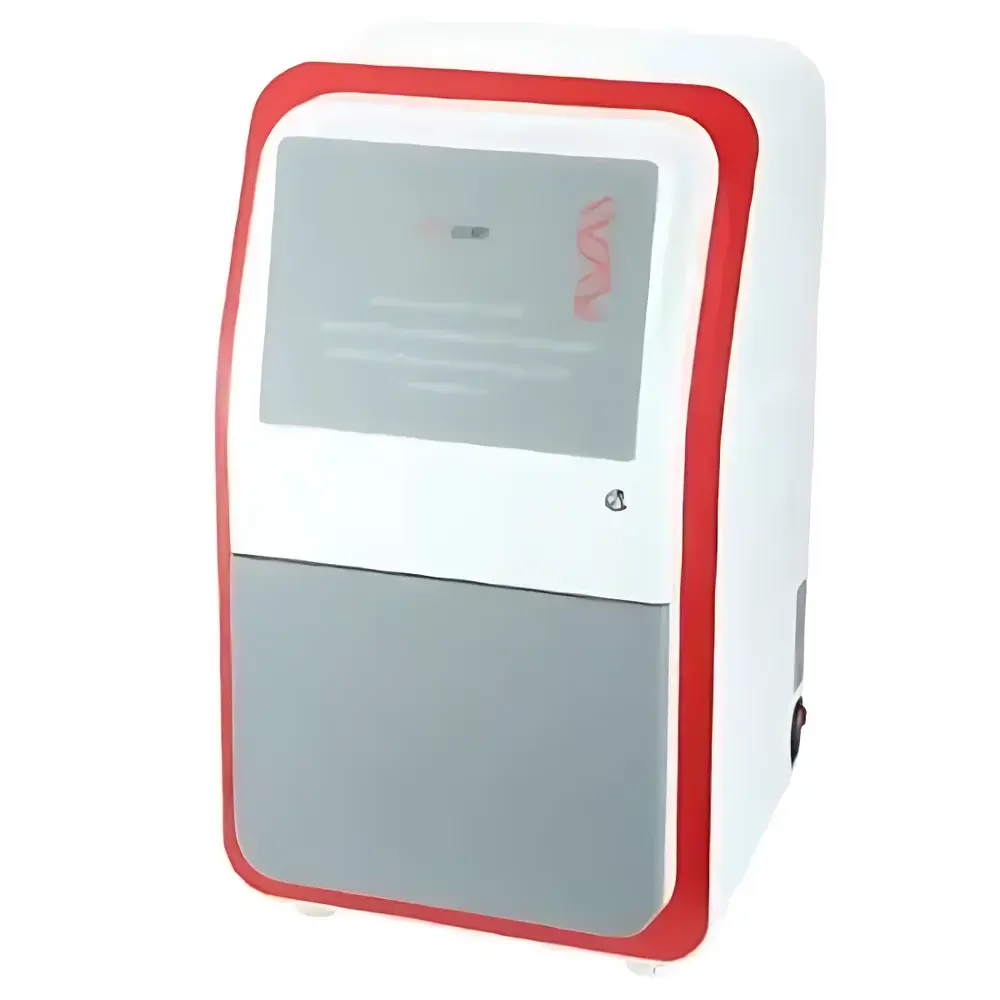
JP-K3600 Chemiluminescence Gel Imaging System
| Brand | JiaPeng |
|---|---|
| Origin | Shanghai, China |
| Model | JP-K3600 |
| Instrument Type | Chemiluminescent Gel Imaging System |
| CCD Resolution | 9 MP (3000 × 3000) |
| Bit Depth | 16-bit |
| Dynamic Range | >4.8 OD |
| CCD Sensor Size | 4/3" |
| Detection Sensitivity | Protein ≥0.02 ng, DNA ≥0.05 ng (EB-stained dsDNA ≤20 pg) |
| Signal-to-Noise Ratio | ≥56 dB |
| Lens Aperture | f/0.95 Fixed Focus Lens |
| Cooling Temperature | −45 °C (ΔT ≈ −65 °C vs ambient) |
| Pixel Size | 5.4 µm × 5.4 µm |
| Pixel Binning Options | 1×1 to 8×8 |
| White Light Transilluminator | Uniform Top-Illumination Panel |
| UV Transilluminator | 300 nm (transmission), optional 254/365 nm (reflection) |
| UV Tray Size | 200 × 200 mm |
| Filter Wheel | 5-position motorized (optional 10-position) |
| Standard Emission Filter | 590 nm |
| Dimensions (W×D×H) | 390 × 440 × 735 mm |
| Weight | 18.3 kg |
Overview
The JP-K3600 Chemiluminescence Gel Imaging System is a fully automated, multi-modal digital imaging platform engineered for high-sensitivity detection and quantitative analysis of nucleic acids and proteins in electrophoretic gels, blots, and luminescent assays. It integrates three core optical modalities—visible-light transillumination (white light), ultraviolet trans- and epifluorescence (254/300/365 nm), and low-light chemiluminescence/bioluminescence imaging—within a thermoelectrically cooled, light-tight dark chamber. The system employs a back-illuminated Sony IMX533CLK-D CMOS sensor (4/3″ format, 9 MP resolution), optimized for photon-limited applications through deep-cooling (−45 °C operational, ΔT ≈ −65 °C relative to ambient), ultra-low dark current (75% at 550 nm. Its f/0.95 fixed-focus lens maximizes photon collection per unit exposure time, enabling reliable detection of sub-nanogram protein bands and ≤20 pg EB-stained dsDNA—performance aligned with ISO 15195:2019 requirements for analytical sensitivity in molecular biology imaging.
Key Features
- Thermoelectrically cooled scientific-grade sensor operating at −45 °C to suppress thermal noise and extend usable exposure times up to 60 minutes without saturation.
- f/0.95 wide-aperture fixed-focus lens with precision anti-reflective coating; optional f/0.8 upgrade available for enhanced light throughput in ultra-low-signal applications.
- Dual-area sample stage: motorized drawer-style dual-position platform (9.5 × 9.5 cm and 12.5 × 12.5 cm fields of view) with fine Z-axis adjustment for optimal focus across heterogeneous sample thicknesses.
- Integrated white-light transilluminator with uniform illumination profile (±5% intensity variation), calibrated for consistent densitometric quantification of Coomassie- and silver-stained gels.
- UV subsystem includes 300 nm transmission source (200 × 200 mm tray) and optional 254/365 nm reflectance modules for ethidium bromide, SYBR® Safe, and other nucleic acid dyes.
- Motorized 5-position filter wheel (standard); configurable to 10-position for expanded multiplex assay support (e.g., Cy2/Cy3/Cy5, IRDye® channels).
- User-configurable auto-shutdown timer (0–60 min) for excitation sources to minimize photobleaching and extend LED lifetime.
- Optimized optical baffling and black-anodized interior surfaces reduce stray light, achieving effective background suppression for high-contrast chemiluminescent signals.
Sample Compatibility & Compliance
The JP-K3600 supports standard electrophoretic formats including agarose and polyacrylamide gels (up to 12.5 × 12.5 cm), nitrocellulose and PVDF membranes, microplates (6–96-well), and autoradiography films. Its 16-bit digitization (0–65,535 gray levels) and >4.8 optical density dynamic range ensure linear signal response across broad concentration gradients—critical for compliance with GLP/GMP documentation standards and quantitative Western blot validation per FDA Guidance for Industry (2021) and USP . All image metadata—including exposure time, binning mode, lens aperture, temperature, and filter position—is embedded in TIFF headers and exportable in FAIR-compliant formats (MIAME/MIAPE-aligned). System firmware supports audit trail logging and user access control, facilitating 21 CFR Part 11 readiness when deployed with validated software configurations.
Software & Data Management
The JP-K3600 operates with proprietary JiaPeng ImageStudio Pro v4.x software, compatible with Windows 10/11 (64-bit). The application provides real-time preview with histogram-based exposure optimization, non-linear background subtraction, band/marker detection via adaptive thresholding, and integrated molecular weight calibration using ladder interpolation. Quantitative modules include volume-integrated OD measurement, % lane normalization, and statistical comparison across replicates (ANOVA, t-test). Export options include TIFF (uncompressed), PNG, PDF, and CSV for downstream analysis in GraphPad Prism, ImageJ/Fiji, or Python-based pipelines (OpenCV, scikit-image). Raw image files retain full bit-depth fidelity and are stored with SHA-256 checksums for integrity verification during regulatory submissions.
Applications
- Quantitative Western blotting using HRP- or AP-conjugated secondary antibodies with ECL, SuperSignal™, or Luminata™ substrates.
- DNA/RNA gel documentation under UV and visible light, including restriction digest verification, PCR product sizing, and RNA integrity assessment.
- Chemiluminescent ELISA and cell-based reporter assays (e.g., luciferase, β-galactosidase) with plate-compatible adapters.
- Stain-free total protein normalization on SDS-PAGE gels using UV-activated tryptophan fluorescence.
- Long-exposure bioluminescent imaging of live-cell reporters (e.g., NF-κB, p53, circadian clock constructs) in low-oxygen environments.
- Validation of CRISPR-Cas9 editing efficiency via T7E1 or Surveyor nuclease assays imaged under UV reflection.
FAQ
What is the minimum detectable amount of protein using the JP-K3600?
The system achieves ≥0.02 ng detection sensitivity for chemiluminescently labeled proteins (e.g., HRP-conjugated IgG on PVDF), verified using standard BSA ladder dilutions under controlled dark-current conditions.
Can the JP-K3600 perform multiplex Western blotting?
Yes—when equipped with the optional 10-position filter wheel and compatible near-infrared dyes (e.g., LI-COR’s IRDye® 680RD/800CW), the system supports two-color ratiometric quantification with spectral separation and crosstalk correction algorithms.
Is the software compliant with 21 CFR Part 11 requirements?
The base software includes electronic signature capability, audit trail generation, and role-based permissions; full Part 11 compliance requires site-specific validation protocols and integration with a qualified LIMS or ELN.
Does the system support time-lapse chemiluminescence imaging?
Yes—programmable exposure sequencing allows automated acquisition of kinetic ECL decay curves over defined intervals (1 s to 30 min per frame), with metadata timestamping synchronized to system clock.
What maintenance is required for long-term performance stability?
Annual recalibration of UV intensity output and white-light uniformity is recommended; sensor cooling performance should be verified quarterly via dark-frame SNR assessment using factory-provided test protocols.





