
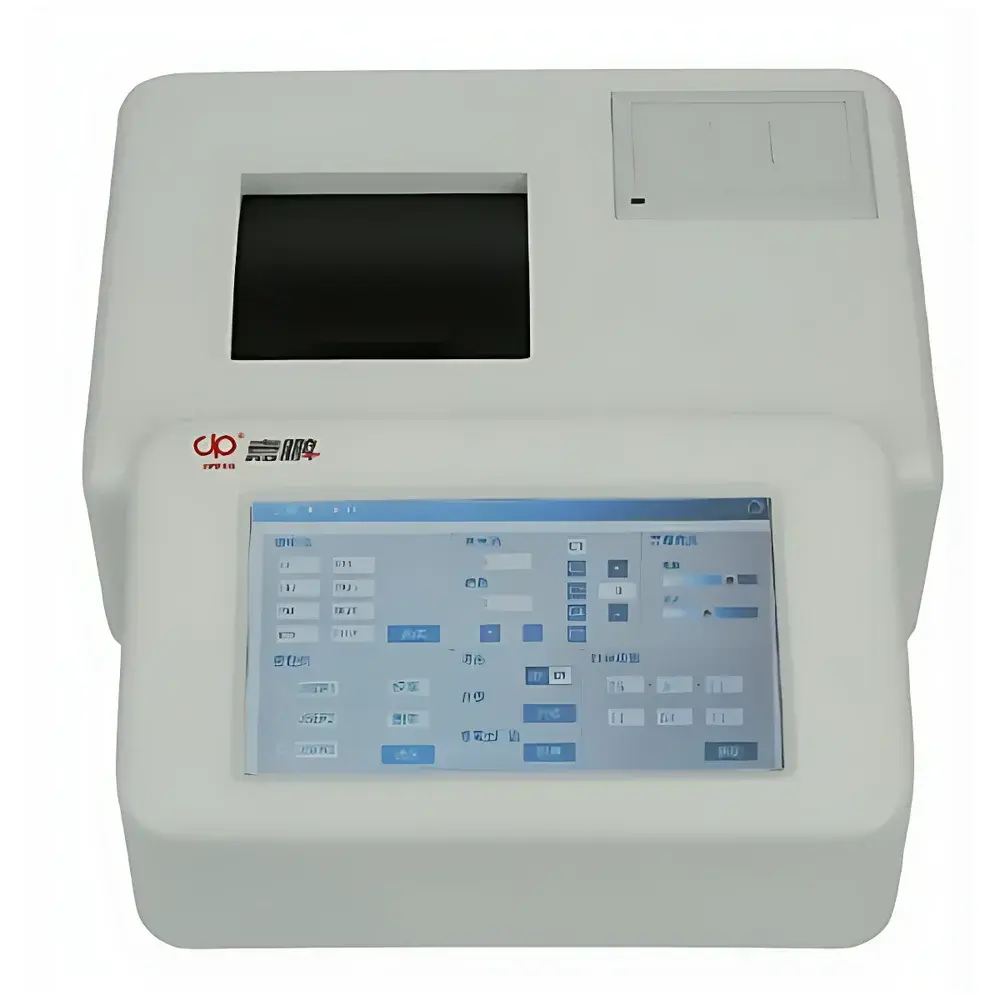
JP-Keebio600 Bacterial Concentration Spectrophotometer
| Brand | JiaPeng |
|---|---|
| Origin | Shanghai, China |
| Model | JP-Keebio600 |
| Detection Method | Absorbance Photometry |
| Wavelength | 600 nm |
| Wavelength Accuracy | ±4.0 nm |
| Spectral Bandwidth | 8 nm |
| Absorbance Range | −0.3 to 3.0 A |
| Absorbance Accuracy | ±0.005 A (0–0.5 A), ±0.01 A (0.5–1.0 A) |
| Absorbance Repeatability | 0.002 A |
| Sample Volume | ≥200 µL |
| Light Source | Long-life LED (Cold White) |
| Detector | Silicon Photodiode |
| Display | 7-inch Color Touchscreen (1024 × 600) |
| Data Storage | Internal (128 MB) + USB/SD Card Export |
| Connectivity | USB-B |
| Power Supply | AC 100–240 V, 50/60 Hz or DC 12 V / 3 A |
| Dimensions (W×D×H) | 290 × 260 × 100 mm |
| Weight | 2.15 kg |
Overview
The JP-Keebio600 Bacterial Concentration Spectrophotometer is a dedicated single-wavelength absorbance instrument engineered for rapid, reproducible quantification of microbial cell density and protein concentration in life science laboratories. Operating exclusively at 600 nm, it leverages the well-established optical density (OD600) principle—where light attenuation correlates linearly with viable bacterial or yeast cell concentration in suspension—and supports standardized colorimetric assays such as the Bradford method for total protein estimation. Unlike general-purpose microplate readers, the JP-Keebio600 employs a fixed-wavelength, single-cuvette (or single-microtube) optical path optimized for high signal-to-noise ratio and minimal stray light interference. Its solid-state LED illumination ensures thermal stability and eliminates warm-up drift, while the silicon photodiode detector provides consistent responsivity across the operational absorbance range (−0.3 to 3.0 A). Designed for benchtop use in academic teaching labs, QC microbiology workflows, and fermentation monitoring, the instrument delivers traceable, repeatable measurements without requiring spectral scanning or complex calibration routines.
Key Features
- Fixed 600 nm LED light source with 8 nm spectral bandwidth—optimized for OD600 and Bradford assay compatibility
- High-precision photometric performance: ±0.005 A accuracy in low-absorbance range (0–0.5 A), repeatability of 0.002 A
- 7-inch capacitive touchscreen interface (1024 × 600 resolution) with intuitive icon-driven navigation—no keyboard or mouse required
- Compact footprint (290 × 260 × 100 mm) and lightweight design (2.15 kg) for flexible placement in biosafety cabinets or shared lab spaces
- Minimal sample requirement: compatible with standard 1 mL cuvettes and microtubes; validated down to 200 µL sample volume
- Dual data export: internal 128 MB memory plus direct file transfer via USB-B port or SD card slot
- Integrated thermal printer for immediate hardcopy output of measurement records—including timestamp, OD value, and user ID if configured
- Robust modular architecture with isolated optical and electronic compartments to minimize cross-talk and ensure long-term baseline stability
Sample Compatibility & Compliance
The JP-Keebio600 accepts standard 10 mm pathlength cuvettes (glass, quartz, or disposable plastic) and 1.5 mL microcentrifuge tubes placed in the integrated sample holder. It is routinely deployed in accordance with ASTM E2554-22 (Standard Practice for Estimating and Monitoring Microbial Growth by Optical Density) and ISO 8199:2018 (Water quality — General guidelines for the enumeration of microorganisms by culture). While not certified for GMP-regulated environments out-of-the-box, its firmware supports audit-trail-enabling configurations (e.g., user login, timestamped data logs, and immutable export files), facilitating alignment with GLP documentation requirements. The device complies with IEC 61010-1:2010 for electrical safety and electromagnetic compatibility (EMC Class B).
Software & Data Management
The embedded operating system features a real-time data acquisition engine with automatic zeroing, blank subtraction, and linear regression fitting for OD vs. concentration curves. Measurement results are stored with metadata including date/time, operator ID (optional), and instrument serial number. Export formats include CSV (comma-separated values) and PDF (for printed reports), both compliant with FDA 21 CFR Part 11 when used in conjunction with institutional access controls and electronic signature policies. No proprietary software installation is required—data retrieval is accomplished via plug-and-play USB mass storage mode or SD card readout on any Windows/macOS/Linux host.
Applications
- Monitoring E. coli, Bacillus subtilis, Saccharomyces cerevisiae, and other model organisms during exponential growth phase
- Standardizing inoculum density prior to transformation, electroporation, or fermentation scale-up
- Quantifying total protein in lysates using Bradford reagent (λmax ≈ 595 nm; 600 nm provides optimal signal fidelity)
- Validating sterilization efficacy by measuring residual turbidity in filtered media or buffer solutions
- Supporting undergraduate microbiology labs where simplicity, reliability, and cost-efficiency are prioritized over multi-wavelength flexibility
FAQ
What is the maximum measurable OD value, and how is linearity maintained at high concentrations?
The JP-Keebio600 supports an absorbance range from −0.3 to 3.0 A. At OD values >2.0 A, users are advised to dilute samples to remain within the validated linear range (0.1–1.5 A), where photometric accuracy is highest. The instrument’s optical design minimizes detector saturation through calibrated LED intensity control and analog front-end gain staging.
Can the device be used with non-standard cuvettes or microplates?
It is designed for single-channel detection only and does not support microplate formats. Use of non-10 mm pathlength cuvettes requires manual correction of OD values using Beer-Lambert law scaling factors.
Is wavelength calibration required by the user?
No. The 600 nm LED is factory-aligned and thermally stabilized; no field recalibration is necessary under normal operating conditions (15–30 °C ambient).
Does the instrument meet regulatory requirements for pharmaceutical QC?
While suitable for in-process checks and R&D applications, formal GMP compliance requires supplementary validation documentation (IQ/OQ/PQ), which can be supported by the manufacturer upon request.
How is data integrity ensured during power interruption?
All measurements are written to non-volatile memory immediately upon acquisition. The internal battery-backed real-time clock maintains accurate timestamps even during AC power loss.





