
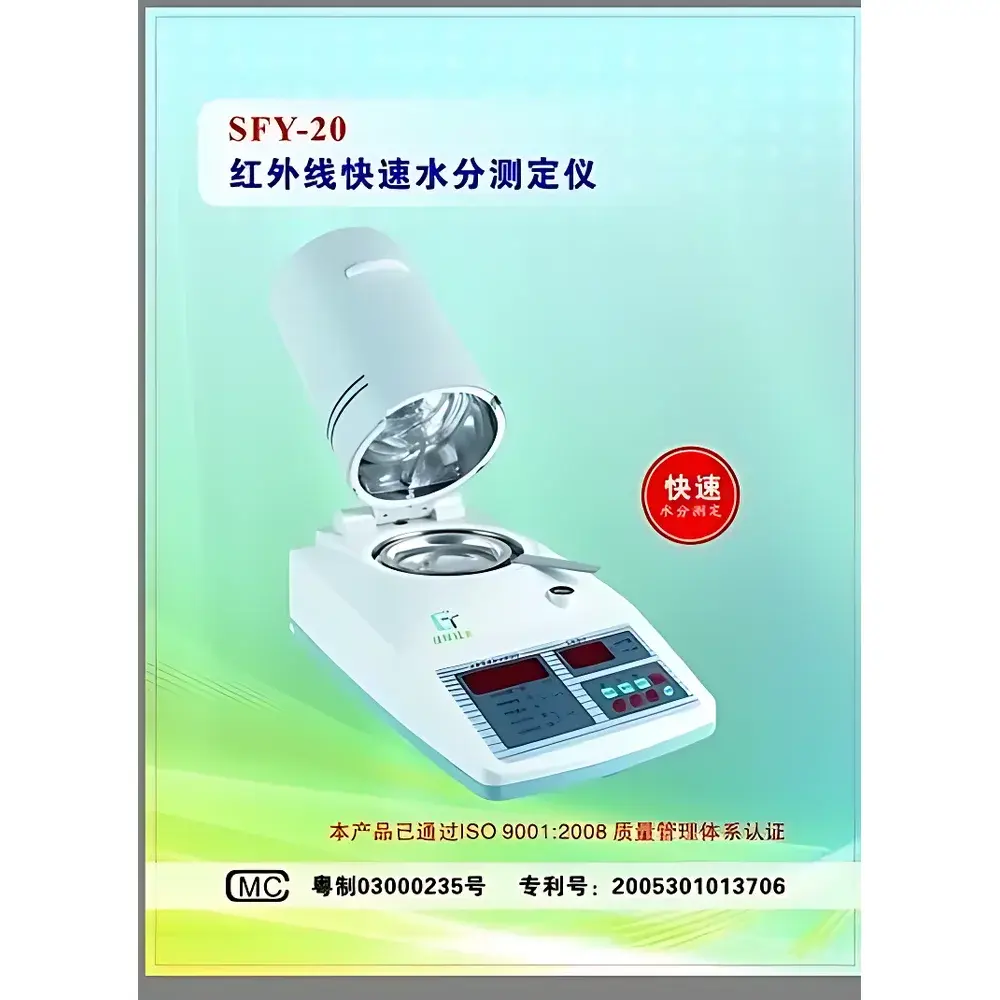
JQR SFY-20 Halogen Rapid Moisture Analyzer for Plastics and General Laboratory Use
| Origin | Guangdong, China |
|---|---|
| Manufacturer Type | Authorized Distributor |
| Origin Category | Domestic (PRC) |
| Model | SFY-20 |
| Price | USD 1,890 (FOB Guangdong) |
| Weighing Range | 0–90 g |
| Moisture Measurement Range | 0.01–100% |
| Minimum Readability | 0.001 g |
| Sample Mass | 0.5–90 g |
| Heating Temperature Range | Ambient to 205 °C |
| Heating Method | Variable Hybrid Halogen Heating |
| Auto Temperature Compensation | ±15 °C |
| Moisture Resolution | 0.01% |
| Display Modes | 7 Parameters (Moisture %, Initial/Final Mass, Test Duration, Initial/Final Temp, Endpoint Detection Time) |
| Interface | Dual RS-232 (Printer & PC) |
| Dimensions (W×D×H) | 380 × 205 × 325 mm |
| Power Supply | 220 V ±10%, 50 Hz ±1 Hz |
| Net Weight | 3.7 kg |
Overview
The JQR SFY-20 Halogen Rapid Moisture Analyzer is a precision laboratory instrument engineered for fast, gravimetric moisture determination using halogen lamp heating coupled with high-resolution analytical weighing. It operates on the loss-on-drying (LOD) principle: a sample is heated under controlled thermal conditions while its mass is continuously monitored; moisture content is calculated as the percentage mass loss relative to the initial sample weight. Unlike traditional oven-drying methods requiring hours, the SFY-20 delivers repeatable results in minutes—making it suitable for high-throughput quality control environments where speed, traceability, and consistency are critical. Designed specifically for heterogeneous materials—including thermoplastic resins, polymer granules, pharmaceutical excipients, food powders, and agricultural commodities—the instrument features an integrated halogen heating system optimized for uniform thermal distribution and minimal thermal lag, ensuring reproducible endpoint detection across diverse sample matrices.
Key Features
- High-precision JQR load cell with 0.001 g readability and built-in auto-calibration routines to mitigate drift from temperature or time-dependent effects
- Variable hybrid halogen heating system with programmable ramp profiles and real-time temperature feedback, enabling precise thermal control from ambient up to 205 °C
- Intelligent endpoint detection algorithm that dynamically adjusts termination criteria based on mass stabilization rate—eliminating manual timer dependency
- Seven-parameter red LED display (moisture %, initial/final mass, test duration, initial/final temperature, endpoint confirmation time) optimized for visibility under varied ambient lighting conditions
- Dual RS-232 ports supporting simultaneous connection to external printers and host PCs for audit-ready data export and long-term record retention
- Compact footprint (380 × 205 × 325 mm) and lightweight design (3.7 kg) facilitate integration into QC labs, production line stations, or mobile testing units
Sample Compatibility & Compliance
The SFY-20 accommodates a broad spectrum of physical sample forms without pre-processing: free-flowing powders, granular polymers (e.g., ABS, PP, PET), fibrous textiles, moist pastes, viscous slurries, and thin-film specimens. Its adjustable sample pan geometry and optimized airflow path minimize edge effects and ensure consistent heat transfer—even for low-density or high-surface-area materials. While not certified to ISO 8573 or ASTM D4456 as a standalone metrological standard, the instrument supports GLP/GMP-aligned workflows through traceable calibration logs, user-accessible service diagnostics, and configurable data output formats compatible with LIMS integration. All firmware operations comply with IEC 61000-4 electromagnetic compatibility standards, and electrical safety meets GB 4793.1–2019 (equivalent to IEC 61010-1).
Software & Data Management
Data acquisition and reporting are fully configurable via optional PC software compliant with FDA 21 CFR Part 11 requirements—including electronic signatures, audit trails, and role-based access control. Raw mass vs. time datasets, temperature profiles, and final moisture calculations are timestamped and exportable in CSV or XML format. Printer output includes operator ID, sample ID, batch number, environmental conditions (if logged externally), and pass/fail status against user-defined specification limits. Internal memory retains up to 100 test records with full parameter metadata, accessible for review without external connectivity.
Applications
This analyzer serves as a primary moisture verification tool in regulated and non-regulated settings alike: incoming raw material inspection for plastic pellet suppliers (per ISO 62/ISO 1183); in-process moisture monitoring during extrusion or drying stages; final product release testing for pharmaceutical tablet granulations (aligned with USP guidance); QC screening of hygroscopic food ingredients (e.g., starches, whey protein, maltodextrin); and R&D studies evaluating desiccant efficiency or polymer hydrolysis kinetics. Its adaptability extends to academic research in polymer science, food engineering, and agricultural post-harvest technology—where rapid LOD screening accelerates method development cycles.
FAQ
What calibration standards are recommended for routine verification?
NIST-traceable sodium tartrate dihydrate (15.66% H₂O) and anhydrous calcium sulfate are advised for two-point verification across the measurement range.
Can the SFY-20 be used for volatile organic compound (VOC) analysis?
No—it measures total volatile loss as moisture equivalent; dedicated GC or headspace analysis is required for VOC speciation.
Is temperature compensation active during the entire heating cycle?
Yes—the microprocessor applies real-time thermal drift correction to both heating element output and load cell signal throughout the assay.
Does the instrument support custom drying protocols?
Not natively; it uses fixed-rate heating with adaptive endpoint logic. For multi-stage thermal programs, consider the JQR SFY-30 series with programmable step profiles.
How often should the halogen lamp be replaced?
Typical service life exceeds 5,000 hours; replacement is indicated by inconsistent heating response or visible filament degradation observed during maintenance inspection.






