
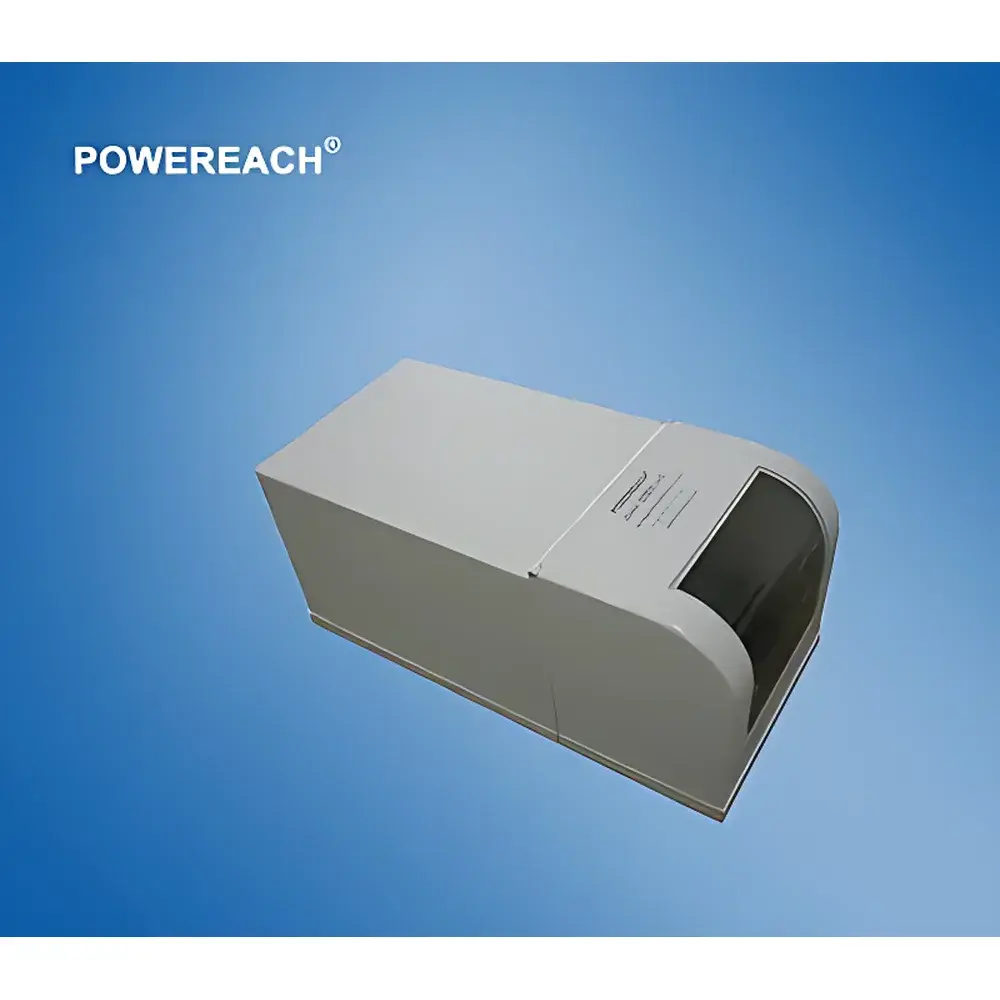
JS94JM Zeta Potential Analyzer (Microelectrophoresis Instrument)
| Origin | Beijing, China |
|---|---|
| Manufacturer Type | Authorized Distributor |
| Origin Category | Domestic (China) |
| Model | JS94JM |
| Price Range | USD 7,000–14,000 |
| Zeta Potential Range | ±3000 mV |
| pH Operating Range | 2.0–12.0 (extended range: 1.6–13.0, resolution: 0.1) |
| Temperature Operating Range | 5–35 °C (resolution: 0.1 °C) |
| Accuracy | ≤5% |
| Repeatability | ≤5% |
| Particle Size Applicability | 0.1–10 µm (aqueous dispersions) |
| Sample Volume per Measurement | 0.5 mL |
| Optical System | Semiconductor-based near-field illumination (blue/green wavelengths), magnification ≥1200× |
| Voltage Polarity Switching Time | 0.30–1.20 s (adjustable) |
| Sampling Duration | 3–10 s |
| Power Supply | 220 V AC, 50 Hz, 150 W |
Overview
The JS94JM Zeta Potential Analyzer is a microelectrophoresis instrument engineered for precise determination of electrophoretic mobility and surface charge characteristics of colloidal particles and dispersed phase droplets in aqueous media. It operates on the principle of laser-assisted microelectrophoresis—applying a controlled electric field across a precisely fabricated capillary cell while optically tracking particle displacement via high-magnification (≥1200×), low-power semiconductor illumination (blue/green wavelengths). The system computes zeta potential using the Henry equation with Smoluchowski or Hückel approximations, depending on particle size and medium conductivity. Designed for laboratory-scale analysis rather than process monitoring, the JS94JM delivers quantitative surface charge data critical for understanding colloidal stability, interfacial reactivity, and electrokinetic behavior in formulations ranging from pharmaceutical nanosuspensions to mineral flotation slurries.
Key Features
- Proprietary open-cup electrophoresis cell constructed from 0.5 mm-thick optical-grade borosilicate glass, with integrated Ag/AgCl, Pt, and Ti electrodes subjected to controlled surface passivation for stable current distribution and minimized polarization effects.
- Optimized microfluidic geometry validated by computational fluid dynamics (CFD) modeling to eliminate stagnant layer artifacts at the electrode–solution interface—enabling accurate mobility measurement without boundary correction assumptions.
- Three-axis precision stage with calibrated crosshair reticle ensures reproducible optical alignment; real-time image capture of particle trajectories under bidirectional field reversal eliminates operator-dependent focusing errors.
- Low-power (<50 µW) near-field optical excitation minimizes localized thermal convection, preserving hydrodynamic equilibrium during measurement—critical for submicron particle tracking in low-conductivity buffers.
- Programmable polarity-switching power supply (0.30–1.20 s dwell time) combined with synchronized 3–10 s acquisition windows enables rapid, statistically robust mobility averaging across multiple field cycles.
- Integrated Pt100 temperature probe provides continuous ambient feedback to the control software, automatically compensating viscosity and dielectric constant inputs used in zeta potential calculation per ISO 13099-2:2012.
Sample Compatibility & Compliance
The JS94JM supports aqueous dispersions with particle diameters between 0.1 µm and 10 µm, including latex standards, metal oxides (e.g., SiO₂, TiO₂), polymeric nanoparticles, liposomes, and protein aggregates. Its pH range (2.0–12.0, extendable to 1.6–13.0) accommodates acidic catalysts, alkaline cementitious systems, and biological buffers. While not certified for GMP environments, the instrument’s design aligns with key principles of GLP-compliant operation: traceable calibration (via NIST-traceable zeta standard suspensions), audit-ready parameter logging, and user-accessible raw trajectory images for method validation. It complies with core metrological requirements outlined in ASTM D7824–18 and ISO 13099-1:2012 for electrophoretic light scattering instrumentation.
Software & Data Management
Bundled Windows-based acquisition software performs real-time particle tracking using centroid-based gray-level analysis across four consecutive frames (two per field direction). Output includes electrophoretic mobility histograms, zeta potential distributions (mean ± SD), and isoelectric point (IEP) estimation via pH titration series. All raw image sequences, voltage/time stamps, temperature logs, and calculated parameters are stored in vendor-neutral CSV and TIFF formats. Software supports export to third-party statistical packages (e.g., OriginLab, MATLAB) and permits manual override of dielectric constant or viscosity inputs when non-standard media are employed. No FDA 21 CFR Part 11 compliance features (e.g., electronic signatures, role-based access) are included—intended for R&D and quality control labs operating under internal SOPs.
Applications
- Formulation development in cosmetics (emulsion stability prediction via IEP mapping)
- Mineral processing optimization (surface charge modulation of ore slurry particles)
- Pharmaceutical colloidal delivery systems (zeta–pH profiling of liposomal or polymeric nanocarriers)
- Water treatment coagulant selection (charge neutralization thresholds for clay/ferric hydroxide suspensions)
- Academic teaching laboratories (hands-on demonstration of DLVO theory, Stern layer modeling, and electrophoretic mobility–zeta conversion)
- Cement chemistry research (early-age hydration kinetics inferred from C-S-H colloid charge evolution)
FAQ
What sample volume is required per measurement?
Each analysis consumes only 0.5 mL of dispersion, minimizing reagent cost and enabling high-throughput screening of formulation variants.
Can the instrument measure zeta potential in non-aqueous media?
No—the optical and electrokinetic design is optimized for aqueous systems with conductivity below 20 mS/m; organic solvents require dedicated high-voltage or acoustic-electrokinetic platforms.
Is temperature control built into the instrument?
The unit includes a high-resolution temperature sensor but lacks active Peltier cooling/heating; users must perform measurements in an externally stabilized environment (±0.5 °C) on a vibration-isolated bench.
How is electrode polarization mitigated during measurement?
Through low-frequency field reversal (0.3–1.2 s duty cycle) combined with inert metal electrodes (Pt/Ti) and surface-treated Ag/AgCl references—reducing Faradaic overpotential and maintaining linear current–voltage response.
Does the system support automated pH titration?
No—pH adjustment must be performed manually between runs; however, the software allows batch import of multi-pH datasets for IEP curve fitting.



