
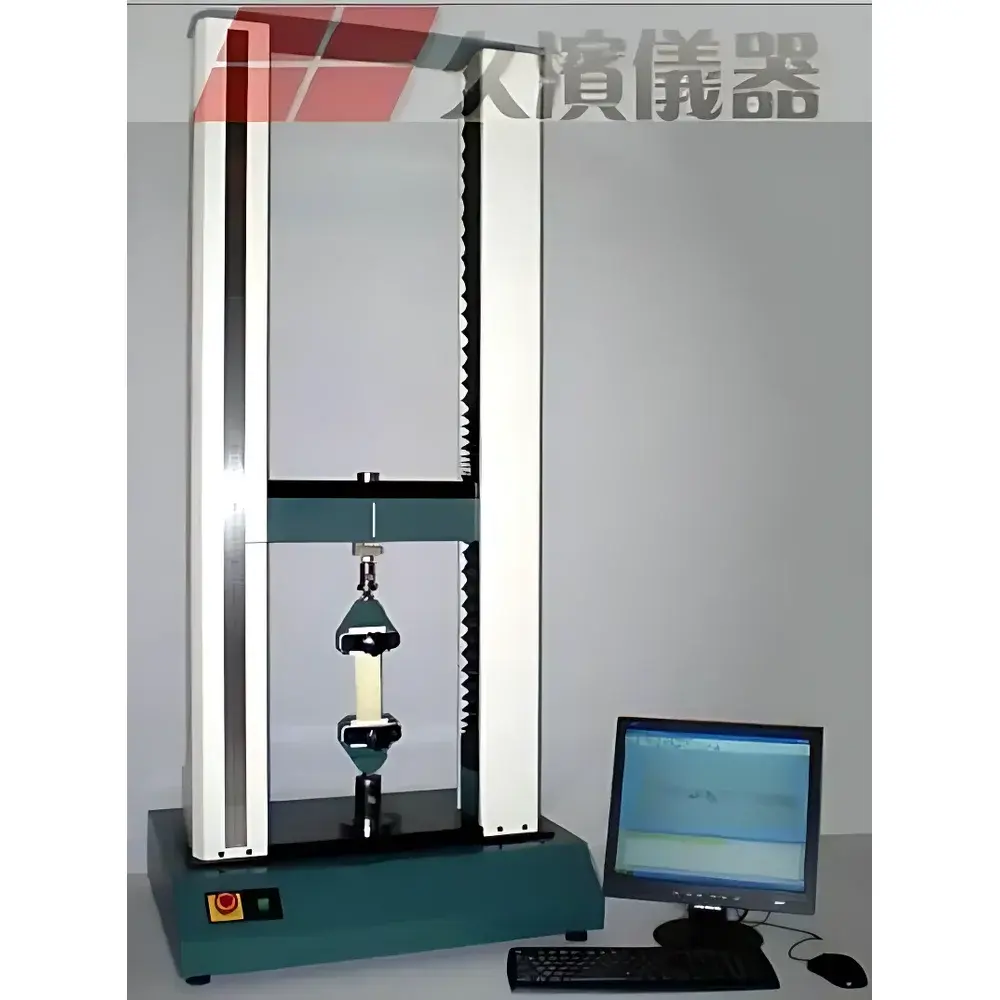
JuBin JB-121 Series Universal Tensile Testing Machine
| Brand | JuBin |
|---|---|
| Model | JB-121 |
| Capacity Range | 0–5 kN (user-selectable) |
| Load Cell Accuracy | ±0.5% of full scale |
| Effective Test Width | 380 mm |
| Max. Traverse Travel | 1000 mm |
| Test Speed Range | 0.001–500 mm/min (infinitely variable) |
| Displacement Resolution | 1/200,000 |
| Positioning Accuracy | ±0.005% of full stroke |
| Control System | Servo motor (Japan-made) + AC motor (Taiwan-made) |
| Mechanical Drive | Precision ball screw (Taiwan-made) + High-strength backlash-free screw (Korea-made) |
| Safety Features | Upper/lower mechanical limits, emergency stop button |
| Display Interface | Dual-mode — PC-based software + embedded microcomputer display |
| Power Supply | 220 V, 50 Hz |
| Net Weight | 1080–1180 kg |
| Dimensions (W×D×H) | 1280 × 950 × 1800 mm |
| Compliance | Designed for ASTM E4, ISO 7500-1, GB/T 228.1, and general QC/QA laboratory requirements |
Overview
The JuBin JB-121 Series Universal Tensile Testing Machine is an electromechanically integrated materials testing system engineered for precision mechanical property evaluation under controlled quasi-static loading conditions. Based on the fundamental principles of uniaxial force-displacement measurement, it applies calibrated tensile, compressive, flexural, and shear loads to standardized or custom specimens while continuously recording load, displacement, and strain data in real time. Its modular architecture supports both manual operation via embedded microcontroller interface and fully automated execution through dedicated PC-based control software—making it suitable for routine quality control laboratories, R&D centers, and accredited testing facilities requiring traceable, repeatable mechanical characterization per international standards.
Key Features
- Modular load frame with dual-drive configuration: high-torque servo motor (Japan-sourced) for low-speed high-precision testing and robust AC motor (Taiwan-sourced) for rapid positioning and high-throughput operation.
- High-fidelity load measurement using U.S.-manufactured precision load cells, certified to ±0.5% accuracy across the full 0–5 kN range, with internal auto-zero and calibration verification routines.
- Ultra-stiff mechanical transmission system featuring Taiwan-sourced ground ball screws and Korea-sourced zero-backlash lead screws, ensuring minimal deflection and long-term dimensional stability during cyclic or creep testing.
- Infinitely variable speed control from 0.001 to 500 mm/min, programmable in both constant-rate and multi-segment profiles to emulate real-world loading histories.
- Dual-display architecture: real-time waveform visualization and parameter monitoring via Windows-based software, complemented by a standalone microcomputer interface for quick setup and offline diagnostics.
- Comprehensive safety infrastructure including mechanical upper/lower travel limits, redundant emergency stop circuitry, and automatic overload cutoff at 110% of selected capacity.
- Resolution of 1 part in 200,000 for displacement feedback, enabling sub-micron positional repeatability over extended test durations.
Sample Compatibility & Compliance
The JB-121 accommodates a broad spectrum of specimen geometries and material classes—including metallic wires and sheets, polymer films and molded parts, elastomeric compounds, textile yarns and fabrics, leather strips, rubber gaskets, and composite laminates—via interchangeable jaw configurations (tensile grips, compression platens, three-point bend fixtures, and shear adapters). All hardware and firmware are designed to support compliance with ASTM E4 (Standard Practices for Force Verification of Testing Machines), ISO 7500-1 (Metallic Materials – Calibration of Force-Testing Machines), and GB/T 228.1 (Metallic Materials – Tensile Testing – Part 1: Method of Test at Room Temperature). The system supports audit-ready data logging aligned with GLP/GMP documentation practices, including user authentication, electronic signatures, and timestamped event tracking.
Software & Data Management
The included Windows-compatible testing software provides full control over test sequencing, parameter definition, real-time curve plotting (load vs. displacement, stress vs. strain), and post-test analysis. It enables customizable report generation compliant with internal QA templates or external regulatory formats (e.g., PDF, Excel, CSV). Advanced features include group curve overlay for comparative analysis, automatic yield point detection (0.2% offset method), modulus calculation via linear regression, and pass/fail threshold enforcement. Data files retain full metadata—operator ID, environmental conditions (if externally logged), calibration history, and instrument configuration—for full traceability. Optional modules support FDA 21 CFR Part 11 compliance, including electronic signature validation and immutable audit trails.
Applications
This universal tester is routinely deployed in industrial quality assurance labs for routine verification of mechanical specifications including ultimate tensile strength (UTS), yield strength, elongation at break, Young’s modulus, compressive yield stress, flexural modulus (per ASTM D790), and peel/adhesion strength (per ASTM D903). It serves as a primary tool in supplier qualification programs, incoming material inspection, process validation studies, and failure mode analysis. In academic and government research settings, it supports fundamental studies on viscoelastic behavior, creep response, and fatigue precursor characterization—particularly when integrated with optional extensometers or environmental chambers.
FAQ
What standards does the JB-121 comply with for calibration and verification?
It meets the metrological requirements of ISO 7500-1 Class 1 and ASTM E4 for force measurement systems, and its mechanical design conforms to ISO 5893 for testing machine performance criteria.
Can the system be used for creep or stress-relaxation testing?
Yes—when configured with appropriate load-hold protocols and extended-duration data logging, it supports ISO 899-1 and ASTM D2990 creep testing up to 1000 hours, subject to ambient temperature control.
Is third-party certification available for ISO/IEC 17025 accreditation?
Factory calibration certificates are provided; users may engage ISO/IEC 17025-accredited laboratories for on-site verification and uncertainty reporting.
Does the software support multi-user access with role-based permissions?
Yes—the enterprise version includes configurable user roles (operator, supervisor, administrator) with granular control over method editing, result modification, and report export privileges.
What is the recommended maintenance interval for mechanical components?
Ball screw lubrication and drive belt tension verification are advised every 6 months or 500 operational hours, whichever occurs first; load cell recalibration is recommended annually or after any impact event.



