
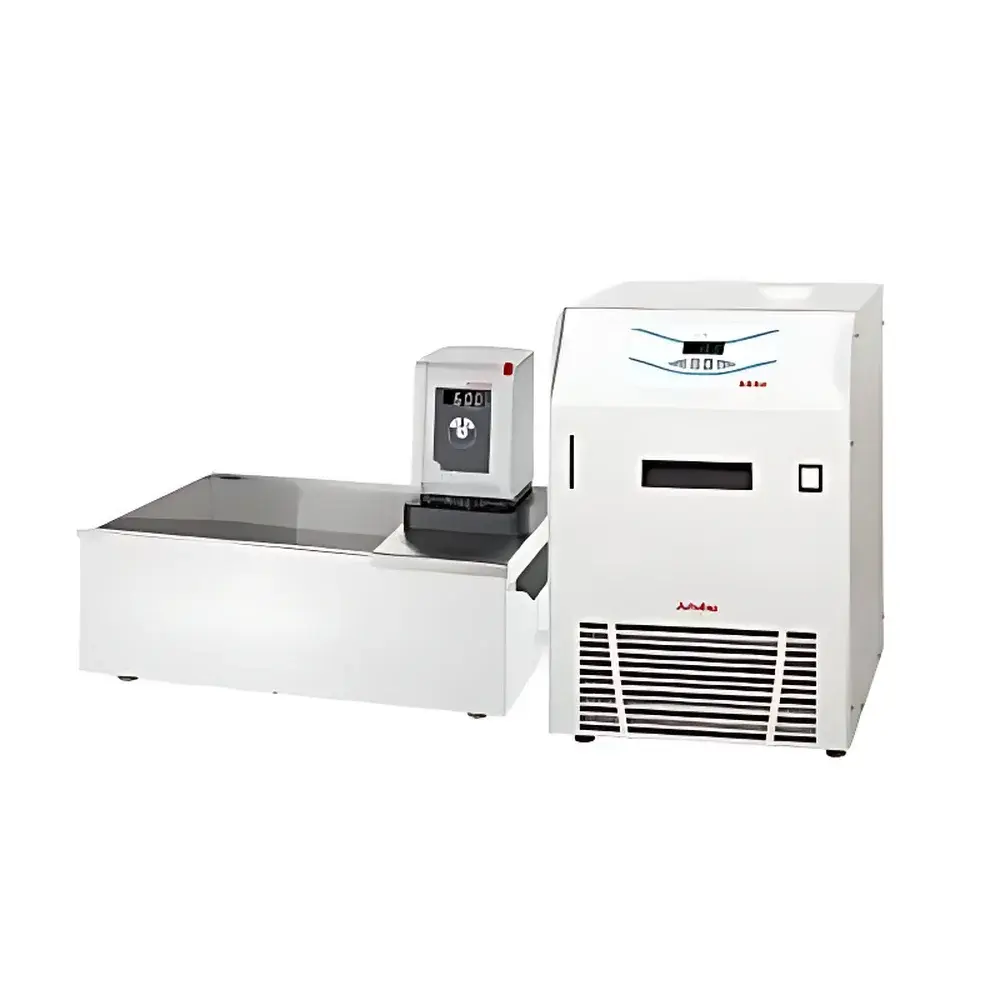
Julabo C-19L Circulating Chiller Bath
| Brand | Julabo |
|---|---|
| Origin | Germany |
| Model | C-19L / CD-33L |
| Bath Volume | 19–33 L |
| Temperature Range | 10–40 °C |
| Temperature Stability | ±0.03 °C |
| Circulation Type | Internal & External |
| Cooling/Heating Mode | Dual-function |
| Pump Flow Rate | 6–15 L/min @ 0.1–0.35 bar |
| Bath Opening × Depth (W×L/D) | 36×39×15 cm / 66×32×15 cm |
| External Dimensions (W×L×H) | 57×33×37 cm / 91×36×43 cm |
Overview
The Julabo C-19L Circulating Chiller Bath is a precision-engineered temperature control system designed for laboratory applications requiring stable, reproducible thermal management of external equipment or sample environments. Operating on a closed-loop refrigeration and heating principle, the unit integrates a hermetically sealed compressor, high-efficiency plate heat exchanger, and PID1 + ACC (Adaptive Control Compensation) temperature regulation algorithm to maintain setpoint accuracy across dynamic load conditions. Unlike basic immersion baths, the C-19L delivers active temperature control via dual-mode operation—simultaneously cooling and heating—to compensate for ambient fluctuations or exothermic/endothermic processes in connected apparatus (e.g., spectrophotometers, viscometers, reactors, or chromatography columns). Its operational envelope—10 to 40 °C—with ±0.03 °C stability at setpoint reflects compliance with ISO 17025 metrological requirements for controlled environment instrumentation. The bath is constructed entirely from electropolished stainless steel (AISI 316-grade wetted parts), ensuring long-term resistance to corrosion, mineral scaling, and organic residue accumulation—critical for GMP-compliant QC labs and multi-user academic facilities.
Key Features
- PID1 + ACC adaptive temperature control algorithm enables rapid settling time (<15 min from 25 °C to 20 °C at full load) and minimizes overshoot under variable thermal loads.
- ATC1 (Automatic Temperature Calibration) function allows single-point user calibration at any temperature within the operating range—traceable to NIST-certified reference thermometers—ensuring ongoing accuracy without third-party service intervention.
- Dual-circulation architecture supports both internal bath homogenization and external flow-through applications via adjustable pressure-rated pump (6–15 L/min, max 0.35 bar), compatible with tubing up to 10 mm ID and line lengths ≤8 m.
- Integrated safety systems include overtemperature cut-off (hardware-latched relay), low-level float switch with audible/visual alarm and automatic power disconnection, and lockable IEC 60320 C14 power inlet compliant with EN 60950-1.
- Thermally optimized chassis design features rear-mounted condenser with forced-air convection, isolated electronic compartment, and ≥40 mm clearance around all heat-generating components—validated for continuous 24/7 operation at 35 °C ambient.
- Intuitive membrane keypad interface with real-time display of bath temperature, setpoint, pump status, and active alarms; supports standby mode and programmable auto-start timers aligned with lab shift schedules.
Sample Compatibility & Compliance
The C-19L is suitable for temperature stabilization of diverse external devices including UV-Vis spectrophotometers, rotary evaporators, laser sources, and analytical balances requiring thermal drift mitigation. Its stainless-steel bath chamber accommodates standard laboratory glassware (up to 5 L jacketed reactors) and permits direct immersion of temperature-sensitive probes (e.g., Pt100, thermistors) without chemical interaction. The unit meets CE marking requirements per EU Directive 2014/30/EU (EMC) and 2014/35/EU (LVD), conforms to RoHS 2011/65/EU, and supports audit-ready documentation packages for GLP and ISO/IEC 17025 accreditation. Optional calibration certificates (traceable to DAkkS-accredited labs) and IQ/OQ protocols are available upon request.
Software & Data Management
While the C-19L operates as a standalone instrument, its RS232 interface enables integration into centralized lab monitoring networks via optional Julabo LabSoft software (Windows-based). This platform supports real-time temperature logging, alarm event timestamping, user-access-level configuration (admin/operator), and export of CSV-formatted datasets compliant with FDA 21 CFR Part 11 requirements—including electronic signatures, audit trails, and data integrity validation. All internal firmware updates preserve calibration constants and user-defined parameters without reset.
Applications
- Stabilizing optical path temperatures in FTIR and Raman spectrometers to reduce baseline drift.
- Maintaining constant jacket temperature during polymer solution viscosity measurements (ASTM D2196).
- Providing coolant supply to HPLC column ovens and detector flow cells to improve retention time reproducibility (USP & EP monographs).
- Controlling reaction temperature in small-scale catalytic screening setups where precise ΔT control impacts selectivity (e.g., asymmetric hydrogenation).
- Calibration reference baths for secondary thermometer verification per ISO/IEC 17025 Clause 6.5.2.
FAQ
What is the maximum external loop pressure this chiller bath can sustain?
The integrated pump delivers up to 0.35 bar static pressure at minimum flow (6 L/min); system backpressure must remain below 0.3 bar to ensure stable circulation and avoid pump cavitation.
Can the C-19L operate continuously at 10 °C in a 30 °C ambient room?
Yes—its refrigeration system is rated for continuous duty at full capacity down to 10 °C ambient delta, validated per EN 60068-2-1 (cold testing) and EN 60068-2-2 (dry heat).
Is the bath fluid level sensor field-serviceable?
The magnetic float switch assembly is accessible via the rear service panel and requires no recalibration after replacement—part number 9011419-01 is stocked globally.
Does Julabo provide validation documentation for GMP environments?
Yes—Factory Acceptance Test (FAT) reports, Installation Qualification (IQ), and Operational Qualification (OQ) templates are included with each unit; site-specific Performance Qualification (PQ) support is available through Julabo’s certified field engineers.
How often does ATC1 calibration require verification?
Julabo recommends annual verification against a traceable reference standard; however, the built-in self-diagnostic routine checks sensor linearity and heater response every 72 hours during operation.
Related Products



