
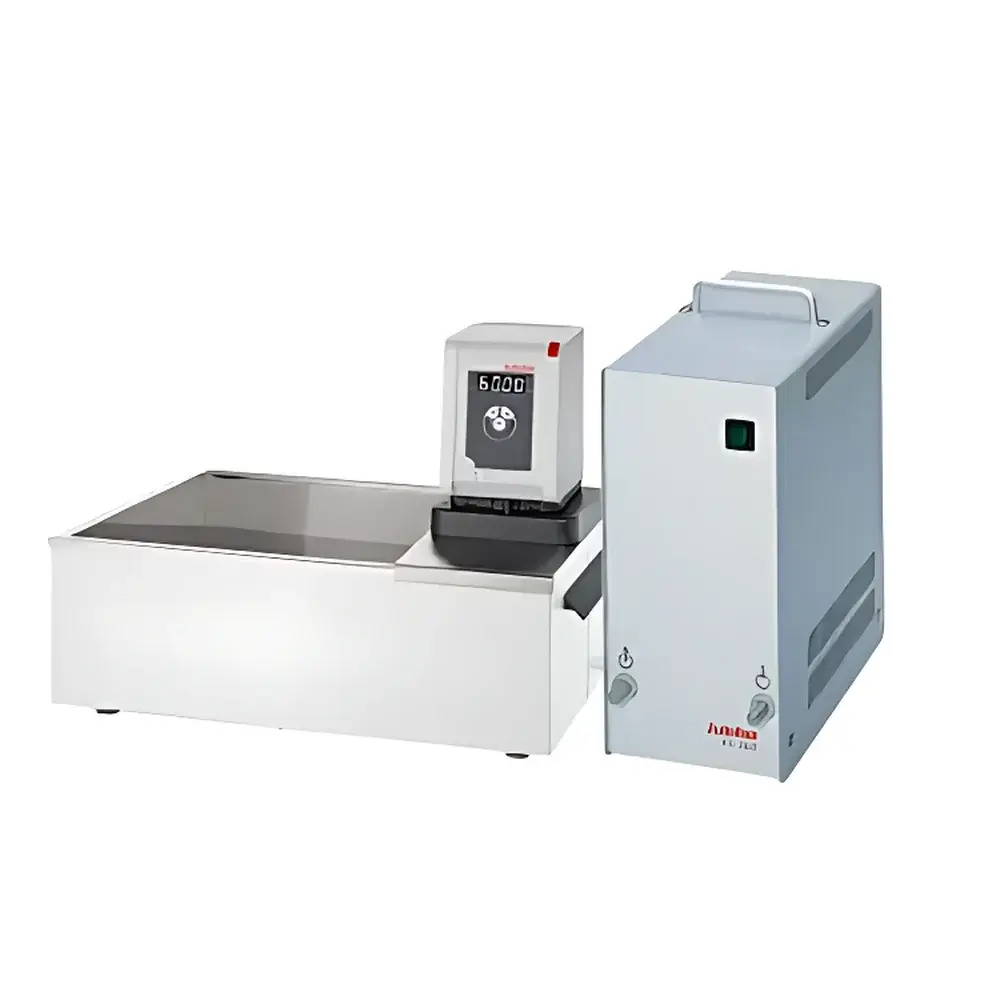
Julabo CD-19L and CD-33L Circulating Chillers
| Brand | Julabo |
|---|---|
| Origin | Germany |
| Model | CD-19L / CD-33L |
| Bath Volume | 19 L / 33 L |
| Temperature Range | 10–40 °C |
| Temperature Stability | ±0.03 °C |
| Pump Flow Rate | 15 L/min |
| Maximum Pressure | 0.35 bar |
| Bath Opening × Depth (W×L/D) | 36×39×15 cm / 66×32×15 cm |
| External Dimensions (W×L×H) | 57×33×37 cm / 91×36×43 cm |
Overview
The Julabo CD-19L and CD-33L are precision-engineered circulating chillers designed for stable, low-temperature thermal control in laboratory environments where large-volume sample conditioning is required. Unlike standard immersion baths or compact recirculating units, these models integrate a high-capacity open bath with an external refrigeration loop—comprising a dedicated chiller unit (CD-19 or CD-33), a compatible heat exchanger (FD200 for CD-19L; CS-12 for CD-33L), and optimized fluid circulation architecture. The system operates on vapor-compression refrigeration with PID-controlled heating/cooling, enabling precise maintenance of setpoints within ±0.03 °C across the 10–40 °C range. This stability is achieved through dual-sensor feedback, adaptive compressor modulation, and low-turbulence flow design—critical for applications demanding thermal homogeneity over extended durations, such as spectroscopic cell conditioning, calorimetric reference baths, or multi-vessel enzymatic assays.
Key Features
- Large open-bath geometry (36×39×15 cm for CD-19L; 66×32×15 cm for CD-33L) facilitates easy insertion and retrieval of bulky or multiple sample containers—including glass jackets, reactor vessels, and custom fixtures.
- Low-profile mechanical layout positions the chiller base below bench level where possible, minimizing vertical footprint while maximizing accessible bath depth and ergonomic handling.
- Integrated dual-mode temperature control delivers both active cooling and resistive heating, ensuring rapid recovery after load changes and eliminating overshoot during ramp transitions.
- High-flow, low-pulsation pump (15 L/min at 0.35 bar max pressure) supports both internal bath circulation and external closed-loop applications via standardized ½″ BSP ports.
- Corrosion-resistant stainless-steel bath chamber and PTFE-coated internal components ensure long-term compatibility with water, water-glycol mixtures, and other common heat-transfer fluids.
- Front-panel interface with intuitive rotary encoder and LCD display provides real-time monitoring of bath temperature, setpoint, pump status, and system diagnostics—including refrigerant pressure alerts and overtemperature lockout.
Sample Compatibility & Compliance
The CD-19L and CD-33L accommodate a wide range of sample formats—from standard 100 mL to 2 L jacketed reactors, quartz cuvette holders, and multi-position probe arrays—without requiring auxiliary mounting hardware. Bath geometry allows unobstructed optical access for inline UV-Vis or FTIR measurements. Units comply with IEC 61010-1:2010 for electrical safety in laboratory equipment and meet EN 60335-1 requirements for temperature-controlled appliances. All firmware and control logic adhere to GLP-relevant operational integrity standards, supporting audit-ready operation logs when integrated with external data acquisition systems. While not inherently 21 CFR Part 11 compliant, the chiller’s deterministic behavior and repeatable setpoint execution make it suitable for use in GMP-aligned workflows where temperature-critical steps require documented thermal history.
Software & Data Management
Julabo’s optional LabView-compatible communication protocol (RS232 or USB virtual COM port) enables remote setpoint adjustment, real-time temperature streaming, and event-triggered logging. When paired with Julabo’s Wintherm software or third-party SCADA platforms, users can configure time-stamped profiles, generate calibration reports per ISO/IEC 17025 guidelines, and export CSV-formatted datasets for statistical process control (SPC) analysis. System alarms—including low-fluid detection, pump failure, and compressor timeout—are timestamped and retain memory across power cycles, facilitating root-cause investigation during QA/QC reviews.
Applications
- Stabilization of optical benches and interferometer reference paths requiring sub-0.05 °C thermal drift control over 8+ hour intervals.
- Temperature regulation of multi-channel electrophoresis tanks and gel documentation systems operating under ambient-sensitive conditions.
- External cooling of HPLC column ovens, GC injectors, and mass spectrometer source housings where ambient air cooling proves insufficient.
- Pre-conditioning of polymer solutions prior to rheological testing, ensuring consistent viscoelastic baseline states across replicate runs.
- Support of accelerated stability studies per ICH Q1A(R2), maintaining defined storage temperatures for pharmaceutical formulations in open-bath immersion protocols.
FAQ
What heat transfer fluids are compatible with the CD-19L and CD-33L?
Deionized water, 20–30% aqueous glycol solutions, and silicone oils with kinematic viscosity ≤50 cSt are approved. Avoid chlorinated solvents or fluids with pH 9.
Can the unit operate continuously at 10 °C in a 30 °C ambient environment?
Yes—both models are rated for continuous duty at minimum setpoint under ISO 13732-2 ambient class B conditions (≤35 °C, ≤75% RH).
Is external temperature feedback supported for cascade control?
Yes—via optional PT100 input (accessory kit required), enabling process temperature feedback from a remote sensor location.
How often does the system require preventive maintenance?
Compressor oil and refrigerant charge verification are recommended every 24 months; pump impeller inspection and bath cleaning every 6 months under daily use.
Are NIST-traceable calibration certificates available?
Yes—factory calibration includes traceable documentation to DIN EN ISO/IEC 17025 accredited standards, with optional on-site verification services.



