
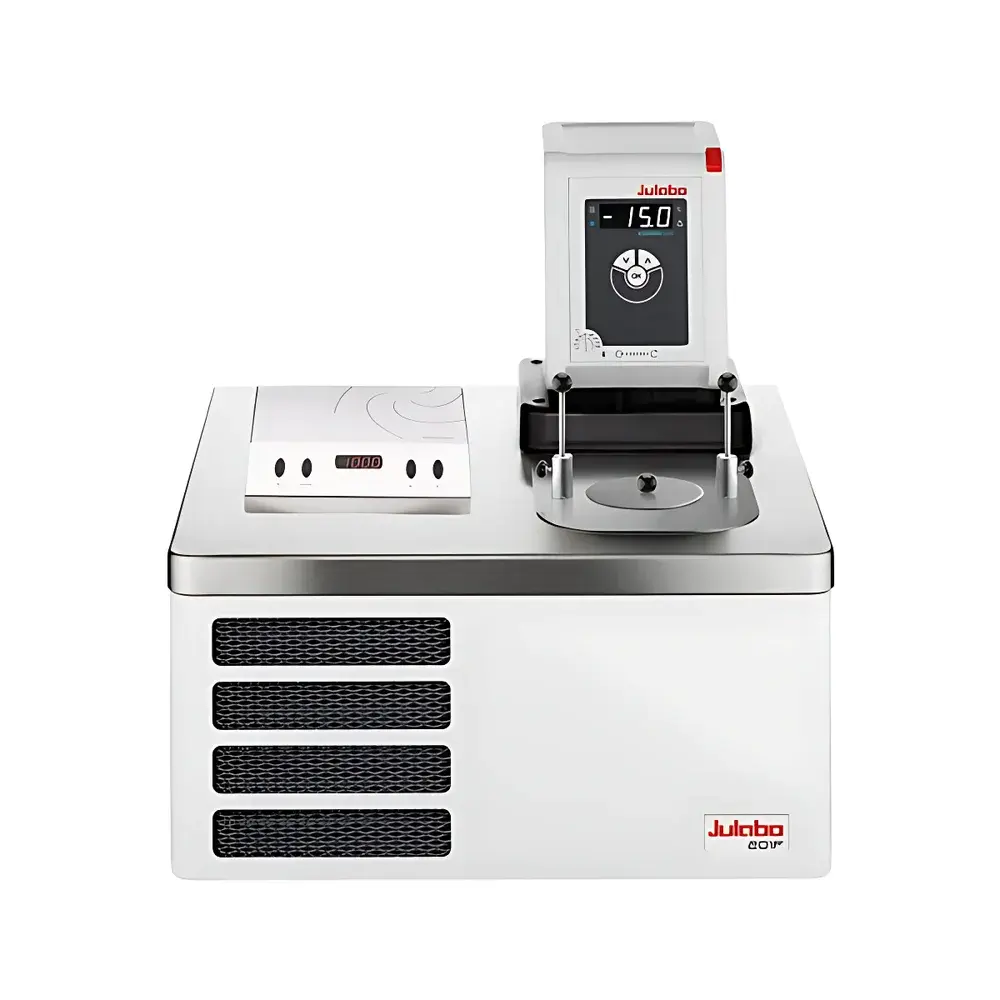
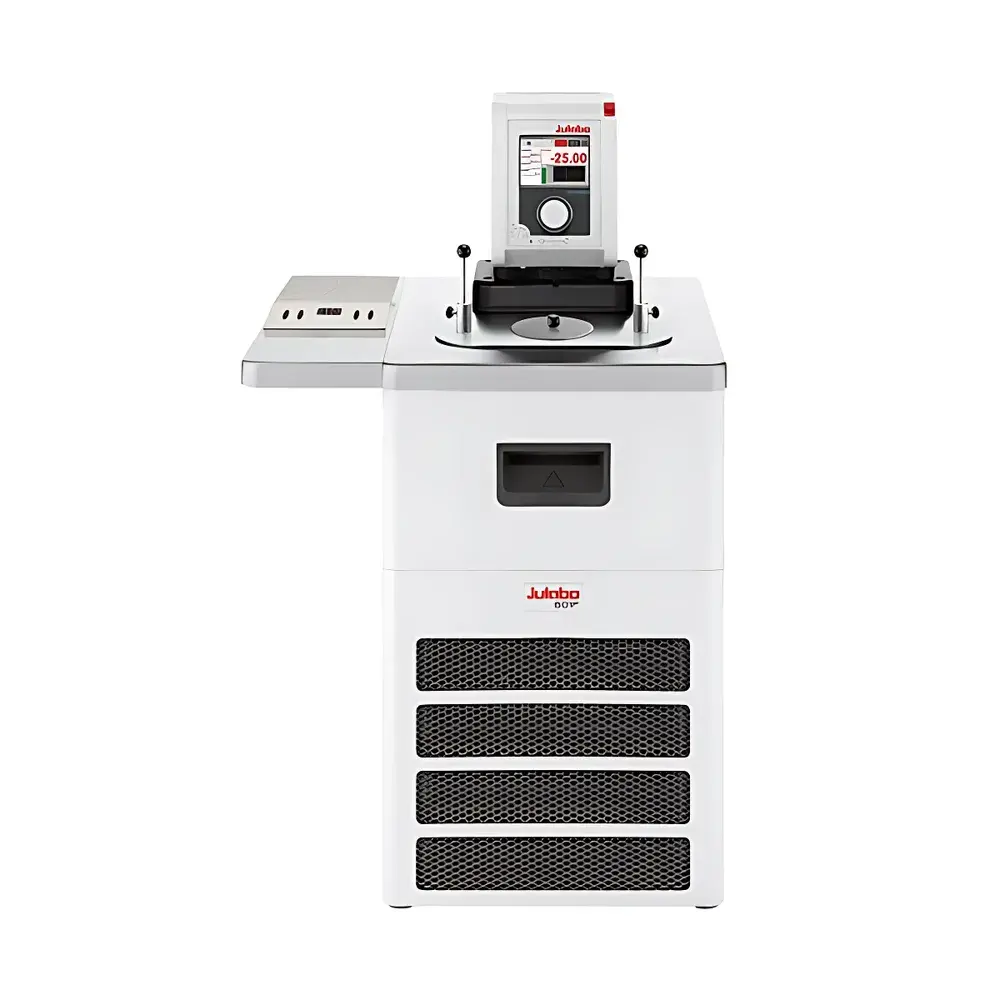
Julabo DD-201FS Magnetic Stirring Circulating Bath with Integrated Chiller
| Brand | Julabo |
|---|---|
| Origin | Germany |
| Model | DD-201FS |
| Temperature Range | –20 °C to +150 °C |
| Temperature Stability | ±0.01 °C |
| Bath Volume | 3–4 L |
| Internal/External Circulation | Yes |
| Cooling/Heating Type | Dual-mode |
| Stirring Speed | 100–1600 rpm |
| Stirring Position | 1 |
| Compliance | EN 61010, EN 61326, DIN 12876-1 Class III (FL), WEEE/RoHS |
| Interface | USB, M16×1 male external circulation port |
| Safety Features | Overtemperature protection, low-level float switch with audiovisual alarm and auto-shutdown, ATC self-calibration, Safety-lock power connector |
Overview
The Julabo DD-201FS is a high-precision magnetic stirring circulating bath engineered for demanding laboratory applications requiring simultaneous temperature control, active mixing, and fluid circulation across a wide thermal range (–20 °C to +150 °C). Unlike conventional water/oil baths, the DD-201FS integrates a compact refrigeration system, PID1 + ACC (Adaptive Cascade Control) dual-loop temperature regulation, and a high-torque magnetic stirrer into a single robust platform. Its core measurement principle relies on closed-loop thermoregulation via platinum resistance thermometer (Pt100) feedback, coupled with intelligent cascade algorithms that dynamically adjust cooling power and heating output to minimize overshoot and stabilize temperature at ±0.01 °C — a performance level aligned with DIN 12876-1 Class III (FL) safety requirements for flammable liquid handling. The unit is designed for both internal bath homogenization and external process circulation, supporting reproducible thermal conditioning of reaction mixtures, calibration standards, sensor validation setups, and material testing protocols under GLP-compliant conditions.
Key Features
- Adaptive Cascade Control (ACC) combined with PID1 algorithm ensures rapid thermal equilibration and exceptional stability (±0.01 °C) across the full operating range.
- ATC (Absolute Temperature Calibration) enables user-performed traceable calibration without external reference equipment — critical for ISO/IEC 17025-compliant labs maintaining instrument metrological integrity.
- Integrated high-efficiency chiller eliminates need for external refrigerated circulators; optimized coil layout maximizes usable bath volume while minimizing footprint.
- Stainless steel heating coil resists corrosion and scale formation in aqueous or organic media, supporting long-term use with minimal maintenance.
- Rotatable internal circulation outlet allows flexible positioning to optimize flow dynamics for varied vessel geometries and sample configurations.
- DIN-certified Class III (FL) safety architecture includes dual redundant overtemperature cutoffs, low-level float switch with audible/visual alarm and automatic power disconnection, and lockable IEC 60320 C14 power inlet.
- Ergonomic pyramid-shaped bath lid directs condensate back into the reservoir, preventing spillage and maintaining consistent fluid volume during extended high-temperature operation.
- Front-panel high-brightness display remains legible from >2 meters; intuitive interface supports standby mode, scheduled startup, and one-touch power cycling.
Sample Compatibility & Compliance
The DD-201FS accommodates standard laboratory glassware (e.g., round-bottom flasks, jacketed reactors, calibration baths) up to Ø150 mm diameter within its 3–4 L stainless steel bath chamber. It supports both aqueous and low-viscosity organic heat transfer fluids (e.g., silicone oils, ethylene glycol/water blends), provided flash point exceeds operational maxima per DIN 12876-1 FL classification. All electrical and electromagnetic design complies with EN 61010-1 (safety) and EN 61326-1 (EMC), while RoHS/WEEE directives govern material composition. The integrated ATC function satisfies traceability requirements outlined in ISO/IEC 17025:2017 clause 6.4.10, and the USB interface enables audit-ready data logging compatible with 21 CFR Part 11–configured software environments.
Software & Data Management
A dedicated PC application (Windows-compatible) connects via USB to enable remote parameter setting, real-time temperature/stir speed monitoring, and time-stamped data export in CSV format. The software supports configurable alarm thresholds, session-based logging, and optional integration with LabArchives or Electronic Lab Notebook (ELN) platforms via API. All recorded values include metadata (timestamp, setpoint, actual reading, stir speed, error codes), fulfilling ALCOA+ data integrity principles. No cloud dependency or vendor-hosted services are required — all processing occurs locally to maintain data sovereignty and network security.
Applications
- Controlled-temperature synthesis requiring precise thermal ramping and homogeneous mixing (e.g., nanoparticle precipitation, polymerization kinetics).
- Calibration of thermometers, RTDs, and thermocouples against NIST-traceable references in accredited metrology labs.
- Viscometer and rheometer bath support where thermal drift must remain below ±0.01 °C over multi-hour measurements.
- Accelerated stability testing of pharmaceutical formulations per ICH Q1A(R3) guidelines.
- Environmental simulation for electronics component thermal cycling per JEDEC JESD22-A104.
- QC/QA testing of adhesives, coatings, and sealants where viscosity-temperature profiles dictate shelf-life predictions.
FAQ
What temperature accuracy can be achieved after ATC calibration?
ATC calibration restores traceability to factory-set Pt100 reference points; post-calibration deviation remains ≤±0.01 °C at any setpoint within the operating range.
Is external circulation compatible with pressurized systems?
Yes — the M16×1 male port delivers up to 0.8 bar static pressure head; users must verify compatibility with downstream equipment per EN 13445 or ASME B31.3.
Does the unit meet FDA requirements for pharmaceutical process support?
While not a GMP-certified manufacturing device, its design, documentation, and data logging capabilities align with FDA expectations for laboratory equipment used in process development and analytical method validation.
Can the stirrer operate independently of temperature control?
Yes — stirring speed (100–1600 rpm) and thermal mode (heating-only, cooling-only, or auto-switching) are fully decoupled via front-panel controls or software.
What maintenance intervals are recommended for the refrigeration system?
No routine refrigerant servicing is required; annual inspection of condenser grille (easily removable) and cleaning of fan intake filters is sufficient under typical lab conditions.



