
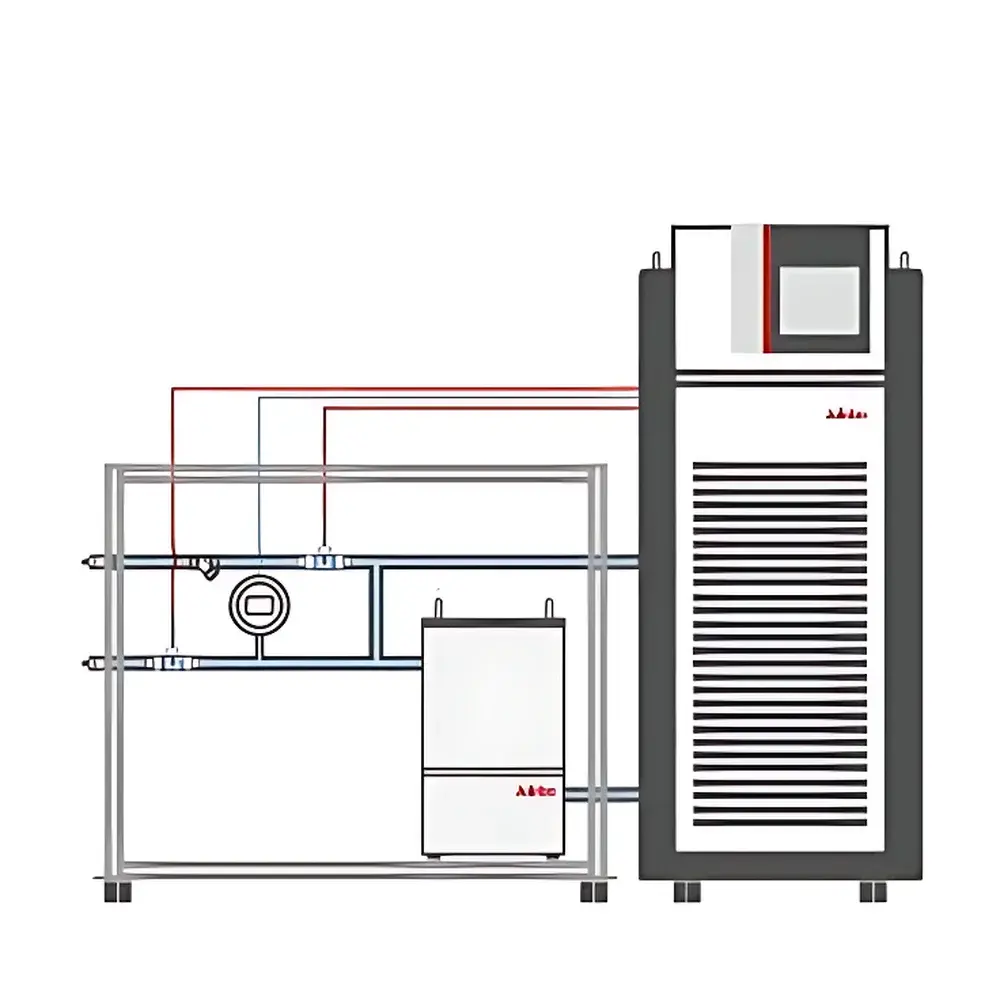
JULABO ECP-50 Electronic Component Performance Test Platform
| Brand | JULABO |
|---|---|
| Origin | Germany |
| Model | ECP-50 |
| Temperature Range | –35 °C to +90 °C |
| Flow Rate | 5–40 L/min |
| Temperature Stability | ±0.05 °C to ±0.1 °C |
| Display | 5.7″ TFT Touchscreen (0.01 °C resolution) |
| Heating Power | 6 kW |
| Refrigeration Capacity | 7.5 kW @ 20 °C |
| Pump Pressure | 0.48–3.2 bar |
| Circulation Medium | Antifreeze-compatible |
| Compressor Type | Single-stage, water-cooled |
| Dimensions (W×D×H) | 53 × 66.5 × 126 cm |
| Integrated Features | EHC segmented shock heat exchange, ACC dynamic refrigeration control, ICC intelligent temperature control, hydraulic sealing, rear-mounted fluid connections, front-panel operation, loop filter, multi-protocol communication interfaces |
Overview
The JULABO ECP-50 Electronic Component Performance Test Platform is a high-precision, thermally robust environmental simulation system engineered for the functional and reliability validation of automotive electronic components under dynamically controlled thermal-fluid conditions. Unlike general-purpose chillers or circulators, the ECP-50 integrates real-time flow regulation, pressure modulation, and sub-0.1 °C temperature stability within a single closed-loop architecture—enabling reproducible thermal stress testing aligned with industry requirements for powertrain ECUs, ADAS sensors, battery management systems (BMS), wireless charging modules, and safety-critical controllers (e.g., ABS, SRS, and airbag deployment units). Its core operational principle relies on active thermal management via a dual-mode refrigeration circuit coupled with intelligent predictive temperature control (ICC), allowing simultaneous ramping, soaking, and cycling across wide operating envelopes—from cryogenic start-up simulations (–35 °C) to high-temperature endurance tests (+90 °C).
Key Features
- Intelligent Dynamic Temperature Control (ICC): Achieves long-term stability of ±0.05 °C at setpoints ≥25 °C, verified per ISO/IEC 17025 traceable calibration protocols.
- EHC Efficient Segmented Shock Heat Exchange Technology: Enables rapid thermal transitions—typical heating/cooling rates exceed 1.8 K/min between –20 °C and +70 °C with load—without compromising compressor lifetime or thermal overshoot.
- ACC Advanced Cooling Control: Maintains low refrigeration power draw (<15% increase) even at elevated ambient temperatures (up to 40 °C), ensuring stable performance during extended high-temperature soak phases.
- High-Fidelity Hydraulic Architecture: Fully sealed hydraulic circuit compatible with ethylene glycol–water mixtures; eliminates vapor lock and supports continuous operation at pressures up to 3.2 bar.
- Dual-Mode Pump System: Programmable flow delivery (5–40 L/min) with selectable constant-pressure or constant-flow modes; integrated pressure feedback loop enables real-time PID adjustment during transient load changes.
- Industrial HMI Interface: 5.7″ sunlight-readable TFT touchscreen with intuitive workflow navigation, alarm logging, and user-accessible calibration offset entry—designed for integration into ISO 9001-certified test labs.
- Multi-Protocol Communication Suite: Standard RS485 (Modbus RTU), Ethernet (TCP/IP), and optional PROFIBUS-DP or CANopen interfaces support seamless integration into automated test benches and MES environments.
Sample Compatibility & Compliance
The ECP-50 is purpose-built for validating electronic assemblies subjected to automotive-grade thermal cycling per ISO 16750-4 (Environmental conditions and testing for electrical and electronic equipment — Part 4: Climatic loads) and AEC-Q200 stress qualification. Its closed-loop design accommodates DUTs with integrated cooling plates, cold plates, or direct-fluid-interface housings—including those used in 800-V EV power electronics and radar transceivers. All wetted materials comply with RoHS Directive 2011/65/EU and REACH Annex XVII restrictions. The system meets CE marking requirements under the EU Machinery Directive 2006/42/EC and Low Voltage Directive 2014/35/EU. Optional audit-ready firmware supports 21 CFR Part 11-compliant electronic signatures and GLP/GMP-aligned event logging when paired with JULABO’s LabSoft Pro software.
Software & Data Management
JULABO LabSoft Pro (v4.2+) provides native driver support for the ECP-50, enabling synchronized acquisition of temperature, flow rate, pump pressure, refrigerant discharge temperature, and power consumption at up to 10 Hz sampling frequency. Test sequences—including ramp-soak-cycle profiles, stepwise gradient testing, and failure-triggered emergency shutdown—are programmable via drag-and-drop logic blocks. Raw data exports in CSV and HDF5 formats include embedded metadata (timestamp, operator ID, calibration certificate ID, ambient sensor readings). Audit trails record all parameter modifications, user logins, and firmware updates—retained for ≥36 months with configurable cloud backup to AWS S3 or on-premise NAS.
Applications
- Thermal validation of automotive DC-DC converters and onboard chargers under combined thermal-load transients.
- Accelerated life testing of MEMS-based inertial measurement units (IMUs) across –40 °C to +105 °C operational boundaries.
- Functional verification of Li-ion battery thermal management systems using realistic coolant flow profiles (e.g., 15–35 L/min at 2.1 bar).
- Qualification of radar front-end modules per UNECE R152 thermal shock requirements (50 cycles, ΔT = 110 K, tramp ≤ 15 s).
- Supporting ISO 26262 ASIL-B hardware-in-the-loop (HIL) test rigs through deterministic thermal stimulus delivery with <50 ms latency.
FAQ
Does the ECP-50 support external PLC synchronization for coordinated thermal-electrical testing?
Yes—the built-in Modbus TCP server allows bi-directional register mapping with Allen-Bradley, Siemens S7, and Beckhoff controllers; cycle synchronization accuracy is ±20 ms over standard industrial Ethernet.
Can the system operate continuously at –35 °C with full flow capacity?
Continuous operation at –35 °C is supported at flow rates ≤25 L/min; full 40 L/min capacity is rated for setpoints ≥–20 °C to maintain compressor oil viscosity and refrigerant mass flow integrity.
Is third-party calibration documentation included with shipment?
Each unit ships with a factory-issued calibration certificate (traceable to PTB, Germany) covering temperature, flow, and pressure sensors—valid for 12 months from date of manufacture.
What maintenance intervals are recommended for the EHC heat exchanger module?
No scheduled maintenance is required; the EHC’s brazed-plate construction eliminates gasket degradation risk. Annual inspection of refrigerant charge and filter element replacement (part no. FIL-ECP-01) is advised.
How does the ACC technology differ from conventional hot-gas bypass control?
ACC employs real-time evaporator superheat modulation combined with variable-speed condenser fan control—reducing energy waste by 22–35% versus fixed-bypass systems while maintaining ±0.03 °C short-term stability during high-ambient operation.
Related Products





