
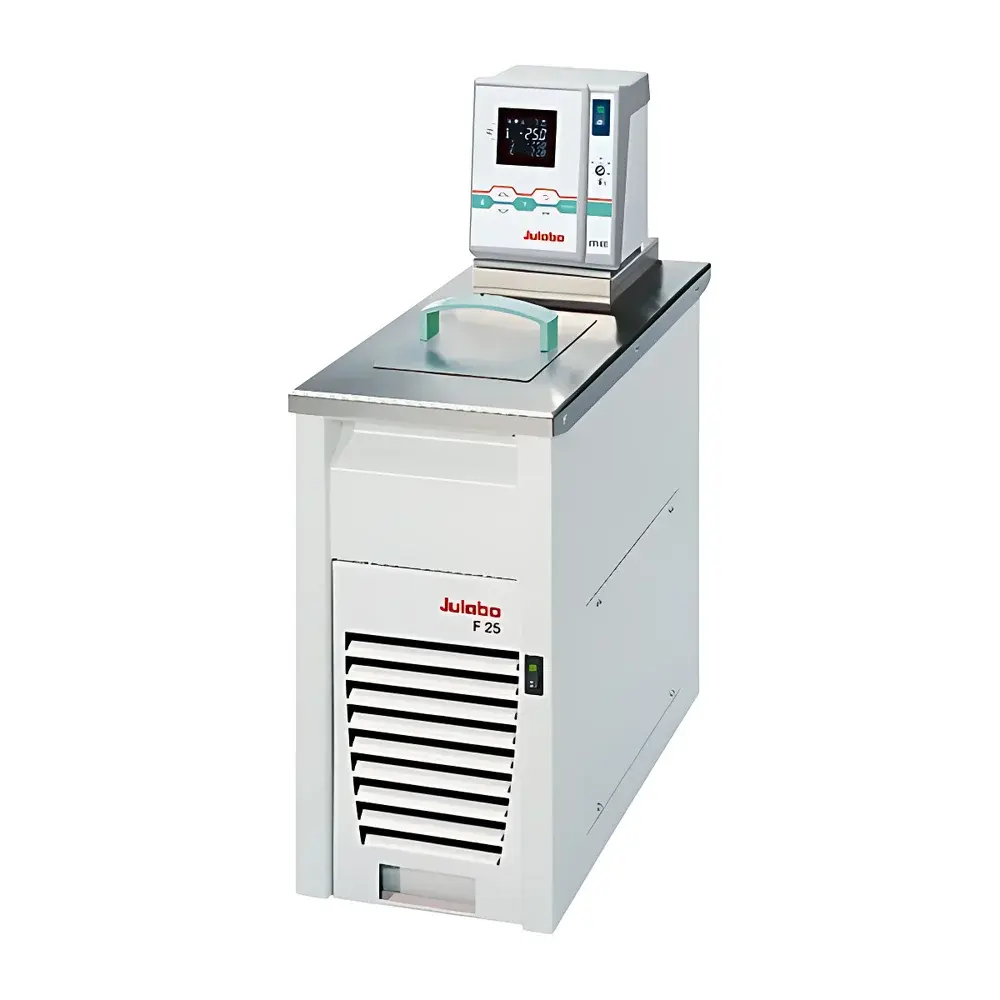
Julabo F25-ME Universal Heating and Cooling Circulating Bath
| Brand | Julabo |
|---|---|
| Origin | Germany |
| Model | F25-ME |
| Temperature Range | -28 to +200 °C |
| Temperature Stability | ±0.01 °C |
| Bath Volume | 4.5 L |
| Circulation Type | Internal & External |
| Control Mode | Heating & Cooling |
| Heating Power | 2 kW |
| Refrigeration Power | 0.26 kW (at 20 °C), 0.2 kW (at 0 °C), 0.6 kW (at −20 °C) |
| Pump Flow Rate | 11–16 L/min |
| Pump Pressure | 0.23–0.45 bar |
| Display | VFD LCD |
| Control Algorithm | PID3 with ATC3 three-point calibration |
| External Sensor Interface | PT100 |
| Communication | RS232 |
| Safety Features | Low-level detection, overtemperature cutoff, adjustable alarm threshold |
| Compressor Refrigerant | R134a (GWP 1430) |
| DIN 12876-1 Classification | Class III (FL) |
| Dimensions (W×L×H) | 23 × 42 × 61 cm |
| Weight | 31 kg |
Overview
The Julabo F25-ME Universal Heating and Cooling Circulating Bath is a precision-engineered temperature control system designed for demanding laboratory applications requiring both high-temperature heating and sub-zero cooling within a single compact unit. Based on forced-circulation thermoregulation, the F25-ME employs a dual-mode refrigeration circuit coupled with a high-efficiency resistive heating element to deliver stable thermal output across its full operating range of −28 °C to +200 °C. Its core architecture integrates a hermetic scroll compressor using R134a refrigerant (GWP 1430), optimized for low-noise, long-life operation under continuous duty cycles. The bath’s 4.5 L stainless-steel reservoir supports both internal temperature stabilization—such as for sample immersion or calibration baths—and external temperature regulation via integrated circulation pumps connected to peripheral instrumentation including jacketed reactors, viscometers, refractometers, spectrophotometers, and calorimeters. Engineered in accordance with DIN 12876-1 Class III (FL) safety standards for flammable liquid environments, the F25-ME meets stringent requirements for chemical compatibility, electrical insulation, and thermal containment in regulated research and quality control laboratories.
Key Features
- VFD white-backlit LCD display showing real-time bath temperature, setpoint, pump status, and alarm conditions simultaneously
- Waterproof membrane keypad with tactile feedback for secure parameter entry—even when wearing gloves
- PID3 adaptive temperature control algorithm with automatic tuning and dynamic response compensation
- ATC3 three-point temperature calibration function enabling traceable accuracy verification against NIST-traceable references
- SmartPump variable-speed circulation system that automatically adjusts motor torque based on fluid viscosity and backpressure—ensuring consistent flow (11–16 L/min) and pressure (0.23–0.45 bar) across diverse heat transfer media (water, silicone oil, ethylene glycol mixtures)
- Dual PT100 sensor inputs: one internal probe for bath temperature monitoring, one external port for direct measurement and closed-loop control of remote systems
- Programmable overtemperature safety cutoff with rotary dial adjustment; triggers immediate power shutdown and visual/audible alert upon breach
- Low-level fluid detection circuit with preemptive warning and hard interlock to prevent dry-run damage to heater and pump
- Front-mounted drain valve and removable air-intake grille for rapid maintenance of condenser coils without disassembly
- RS232 serial interface supporting bidirectional communication with LabVIEW, MATLAB, or custom SCADA platforms for automated protocol execution and audit-ready data logging
Sample Compatibility & Compliance
The F25-ME accommodates a wide range of heat transfer fluids—including deionized water, 50/50 ethylene glycol/water blends, and silicone oils up to 200 °C—without degradation of seals or corrosion of wetted parts (316 stainless steel reservoir, EPDM/PFA tubing interfaces). Its DIN 12876-1 Class III (FL) certification confirms suitability for use with flammable liquids in enclosed lab spaces, incorporating spark-proof electronics, thermal fusing, and vapor-tight enclosures. While not intrinsically rated for hazardous area deployment (ATEX/IECEx), it complies with IEC 61010-1:2010 for laboratory electrical safety and meets CE marking requirements for EMC and low-voltage directives. For GLP/GMP-regulated environments, the RS232 interface supports integration into 21 CFR Part 11-compliant data acquisition workflows when paired with validated software and electronic signature protocols.
Software & Data Management
The F25-ME operates autonomously via its embedded 10-step temperature ramp-and-soak program memory, allowing unattended multi-stage thermal profiles (e.g., 25 °C → hold 10 min → ramp to 80 °C at 2 °C/min → hold 30 min → cool to −10 °C at 1.5 °C/min). All program parameters—including setpoints, ramp rates, dwell times, and safety limits—are stored non-volatilely and retain configuration after power loss. When connected via RS232, the device exposes a documented ASCII command set enabling remote initiation, real-time telemetry polling (temperature, pump speed, error codes), and firmware-updatable parameter tables. Third-party software integrations may generate timestamped CSV logs with metadata (operator ID, instrument serial number, environmental ambient reading) to satisfy ISO/IEC 17025 documentation requirements for method validation and equipment qualification.
Applications
- Calibration of temperature-sensitive analytical instruments (e.g., digital thermometers, RTD probes, infrared sensors) per ASTM E74 and ISO 17025 guidelines
- Thermal conditioning of viscometer baths to maintain Newtonian fluid behavior during shear-rate sweeps
- Stabilization of optical path lengths in refractometers and UV-Vis spectrophotometers where thermal drift induces baseline noise
- Temperature programming of jacketed glass reactors for exothermic/endothermic reaction kinetics studies
- Preconditioning of polymer samples prior to DSC or TMA analysis to eliminate thermal history effects
- Long-term stability testing of pharmaceutical formulations under accelerated aging conditions (ICH Q1A)
FAQ
What is the maximum allowable viscosity of heat transfer fluid for reliable SmartPump operation?
The SmartPump system is validated for fluids up to 500 cP at operating temperature; beyond this, flow rate and pressure may fall outside specified tolerances.
Can the F25-ME be used with silicone oil at 200 °C without seal degradation?
Yes—the bath’s sealing materials (fluoroelastomer O-rings, PFA-lined fittings) are rated for continuous exposure to methylphenyl silicone oils at 200 °C per manufacturer specifications.
Is the RS232 interface compatible with modern Windows/Linux systems lacking legacy serial ports?
Yes—standard USB-to-RS232 adapters (FTDI chipset recommended) enable plug-and-play connectivity; driver installation is required only once per host system.
Does the ATC3 calibration function support user-defined reference points beyond the factory-default 0 °C, 50 °C, and 100 °C?
No—ATC3 is fixed to those three points to ensure metrological traceability; however, users may perform additional manual offset corrections via the “Sensor Offset” menu.
How frequently should the condenser coil be cleaned to maintain rated refrigeration capacity?
Under typical laboratory conditions (23 °C ambient, 40% RH), quarterly cleaning is sufficient; in dusty or high-humidity environments, monthly inspection is advised.



