
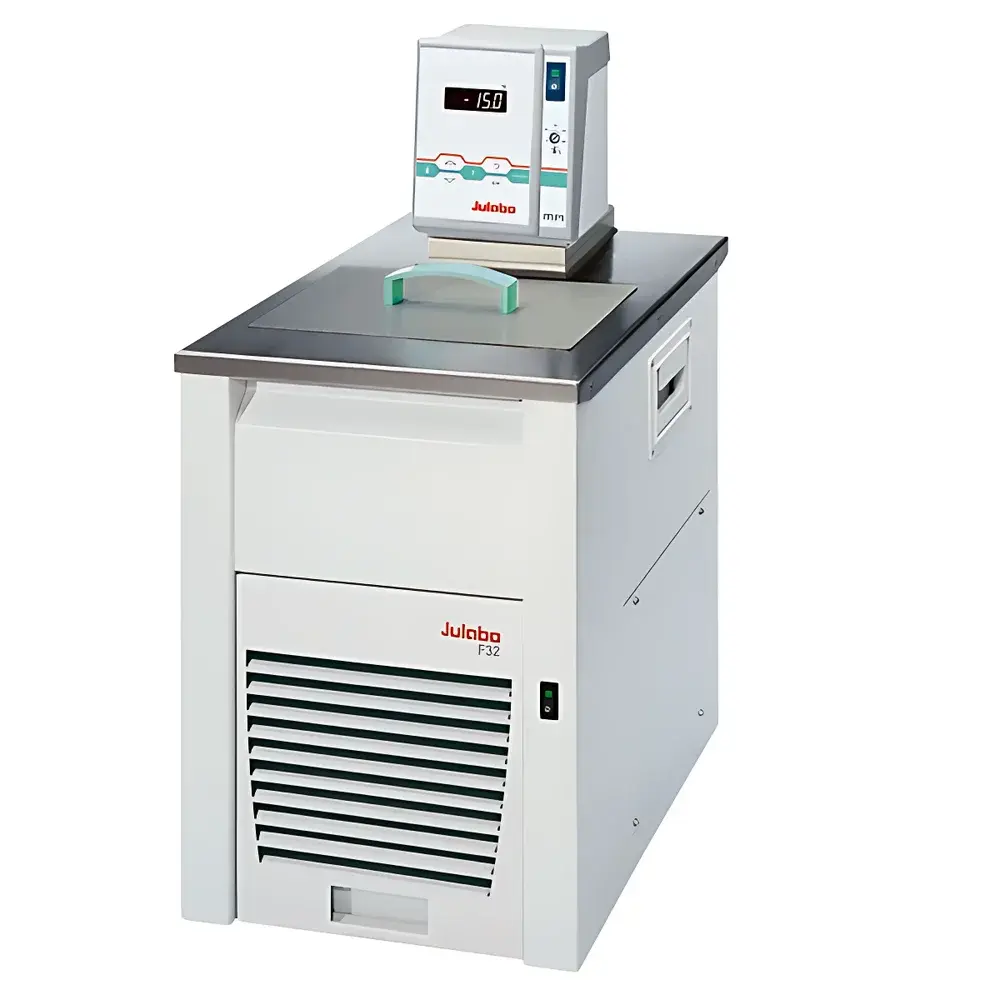
Julabo F32-MA Universal Heating and Cooling Circulating Bath
| Brand | Julabo |
|---|---|
| Origin | Germany |
| Model | F32-MA |
| Bath Volume | 8 L |
| Temperature Range | −35 °C to +200 °C |
| Temperature Stability | ±0.02 °C |
| Control Method | PID2 |
| Calibration | ATC3 Three-Point Calibration |
| Pump Flow Rate | 11–16 L/min |
| Max. Pump Pressure | 0.45 bar |
| Heating Power | 2 kW |
| Refrigeration Power (at 20/0/−20/−30 °C) | 0.45/0.39/0.15/0.06 kW |
| Compressor Type | Single-stage, R134a |
| Communication Interface | RS232 (optional Profibus) |
| Safety Classification | DIN 12876-1 Class III (FL) |
| Dimensions (W×L×H) | 31 × 42 × 64 cm |
| Weight | 37 kg |
Overview
The Julabo F32-MA Universal Heating and Cooling Circulating Bath is an engineered thermal management system designed for precise, stable, and bidirectional temperature control of external devices or internal baths in research laboratories, quality control environments, and pilot-scale process development. Operating on a closed-loop refrigeration cycle with a single-stage R134a compressor and integrated electric heating elements, the F32-MA delivers high-fidelity thermal regulation across an exceptionally wide operational range—from −35 °C to +200 °C—without requiring fluid exchange or auxiliary chillers. Its thermodynamic architecture combines forced convection via a variable-speed SmartPump and advanced PID2 digital control logic to minimize overshoot, reduce settling time, and maintain long-term stability at ±0.02 °C under dynamic load conditions. The unit complies with DIN 12876-1 Class III (FL) safety requirements for flammable liquid handling, making it suitable for use with silicone oils, glycols, and other heat-transfer media commonly employed above 100 °C.
Key Features
- High-resolution LED display showing real-time bath temperature, setpoint, pump pressure, safety status, and alarm codes
- Water-resistant membrane keyboard with intuitive menu navigation for parameter configuration and system diagnostics
- PID2 adaptive temperature control algorithm with auto-tuning capability for optimal response across viscosity and thermal mass variations
- ATC3 three-point temperature calibration function enabling traceable field verification against NIST-traceable reference probes
- SmartPump technology dynamically adjusts motor output based on measured backpressure and fluid viscosity—ensuring consistent flow (11–16 L/min) and pressure (0.23–0.45 bar) even with aging or high-viscosity media
- Multi-level safety architecture: low-level detection, overtemperature cutoff (user-adjustable rotary dial), dry-run protection, and refrigerant leak monitoring
- Rear-mounted RS232 interface (with optional Profibus module) supporting remote command execution, data logging, and integration into LabVIEW, MATLAB, or LIMS platforms
- Service-oriented mechanical design: removable front air grille for condenser cleaning, integrated casters and ergonomic handles, front-positioned drain valve, and compact footprint (31 × 42 × 64 cm)
Sample Compatibility & Compliance
The F32-MA accommodates standard immersion applications—including jacketed reactors, viscometers, spectrophotometer cells, and material testing fixtures—via its dual M10×1 female pump ports (supplied with 8 mm and 12 mm hose barbs). Its 8 L reservoir supports both water and organic heat-transfer fluids rated for continuous operation up to 200 °C. As a DIN 12876-1 Class III (FL) certified device, it incorporates explosion-proof electrical components, sealed refrigerant circuitry, and redundant thermal fuses—meeting essential requirements for GLP-compliant laboratories and ISO/IEC 17025-accredited testing facilities. While not inherently 21 CFR Part 11 compliant, audit-ready operation is achievable when paired with validated third-party software enforcing electronic signatures, change tracking, and secure data archiving.
Software & Data Management
The built-in RS232 port enables ASCII-based SCPI command communication for programmable setpoint ramps, hold profiles, and real-time telemetry streaming (temperature, pump status, error flags). When connected to a host PC running Julabo’s proprietary WinTherm software—or compatible OEM middleware—the system supports scheduled calibration logging, alarm history export (CSV), and automated report generation aligned with internal SOPs. All parameter changes are timestamped and stored in non-volatile memory; however, native electronic signature or role-based access control requires external software validation per FDA guidance. Firmware updates are distributed via Julabo’s technical support portal and installed using standard terminal emulation tools.
Applications
- Calibration of temperature-sensitive analytical instruments (e.g., DSC, TGA, rheometers) requiring traceable thermal uniformity
- Stabilization of laser diodes, photodetectors, and optical benches in metrology labs
- Controlled curing and aging studies of polymers, adhesives, and composites under defined thermal stress protocols
- Viscosity measurements across broad temperature gradients using rotational or capillary viscometers
- Preconditioning of samples prior to mechanical testing (tensile, impact, fatigue) per ASTM D638 or ISO 527
- Support of enzymatic assays and protein stability studies where reaction kinetics are highly temperature-dependent
FAQ
What heat-transfer fluids are compatible with the F32-MA at 200 °C?
Silicone oils (e.g., DC200 series), polyalphaolefins (PAOs), and specially formulated aromatic glycol ethers meeting flash point >220 °C and thermal stability per ASTM D6185 are recommended. Water is restricted to ≤99 °C.
Is external cooling water required for operation?
No—the F32-MA uses air-cooled condensation; no chiller or tap-water connection is needed. Ambient operating temperature must remain between 5 °C and 40 °C.
Can the unit be integrated into a building management system (BMS)?
Yes, via RS232-to-Modbus RTU gateways or custom OPC UA drivers developed using Julabo’s published command protocol.
Does the ATC3 calibration function replace annual third-party calibration?
ATC3 supports user-performed verification at three points but does not substitute for accredited calibration per ISO/IEC 17025; documented traceability to national standards remains mandatory for regulated workflows.
What maintenance intervals are recommended?
Condenser cleaning every 3 months (or more frequently in dusty environments), refrigerant pressure verification annually, and pump seal inspection every 2 years—per Julabo Service Bulletin SB-F32-2023.



