
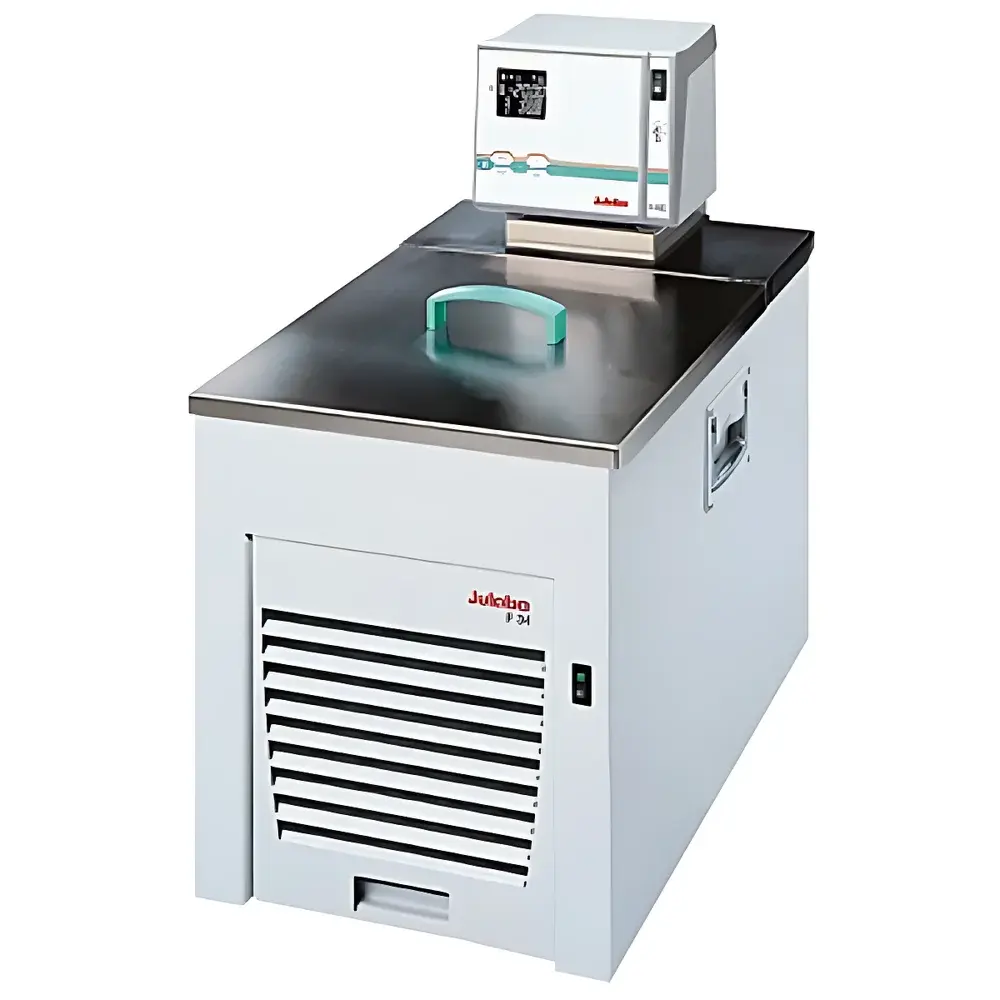
Julabo F34-HE Universal Heating and Cooling Circulating Bath
| Brand | Julabo |
|---|---|
| Origin | Germany |
| Model | F34-HE |
| Temperature Range | −30 to +150 °C |
| Temperature Stability | ±0.01 °C |
| Bath Volume | 20 L |
| Circulation Type | Internal & External |
| Control Mode | Heating & Cooling |
| Display | VFD White High-Brightness LCD |
| Temperature Calibration | ATC3 Three-Point Calibration |
| Pump Control | SmartPump™ Adjustable Pressure |
| Communication Interface | RS232 |
| External Sensor Input | PT100 |
| Safety Features | Low-Level Detection, Over-Temperature Alarm, Auto-Shutdown |
Overview
The Julabo F34-HE Universal Heating and Cooling Circulating Bath is an engineered precision temperature control system designed for demanding laboratory applications requiring stable, bidirectional thermal regulation across a broad operating range (−30 °C to +150 °C). Built upon Julabo’s proprietary ICC (Intelligent Cascade Control) algorithm, the unit delivers high reproducibility in both heating and cooling modes by dynamically coordinating compressor output, heater power modulation, and pump-driven fluid dynamics. Its stainless-steel circulation pump—capable of delivering up to 26 L/min at pressures up to 0.7 bar—ensures consistent thermal transfer to external devices such as jacketed reactors, rotational viscometers, refractometers, spectrophotometers, and calorimeters. The bath’s compact footprint (24 × 30 × 15 cm internal tank dimensions) and front-mounted drain port optimize benchtop integration without compromising accessibility or serviceability.
Key Features
- VFD white high-brightness LCD display showing real-time setpoint, actual bath temperature, external sensor reading (if connected), pump status, and alarm conditions
- Waterproof membrane keyboard with tactile feedback for secure parameter entry under humid or solvent-exposed lab conditions
- ATC3 three-point temperature calibration function enabling traceable adjustment against certified reference probes at low-, mid-, and high-range points
- SmartPump™ technology automatically adjusts motor torque and flow rate in response to changes in heat transfer fluid viscosity—critical when switching between water, silicone oil, or ethylene glycol mixtures
- Dual-sensor monitoring: integrated Pt100 bath sensor plus optional external Pt100 input for direct measurement and closed-loop control of process fluid temperature
- Comprehensive safety architecture including low-level detection, over-temperature cutoff (adjustable via rotary dial), and automatic shutdown with visual/audible alert
- RS232 serial interface supporting remote command execution, data logging, and integration into centralized lab automation platforms
- Optional analog I/O module (0–10 V / 4–20 mA) available for interfacing with PLCs or SCADA systems in regulated manufacturing environments
Sample Compatibility & Compliance
The F34-HE accommodates standard laboratory heat transfer fluids—including deionized water, aqueous glycol solutions, and silicone oils—with compatibility verified per DIN 51528 and ISO 6743-12 specifications. Its sealed refrigeration circuit employs R-404A (or R-513A in newer configurations), compliant with EU F-Gas Regulation (EU) No 517/2014. All electrical components meet IEC 61010-1:2010 safety standards for laboratory equipment. While not inherently 21 CFR Part 11–compliant, audit-ready operation is achievable when paired with validated third-party software that enforces electronic signature, change control, and audit trail requirements—commonly deployed in GLP and GMP-regulated QC laboratories performing ASTM D2857 (viscosity), ISO 2812-3 (coating drying), or USP environmental stability testing.
Software & Data Management
The built-in controller supports one embedded 10-step temperature program with ramp/soak profiles. For advanced sequencing, Julabo’s optional LabView-compatible software (Julabo WinPC) enables multi-channel logging, script-based automation, and export to CSV or Excel formats. When configured with the analog I/O module, the system can feed real-time temperature and pump status signals into LIMS or MES platforms. All parameter changes—including setpoints, alarms, and calibration offsets—are timestamped and stored in non-volatile memory, satisfying basic ALCOA+ data integrity principles for routine analytical workflows.
Applications
- Precise thermal conditioning of reaction mixtures in jacketed glass reactors (e.g., kinetic studies under controlled exotherm management)
- Stabilization of optical path temperature in UV-Vis spectrophotometers and polarimeters to minimize baseline drift
- Calibration verification of thermocouples, RTDs, and digital thermometers per ISO/IEC 17025 Clause 6.4
- Dynamic viscosity measurements using rotational rheometers where bath temperature must remain stable within ±0.01 °C during extended shear sweeps
- Accelerated stability testing of pharmaceutical formulations per ICH Q1A(R2) guidelines
- Material property evaluation—including coefficient of thermal expansion (CTE) and glass transition onset—using dilatometers or TMA instruments
FAQ
What is the maximum allowable working temperature for silicone oil in the F34-HE bath?
Silicone oil with a flash point ≥200 °C may be used up to +150 °C; however, continuous operation above +120 °C requires confirmation of fluid thermal oxidative stability per manufacturer datasheet.
Can the F34-HE maintain temperature stability during rapid external load changes?
Yes—the ICC algorithm continuously adapts heater/refrigeration output and pump speed to compensate for thermal transients introduced by connected equipment, achieving recovery times <15 min after a 1 kW step load change.
Is the RS232 interface optically isolated?
No; the RS232 port is electrically isolated but not optically isolated. For environments with high EMI risk, use of a USB-to-RS232 converter with galvanic isolation is recommended.
Does the unit support NIST-traceable calibration documentation?
Julabo provides factory calibration certificates (traceable to PTB) upon request; field recalibration using ATC3 requires user-supplied Class A Pt100 reference probes.
What maintenance intervals are recommended for the condenser and pump?
Condenser cleaning via removable grille is advised every 6 months in standard lab air; pump impeller inspection and lubrication should occur annually or after 2,000 operating hours—whichever comes first.



