
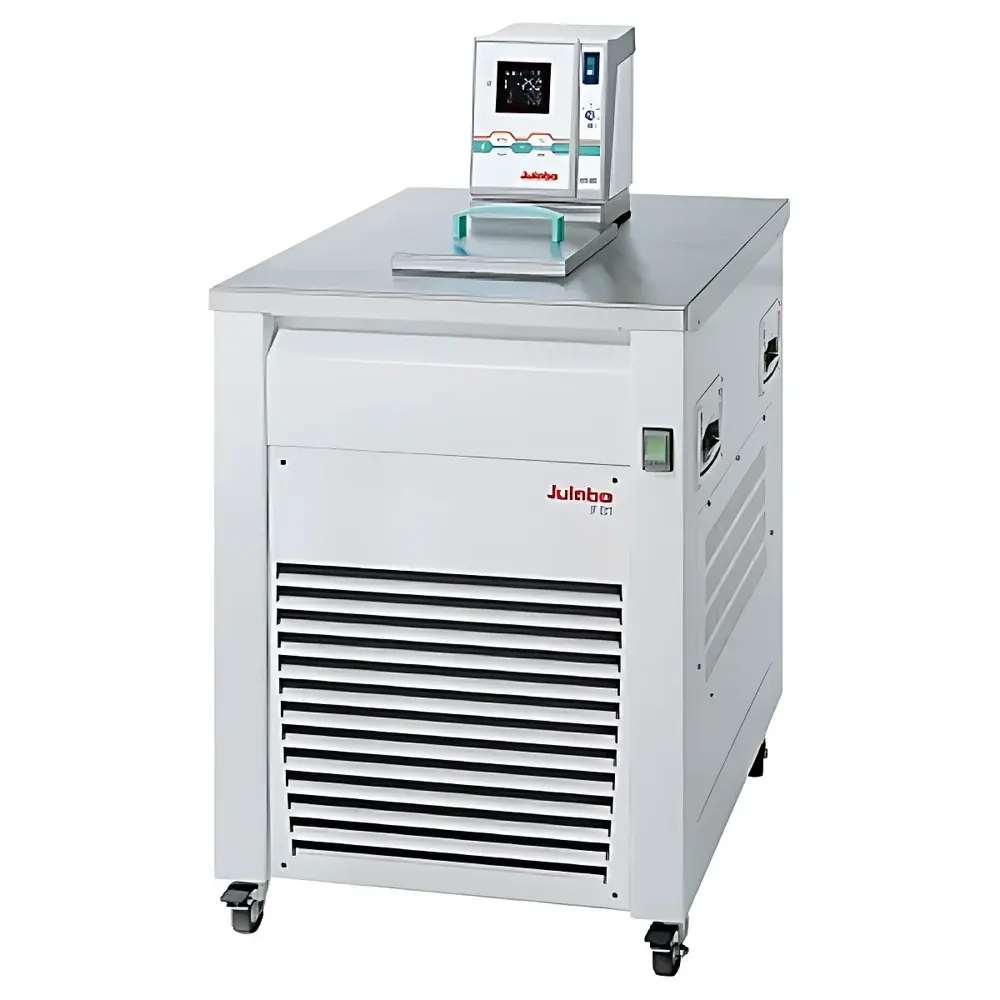
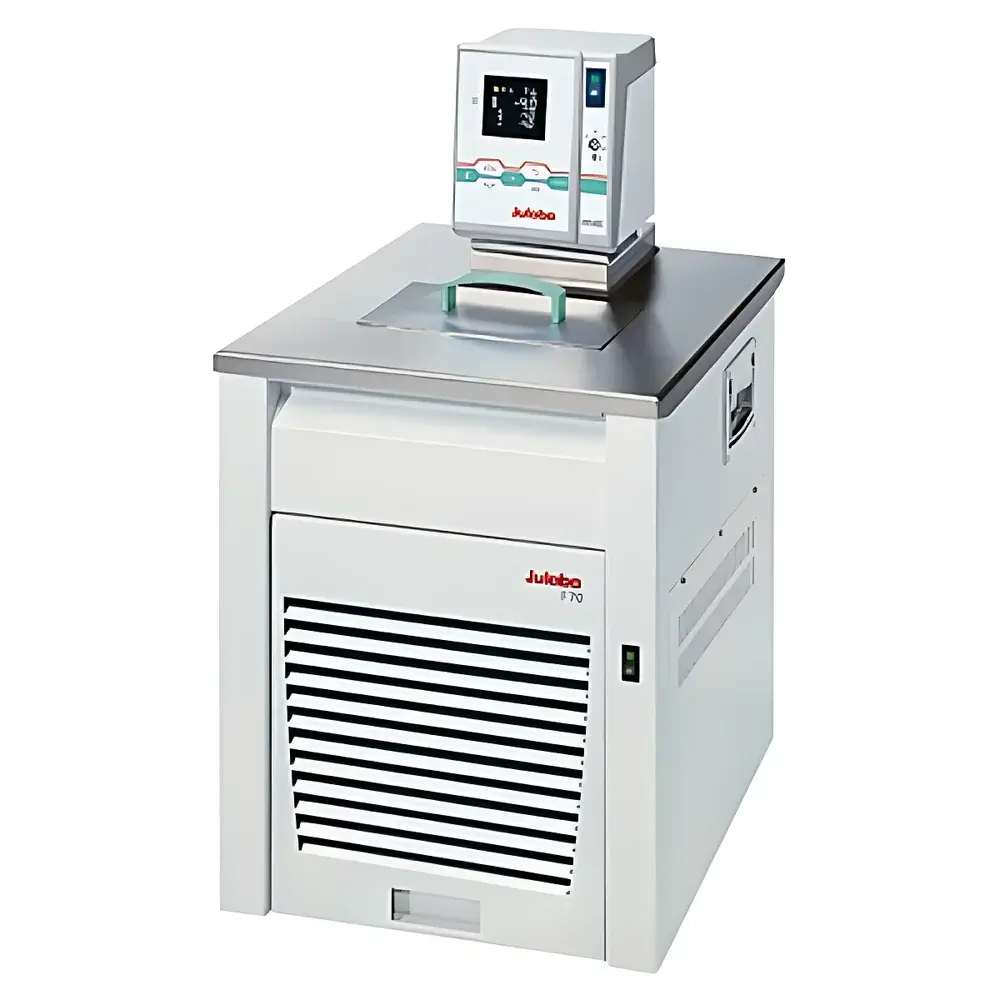
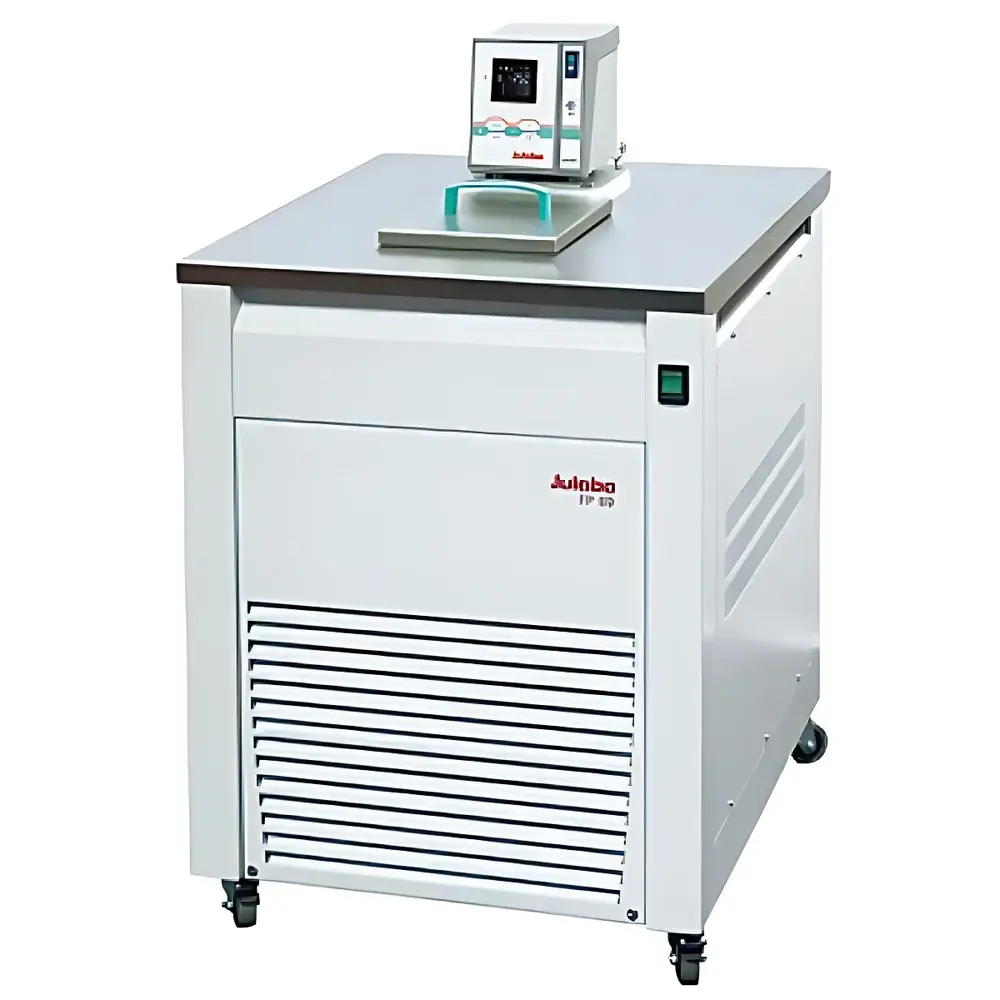
Julabo F81-ME Ultra-Low Temperature Circulating Bath Chiller
| Brand | Julabo |
|---|---|
| Origin | Germany |
| Model | F81-ME |
| Temperature Range | −81 °C to +100 °C |
| Temperature Stability | ±0.02 °C |
| Bath Volume | 6.5 L |
| Circulation Type | Internal & External |
| Control Mode | Heating & Refrigeration |
| Display Resolution | 0.01 °C |
| Heating Power | 1.3 kW |
| Refrigeration Power | 0.45 kW |
| Pump Flow Rate | 11–16 L/min |
| Max. Pump Pressure | 0.45 bar |
| Bath Opening (W × L × D) | 13 × 15 × 16 cm |
| Internal Diameter | 10 mm |
| Refrigerant | R404A (300 g) + R23 (200 g) |
| Compressor | Two-stage air-cooled |
| DIN 12876-1 Classification | Class III (FL) |
| Communication Interface | RS232 |
| External Pt100 Input | Integrated |
| Programming Capacity | 1×10-step ramp/soak |
Overview
The Julabo F81-ME Ultra-Low Temperature Circulating Bath Chiller is an engineered thermal management system designed for precision temperature control across demanding laboratory and industrial applications. Operating on a dual-stage refrigeration principle—combining primary R404A compression with secondary R23 cascade cooling—the F81-ME achieves stable operation from −81 °C to +100 °C without cryogenic fluids or liquid nitrogen dependency. Its thermodynamic architecture integrates high-efficiency heat exchangers, a variable-speed SmartPump™ circulation system, and PID3 digital temperature regulation to deliver rapid thermal response and exceptional long-term stability (±0.02 °C). The unit complies with DIN 12876-1 Class III (FL) safety standards for flammable liquids, making it suitable for use with organic solvents, silicone oils, and other low-flashpoint heat transfer media. Unlike single-stage chillers, the F81-ME maintains consistent refrigeration capacity across its full range—particularly critical during sub-zero ramping—eliminating cold-snap instability and enabling reproducible thermal conditioning of sensitive analytical instrumentation.
Key Features
- VFD white-backlit display showing real-time bath temperature, setpoint, pump pressure, and system status with 0.01 °C resolution
- PID3 adaptive temperature control algorithm with three-point ATC3 calibration support for traceable accuracy verification
- SmartPump™ technology dynamically adjusts motor torque and flow rate in response to fluid viscosity changes—ensuring constant pressure delivery regardless of thermal load or medium type
- Integrated external Pt100 sensor input for closed-loop control of remote reactors, jackets, or columns—enabling direct process temperature feedback without auxiliary controllers
- Programmable 1×10-step temperature profile (ramp/soak) with independent start/stop triggers and event logging
- Dual-level safety architecture: hardware-based overtemperature cut-off (mechanical knob-set limit) plus software-configurable alarms for low fluid level, pump failure, and sensor fault
- Removable front air grille and accessible condenser design simplifying routine maintenance and dust mitigation in ISO-classified lab environments
- Thermally insulated cold-side housing minimizes frost formation and moisture ingress at ultra-low temperatures, reducing dew point-related operational interruptions
Sample Compatibility & Compliance
The F81-ME supports a broad spectrum of heat transfer fluids—including water, ethylene glycol/water mixtures, silicone oils (e.g., DC200 series), and fluorinated solvents—within its certified operating envelope. Its Class III (FL) classification per DIN 12876-1 confirms suitability for continuous operation with flammable media up to flash points ≥ 60 °C. All electrical components meet IEC 61010-1 safety requirements for laboratory equipment. The unit’s construction materials—stainless steel bath vessel, EPDM seals, and corrosion-resistant aluminum heat exchangers—are selected for chemical compatibility and longevity under repeated thermal cycling. Optional RS232 interface enables integration into GLP/GMP workflows requiring audit-trail-capable data capture; when paired with compliant software, it satisfies FDA 21 CFR Part 11 requirements for electronic records and signatures.
Software & Data Management
While standalone operation requires no PC, the integrated RS232 port permits bidirectional communication with host systems using ASCII-based command protocols. Users may log temperature profiles, alarm events, and pump status via third-party SCADA platforms or custom LabVIEW/Python scripts. All parameter changes—including setpoints, program steps, and alarm thresholds—are timestamped and retained in non-volatile memory. The device stores up to 100 hours of internal trend data (sampled every 30 seconds), accessible via serial dump. For regulated environments, optional Profibus-DP modules (available on FP89-ME variants) allow seamless integration into PLC-controlled infrastructure with deterministic cycle times and diagnostic reporting.
Applications
- Calibration of reference thermometers, RTDs, and thermocouples across extended ranges per ASTM E230/E77
- Temperature stabilization of NMR probe preamplifiers, CCD detectors, and laser diodes requiring sub-0.05 °C drift control
- Circulating coolant supply for HPLC column ovens, GC injectors, and mass spectrometer ion sources
- Controlled cooling/heating of reaction vessels in parallel synthesis systems and automated screening platforms
- Material testing under thermal stress per ISO 62, ASTM D648, or IEC 60695-10-2 (glow-wire ignition)
- Environmental simulation of component performance at extreme ambient conditions (−80 °C storage validation, thermal shock profiling)
FAQ
What refrigerants does the F81-ME use, and are they compliant with current environmental regulations?
The F81-ME employs a two-stage refrigerant blend: R404A (300 g) in the primary stage and R23 (200 g) in the secondary cascade stage. While R404A is subject to phasedown under EU F-Gas Regulation (No. 517/2014), Julabo certifies this configuration for laboratory use under exemption clause Art. 11(2)(b). Equipment service and refrigerant recovery must be performed by certified technicians per EN 378-1.
Can the F81-ME maintain ±0.02 °C stability while circulating fluid through an external 5-meter coil?
Yes—provided the external circuit resistance remains within the pump’s specified pressure range (0.23–0.45 bar) and fluid viscosity stays below 50 cSt at operating temperature. SmartPump™ automatically compensates for flow resistance changes; however, optimal stability is achieved with properly insulated external lines and minimal elevation differentials.
Is external Pt100 calibration traceable to national standards?
The ATC3 three-point calibration function supports user-defined offset adjustments at three independent temperatures. When executed with NIST-traceable reference probes, results are fully documented in the internal event log and can serve as part of a laboratory’s metrological chain of custody.



