
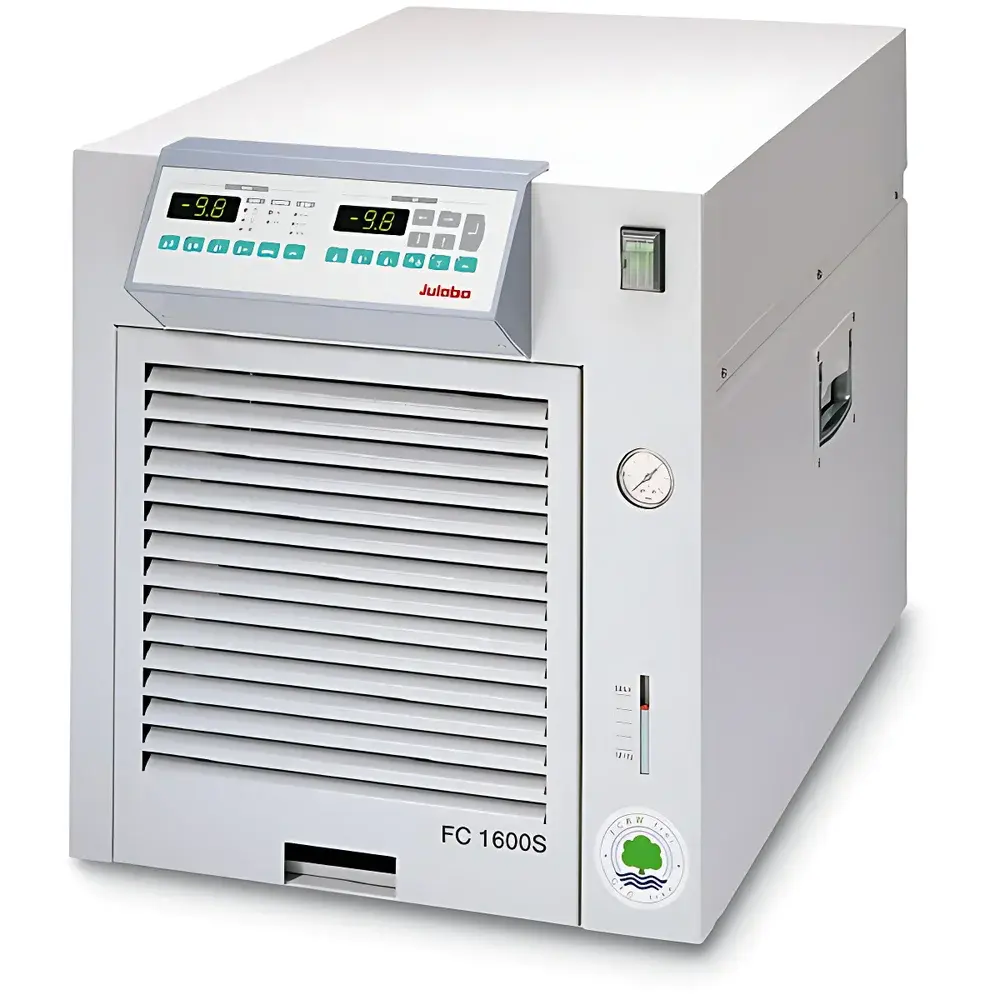
Julabo FC1600S Circulating Chiller
| Brand | Julabo |
|---|---|
| Origin | Germany |
| Model | FC1600S |
| Instrument Type | Integrated Circulating Chiller |
| Cooling Method | Air-Cooled |
| Temperature Range | −15 to +80 °C |
| Temperature Stability | ±0.2 °C |
| Refrigeration Capacity | 1550 W at 20 °C |
| Heating Power | 1.2 kW |
| Pump Flow Rate | 22 L/min |
| Pump Pressure | 1.2 bar |
| Reservoir Volume | 8–11 L |
| Operating Mode | Continuous |
| Refrigerant | R134a (GWP = 1430) |
| Compressor | Single-Stage Hermetic |
| Communication Interface | RS232 |
| Dimensions (W × L × H) | 46 × 61 × 49 cm |
| Weight | 66 kg |
| Sound Pressure Level (1 m) | ≤57 dBA |
| Ambient Operating Temperature | 5–40 °C |
| Hose Connections | Dual quick-fit fittings for 8 mm and 12 mm ID tubing (M16×1 male thread) |
Overview
The Julabo FC1600S Circulating Chiller is an integrated, air-cooled temperature control system engineered for precision thermal management in demanding laboratory and pilot-scale applications. It operates on the principle of closed-loop refrigeration combined with electric resistance heating, enabling bidirectional temperature regulation across a wide span—from sub-zero conditions (−15 °C) up to +80 °C—with high stability (±0.2 °C) and repeatability. Unlike tap-water-based cooling solutions, the FC1600S eliminates reliance on municipal water supply, reducing resource consumption and operational risk associated with variable inlet temperatures or scaling. Its compact footprint (46 × 61 × 49 cm), robust stainless-steel reservoir construction, and intelligent thermal load adaptation make it suitable for integration with analytical instruments—including HPLC columns, spectrophotometer detectors, laser sources, rotary evaporators, and reactor jackets—where consistent heat extraction and precise setpoint maintenance are critical to data integrity and process reproducibility.
Key Features
- Integrated dual-mode temperature control: simultaneous refrigeration (up to 1550 W at 20 °C ambient) and heating (1.2 kW) for seamless ramping and hold cycles
- Air-cooled condenser with low-noise, high-efficiency single-stage hermetic compressor using R134a refrigerant (GWP 1430), compliant with current EU F-Gas Regulation Annex I thresholds for laboratory equipment
- Dual LED display interface showing both setpoint and actual bath temperature, with 0.1 °C resolution and intuitive navigation
- High-capacity circulation pump delivering 22 L/min at 1.2 bar pressure, compatible with standard 8 mm and 12 mm ID silicone or fluoropolymer tubing via M16×1 male-threaded ports
- Reservoir volume of 8–11 L with visual level indicator and top-fill access port for simplified fluid maintenance
- Programmable inlet/outlet temperature differential control to optimize thermal transfer efficiency in external systems
- RS232 serial interface supporting remote monitoring, parameter logging, and integration with LabVIEW, SCADA, or custom PLC-based control architectures
- Optional external Pt100 sensor input for process-critical applications requiring direct load temperature feedback and cascade control
Sample Compatibility & Compliance
The FC1600S is designed for use with aqueous and water-glycol mixtures (e.g., 30% propylene glycol) as heat transfer fluids, ensuring compatibility with corrosion-sensitive instrumentation components. It meets EN 61000-6-3 (EMC emission limits) and EN 61000-6-2 (immunity requirements) for laboratory environments. While not certified for Class I Div 1 hazardous locations, its electrical architecture conforms to IEC 61010-1:2010 safety standards for laboratory equipment. The unit supports GLP-compliant operation when paired with validated data acquisition systems; audit trails, user access levels, and parameter change logs can be implemented externally via RS232-driven software platforms aligned with FDA 21 CFR Part 11 electronic record requirements.
Software & Data Management
The FC1600S does not include embedded graphical software but provides full command-line protocol documentation for RS232 communication (ASCII-based SCPI-like syntax). Third-party integration is supported through open serial protocols enabling real-time temperature logging, alarm triggering (e.g., low-level, overtemperature, pump failure), and scheduled start/stop sequences. When deployed in regulated environments, users commonly pair the chiller with validated temperature monitoring systems such as DeltaTrak Vision or Tulip LabManager, which provide 21 CFR Part 11-compliant electronic signatures, role-based permissions, and encrypted data storage. Firmware updates are performed locally via USB-to-serial adapter and require no network connectivity—minimizing cybersecurity exposure in isolated lab networks.
Applications
- HPLC and UHPLC column ovens and detector cells requiring stable sub-ambient or elevated operating temperatures
- Cooling of high-power lasers (e.g., Ti:sapphire, DPSS) where thermal lensing must be minimized
- Temperature stabilization of FTIR, Raman, and UV-Vis spectrometer optical benches
- Process cooling for small-scale chemical reactors, crystallizers, and distillation units
- Environmental simulation testing of electronic components under controlled thermal stress profiles
- Support for calorimetry systems where precise heat flux measurement depends on constant coolant temperature
FAQ
What is the maximum allowable inlet fluid temperature when operating at +80 °C setpoint?
The FC1600S permits return fluid temperatures up to 80 °C, enabling safe integration with heated jacketed vessels without thermal shock to the chiller’s internal heat exchanger.
Can the FC1600S maintain ±0.2 °C stability under dynamic load conditions?
Yes—the specified stability is verified under steady-state conditions with a minimum flow rate of 15 L/min and thermal load variation <10% of nominal refrigeration capacity; dynamic stability depends on external system thermal mass and flow characteristics.
Is R134a refrigerant serviceable in the field by authorized technicians?
Refrigerant charging and recovery must be performed by F-Gas-certified personnel using calibrated recovery equipment; sealed-system integrity is verified during factory commissioning and should not be compromised during normal operation.
Does the unit support 0–10 V or 4–20 mA analog control inputs?
No—the FC1600S features only digital RS232 communication; analog interfacing requires external signal converters configured per user-defined protocol mapping.
What maintenance intervals are recommended for optimal long-term performance?
Filter inspection every 6 months; reservoir cleaning and fluid replacement annually or after 2000 operating hours—whichever occurs first—using Julabo-recommended heat transfer fluids to prevent degradation-related viscosity shifts and corrosion.



