
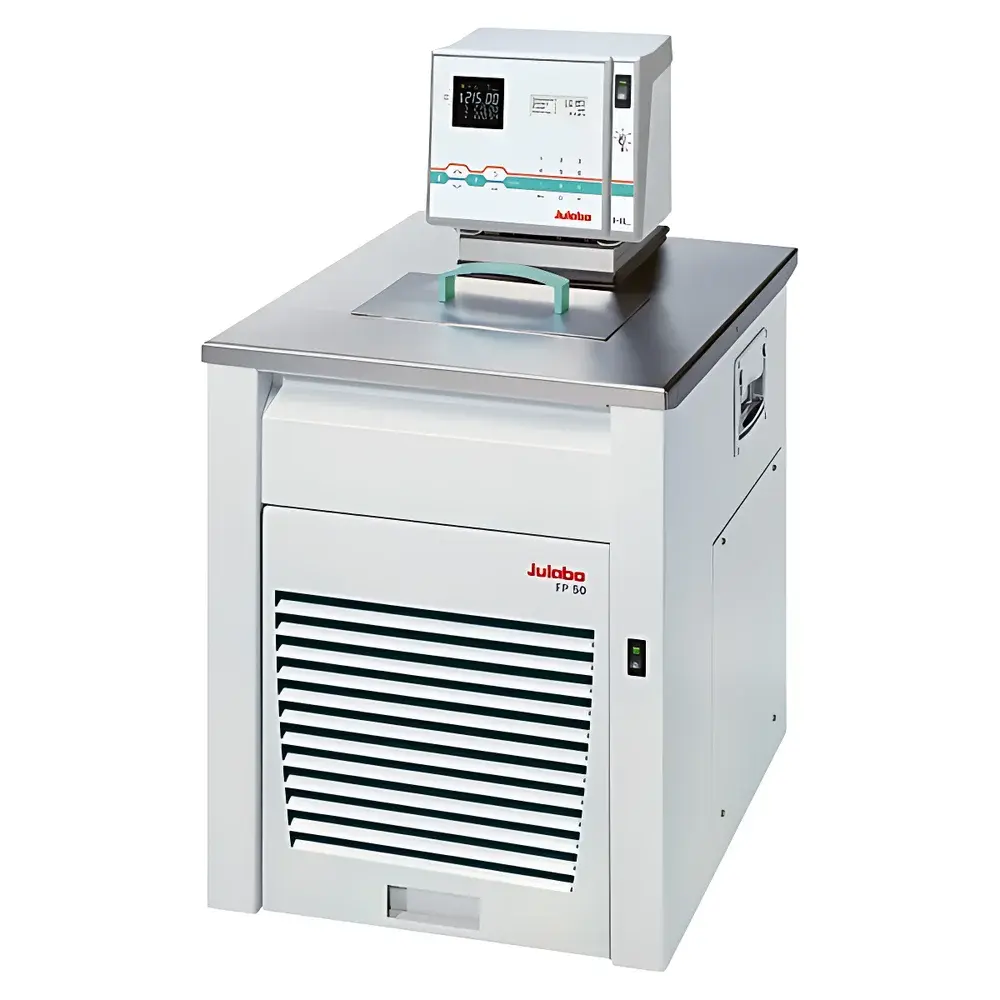
Julabo FPW50-HL Universal Heating and Cooling Circulating Bath
| Brand | Julabo |
|---|---|
| Origin | Germany |
| Model | FPW50-HL |
| Temperature Range | −50 to +200 °C |
| Temperature Stability | ±0.01 °C |
| Bath Volume | 8 L |
| Circulation Type | Internal & External |
| Control Technology | ICC (Intelligent Control Circuit) + TCF (Temperature Control Function) |
| Pump Flow Rate | 22–26 L/min |
| Max. Pump Pressure | 0.7 bar |
| Heating Power | 2 kW |
| Refrigeration Power (at 20 °C) | 0.9 kW |
| Refrigerant | R404A (GWP 3922) |
| Display | VFD + Backlit LCD |
| Communication | RS232, RS485 (optional Profibus), Integrated Pt100 Input |
| Programming | 6 programs × 60 steps |
| Safety | Low-level detection, Overtemperature cutoff, DIN 12876-1 Class III (FL) certified |
| Cooling Method | Water-cooled compressor |
| Dimensions (W×L×H) | 42 × 49 × 70 cm |
| Weight | 57 kg |
Overview
The Julabo FPW50-HL is a high-precision, dual-mode heating and cooling circulating bath engineered for demanding laboratory applications requiring stable thermal control across an exceptionally wide operating range—from −50 °C to +200 °C. Unlike conventional thermostats limited to narrow temperature spans or single-mode operation, the FPW50-HL integrates a water-cooled single-stage R404A refrigeration system with a 2 kW resistive heating module and intelligent adaptive control architecture. Its core function is to deliver precise, reproducible heat transfer to both internal bath media and external process systems—including jacketed reactors, viscometers, refractometers, spectrophotometers, and calorimeters—via closed-loop circulation. The device operates under the principles of forced convection thermoregulation: fluid is actively pumped through a thermally optimized heat exchanger, where real-time power modulation (heating/refrigeration) maintains setpoint accuracy within ±0.01 °C under dynamic load conditions. Designed in accordance with DIN 12876-1 Class III (FL) safety standards for flammable liquid environments, the FPW50-HL meets structural, electrical, and operational requirements for use with organic solvents and high-boiling-point oils.
Key Features
- Intelligent ICC (Intelligent Control Circuit) algorithm with auto-tuning capability—dynamically optimizes PID parameters based on thermal load, fluid viscosity, and ambient conditions.
- TCF (Temperature Control Function) enhances stability during ramping and dwell phases by suppressing overshoot and minimizing settling time.
- ATC3 three-point calibration routine enables traceable, user-performed temperature verification at −20 °C, +20 °C, and +80 °C using external Pt100 reference sensors.
- SmartPump technology continuously monitors backpressure and adjusts motor torque to maintain consistent flow (22–26 L/min) across varying fluid viscosities—from water to silicone oil or glycol mixtures.
- VFD (Vacuum Fluorescent Display) paired with backlit LCD provides simultaneous readout of bath temperature, external sensor reading, setpoint, pump status, and alarm history.
- Integrated Pt100 input channel allows direct connection of an external probe for accurate, location-specific temperature feedback and control of remote equipment.
- Programmable sequence controller supports up to six independent temperature profiles, each containing up to 60 time-temperature steps with ramp rate definition and hold functionality.
- Comprehensive safety suite includes low-bath-level detection, overtemperature cutoff (mechanical rotary dial + digital threshold), refrigerant leak monitoring, and automatic shutdown upon communication timeout or pump stall.
Sample Compatibility & Compliance
The FPW50-HL accommodates a broad spectrum of heat transfer fluids—including deionized water, 50/50 ethylene glycol/water blends, silicone oils (e.g., DC200 series), and specialized low-temperature baths—within its 8 L stainless-steel reservoir. Its M16×1 pump ports accept standard 8 mm and 12 mm ID tubing via included bayonet fittings, while the front-mounted drain valve simplifies fluid exchange and maintenance. Certified to DIN 12876-1 Class III (FL), the unit is rated for safe operation with flammable liquids up to flash point 60 °C. Electrical compliance includes CE marking per 2014/30/EU (EMC) and 2014/35/EU (LVD). Refrigerant handling adheres to EU F-Gas Regulation (EC) No 517/2014; R404A charge (480 g) is documented for service and recovery reporting. The device supports GLP/GMP workflows through configurable audit trails (via optional software), event logging, and 21 CFR Part 11–compatible data export when integrated with Julabo’s Labworldsoft platform.
Software & Data Management
The FPW50-HL features native RS232 and RS485 serial interfaces for bidirectional communication with host PCs or PLC-based control systems. When connected to Labworldsoft (v4.0+), users gain access to full remote parameter configuration, real-time graphing of up to four channels (bath temp, external sensor, setpoint, pump speed), automated report generation (PDF/CSV), and electronic signature-enabled validation protocols. Optional analog I/O modules (0–10 V / 4–20 mA) enable integration into centralized building management or process automation systems. All temperature events—including alarms, program transitions, and calibration actions—are timestamped and stored in non-volatile memory for ≥10,000 entries. Firmware updates are performed via USB port using signed binaries, ensuring integrity and version traceability.
Applications
- Reaction calorimetry: Precise jacket temperature control for exothermic/endothermic synthesis monitoring in glass or stainless-steel reactors.
- Rheological testing: Stabilization of sample cells in rotational rheometers (e.g., Anton Paar MCR series) and capillary viscometers across sub-zero to elevated temperatures.
- Optical instrumentation: Thermal conditioning of cuvettes, flow cells, and prism assemblies in UV-Vis, FTIR, and refractometric analyzers to minimize thermal drift.
- Material testing: Conditioning of polymer samples prior to DSC, TMA, or DMA analysis; maintaining constant bath temperature during melt flow index (MFI) tests per ASTM D1238.
- Pharmaceutical QC: USP compliant temperature control for sterility test incubators and dissolution apparatus water baths.
- Accelerated aging studies: Execution of ICH Q1A-compliant temperature cycling protocols for stability testing of APIs and formulations.
FAQ
What is the minimum recommended fluid volume for stable operation?
The reservoir must be filled to at least 6 L to ensure proper immersion of the heating element and refrigeration coil, prevent dry-run damage, and maintain thermal mass sufficient for ±0.01 °C stability.
Can the FPW50-HL operate without external cooling water?
No. As a water-cooled unit, it requires a continuous supply of clean, deionized water at 10–30 °C and ≥2 bar pressure to reject condenser heat. Failure to supply adequate cooling water will trigger immediate shutdown.
Is external temperature control possible without modifying the internal bath setup?
Yes. Using the integrated Pt100 input and “External Sensor Control” mode, the unit regulates circulation temperature solely based on the external probe signal—bypassing internal bath feedback entirely.
How often should ATC3 calibration be performed?
Julabo recommends ATC3 verification before first use, after major maintenance, following transport-induced shock, and at intervals defined by internal quality procedures—typically every 6 months for GLP environments.
Does the FPW50-HL support Modbus RTU protocol?
Not natively. RS485 communication uses Julabo’s proprietary ASCII command set; however, third-party protocol converters or Labworldsoft can translate to Modbus RTU for SCADA integration.



