
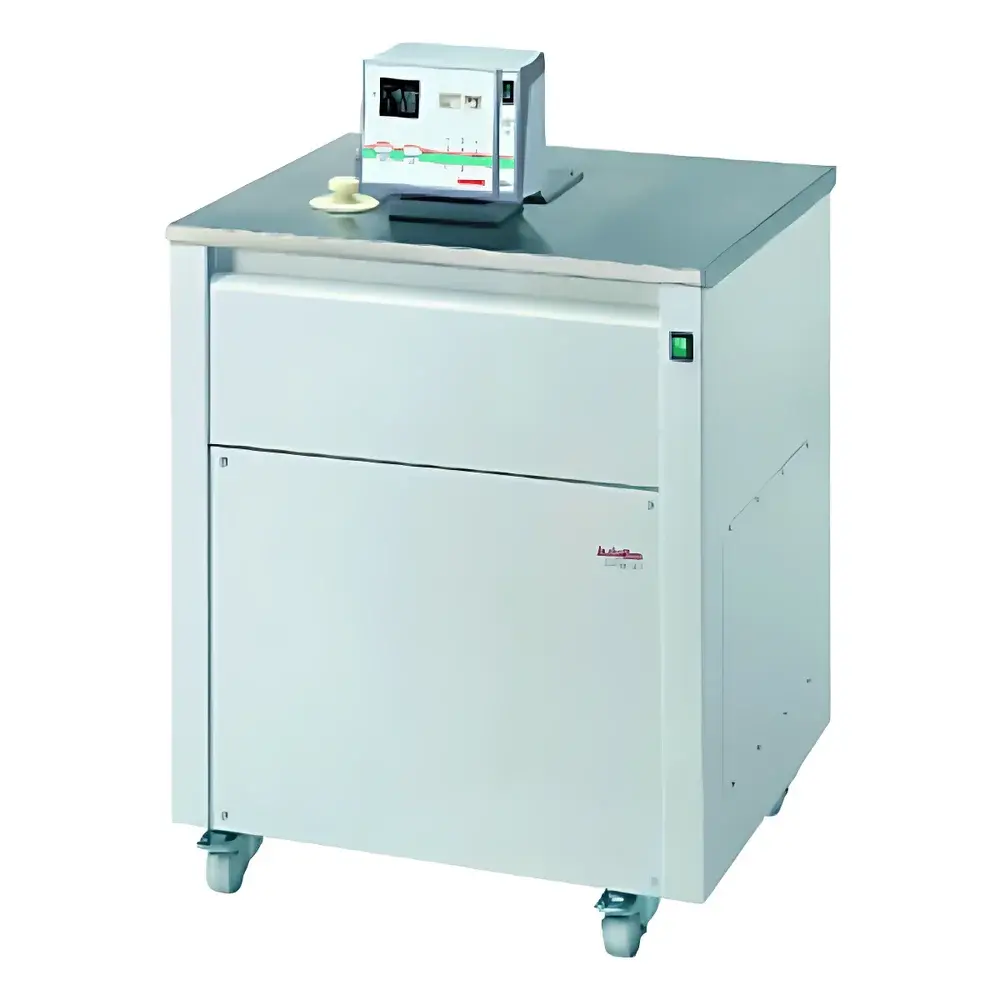
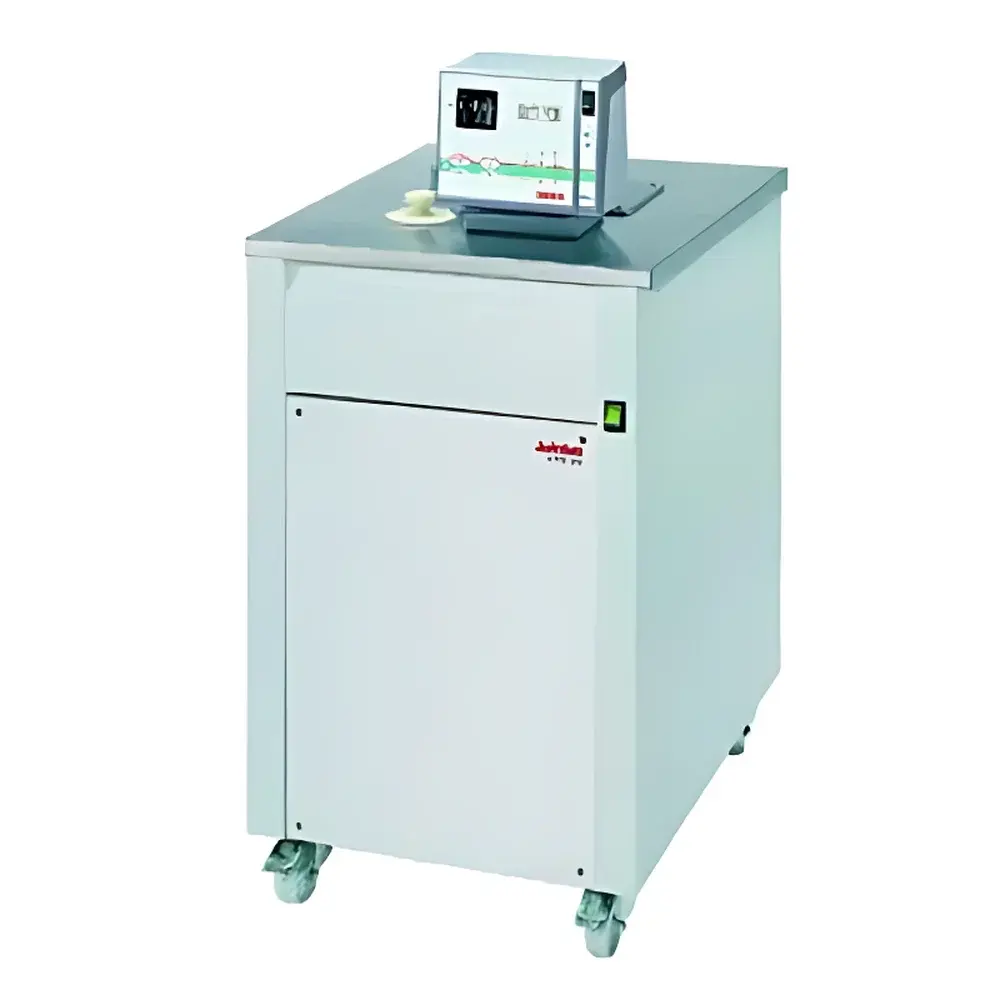
Julabo FPW90-SL Ultra-Low Temperature Heating and Cooling Circulating Bath
| Brand | Julabo |
|---|---|
| Origin | Germany |
| Model | FPW90-SL |
| Temperature Range | −90 °C to +100 °C |
| Temperature Stability | ±0.05 °C |
| Display Resolution | 0.01 °C |
| Heating Power | 3 kW |
| Refrigeration Power (at 20 °C / 0 °C / −20 °C / −40 °C / −60 °C / −80 °C) | 1.8 / 1.7 / 1.6 / 1.35 / 0.75 / 0.15 kW |
| Pump Flow Rate | 22–26 L/min |
| Pump Pressure | 0.4–0.7 bar |
| Pump Suction | 0.2–0.4 bar |
| Internal Bath Volume | 22 L |
| Refrigerant System | Two-stage cascade (R404A + R23) |
| Communication Interfaces | RS232, RS485 (optional Profibus) |
| Safety Classification | DIN 12876-1 Class III (FL) |
| Cooling Method | Water-cooled compressor |
| External PT100 Input | Integrated |
| Programmable Steps | 6 programs × 60 steps each |
Overview
The Julabo FPW90-SL is an ultra-low temperature heating and cooling circulating bath engineered for high-precision thermal control in demanding laboratory and industrial applications. Utilizing a two-stage cascade refrigeration system with R404A (first stage) and R23 (second stage), the FPW90-SL achieves stable operation across an exceptional temperature range of −90 °C to +100 °C—enabling cryogenic process validation, low-temperature reaction kinetics studies, material property testing at extreme conditions, and calibration of sensors and instrumentation under ISO/IEC 17025-compliant thermal environments. Its dual-mode circulation architecture supports both internal bath temperature regulation and external system temperature control via integrated pump and external Pt100 sensor feedback, making it suitable for jacketed reactors, calorimeters, spectroscopic cells, and custom thermal test rigs. The unit complies with DIN 12876-1 Class III (FL) safety requirements for flammable liquid handling, ensuring safe operation with organic solvents and low-flashpoint heat transfer media.
Key Features
- VFD white-backlit display with simultaneous readout of setpoint, actual bath temperature, external sensor temperature, and system status parameters
- Intelligent ICC (Intelligent Control Concept) auto-tuning algorithm dynamically optimizes PID parameters for minimal overshoot and rapid stabilization across the full temperature span
- TCF (Temperature Control Function) mode enhances thermal response during transient load changes, particularly critical during exothermic/endothermic reaction monitoring
- ATC3 three-point temperature calibration support ensures traceable accuracy per ISO/IEC 17025 requirements; enables user verification at −40 °C, 0 °C, and +60 °C using certified reference probes
- SmartPump technology automatically adjusts motor torque and flow output based on real-time viscosity estimation—maintaining consistent pressure head when switching between water, silicone oil, or ethylene glycol/water mixtures
- Modular electromagnetic valve interface supports coordinated control of auxiliary cooling water supply and high-static-pressure (HSP) booster pumps for extended external loop configurations
- Water-cooled condenser design eliminates dependency on ambient air temperature fluctuations, enabling stable performance in rooms up to 40 °C ambient (per DIN EN 61000-6-3)
- Removable front grille and accessible condenser coil facilitate routine maintenance without disassembly; integrated frost-inhibiting insulation minimizes ice accumulation at sub-zero operating points
Sample Compatibility & Compliance
The FPW90-SL accommodates a broad spectrum of heat transfer fluids—including deionized water, aqueous glycol solutions, silicone oils (e.g., DC200 series), and specialized low-temperature baths (e.g., ethanol/dry ice slurries)—within its 22 L working volume. Its M16×1 pump ports accept standard 8 mm and 12 mm ID flexible tubing, while the G¾″ cooling water inlet permits connection to facility-supplied chilled water circuits meeting ASTM D1193 Type IV specifications. The unit conforms to IEC 61010-1:2010 for electrical safety, EN 61326-1:2013 for EMC immunity, and carries CE marking under the EU Machinery Directive 2006/42/EC. For regulated environments, optional firmware enables audit-trail logging compatible with FDA 21 CFR Part 11 requirements when paired with validated PC-based control software.
Software & Data Management
Standard RS232 serial communication allows bidirectional command-and-control integration with LabVIEW™, MATLAB®, or custom SCADA platforms. Optional RS485 or Profibus DP modules enable multi-unit daisy-chaining in centralized process control systems. The embedded 6×60-step programmable controller supports time-temperature ramps, holds, and conditional logic (e.g., trigger external event upon reaching −78 °C). All temperature setpoints, alarm thresholds, and calibration offsets are stored in non-volatile memory with battery-backed retention. Raw data export (CSV format) includes timestamped bath temperature, external sensor reading, pump status, compressor duty cycle, and error codes—facilitating GLP-compliant recordkeeping and statistical process analysis per ISO 10012.
Applications
- Cryogenic characterization of polymers, composites, and superconducting materials per ASTM D7028 and ISO 6721
- Low-temperature enzymatic assay development and stability testing in pharmaceutical QC laboratories
- Calibration of infrared thermometers, RTDs, and thermocouples across extended ranges (−80 °C to +100 °C)
- Thermal cycling validation of electronic components per JEDEC JESD22-A104
- Controlled cooling of NMR probe preamplifiers and laser diode mounts requiring sub-ambient stabilization
- Process simulation for cryogenic distillation columns and LNG-related pilot-scale equipment
FAQ
What is the minimum achievable temperature with external load connected?
The FPW90-SL maintains −90 °C at the bath sensor under no-load conditions. With a typical 5 m external loop (12 mm ID tubing, 3 L fluid volume), the practical lower limit is −85 °C at the external sensor location, assuming adequate insulation and ≤150 W thermal load.
Is the unit suitable for use with flammable solvents?
Yes—certified to DIN 12876-1 Class III (FL), it incorporates explosion-proof electronics, sealed motor windings, and vapor-tight housing for safe operation with ethanol, acetone, and other Class I flammable liquids.
Can the FPW90-SL be integrated into a LIMS or MES environment?
Via optional Profibus DP or Modbus TCP gateway modules (sold separately), the unit supports OPC UA–compliant data exchange and alarm forwarding to enterprise-level manufacturing execution systems.
How often does ATC3 calibration require verification?
Julabo recommends annual verification using NIST-traceable reference standards; the built-in ATC3 function allows user-performed field calibration without sending the unit to service.
What cooling water specifications are required for reliable operation?
Facility water must be deionized or softened (≤100 ppm hardness), maintained at 10–25 °C inlet temperature and ≥3 bar pressure, with flow rate ≥1.2 L/min per compressor stage.



