
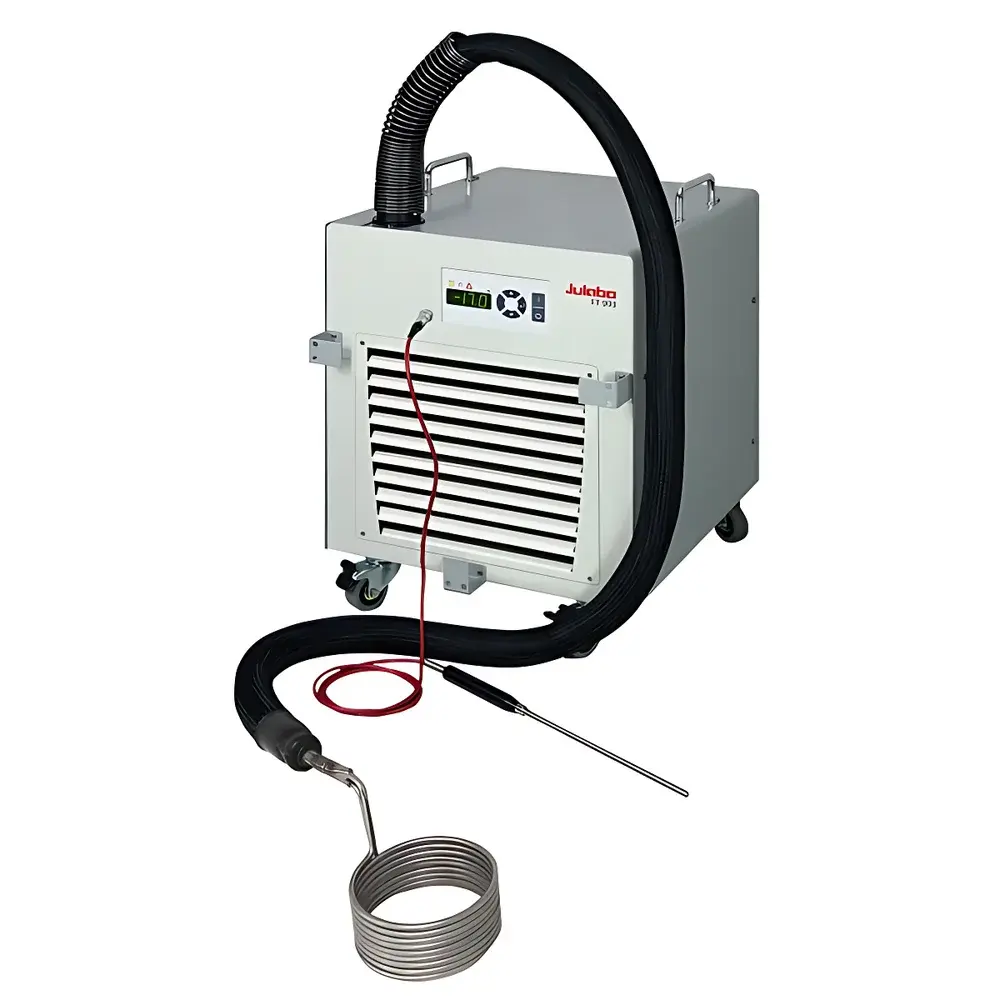
JULABO FT100 Immersion Circulating Chiller
| Brand | JULABO |
|---|---|
| Origin | Germany |
| Model | FT100 |
| Type | Immersion (Bathless) Circulating Chiller |
| Cooling Method | Air-Cooled |
| Temperature Range | −100 °C to +20 °C |
| Refrigeration Capacity | 0.16 kW at 20 °C, 0.14 kW at −20 °C, 0.09 kW at −60 °C, 0.03 kW at −90 °C |
| Temperature Stability | ±0.1 °C |
| Reservoir Volume | 110 L |
| Compressor Type | Single-Stage Hermetic |
| Refrigerant | R134a (GWP = 1430) |
| CO₂-Equivalent Emissions | 0.157 t per unit |
| Dimensions (W × L × H) | 38 × 55 × 60 cm |
| Weight | 58 kg |
| Immersion Probe Dimensions | 7.5 × Ø1.8 cm (L × Ø) |
| Hose Length | 190 cm |
| Operating Ambient | 5–40 °C |
Overview
The JULABO FT100 Immersion Circulating Chiller is a high-performance, air-cooled low-temperature thermal management system engineered for precise and stable sub-ambient temperature control in demanding laboratory applications. Unlike conventional bath-type chillers, the FT100 employs an immersion cooling architecture—delivering refrigeration directly through a compact, stainless-steel probe inserted into the user’s process vessel or jacketed reactor. This design eliminates heat transfer losses associated with external baths and enables rapid thermal response, particularly critical in cryogenic reaction control, low-temperature spectroscopy, and superconductivity testing. The system operates across a wide span of −100 °C to +20 °C using a single-stage hermetic compressor and environmentally compliant R134a refrigerant (GWP 1430), meeting EU F-Gas Regulation (EU No. 517/2014) requirements for lab-scale equipment. Its integrated refrigeration circuit is optimized for continuous-duty operation under ambient conditions ranging from 5 °C to 40 °C, ensuring reproducible thermal performance without condensation risk or thermal drift.
Key Features
- Ultra-low temperature capability down to −100 °C, enabling replacement of dry ice and liquid nitrogen in controlled, repeatable experiments
- Stainless-steel immersion probe (7.5 × Ø1.8 cm) with electropolished surface finish for corrosion resistance and compatibility with organic solvents, aqueous media, and cryogenic fluids
- High thermal efficiency due to direct conduction path: refrigerant loop terminates inside the probe, minimizing thermal lag and maximizing heat extraction rate
- Stable temperature control with ±0.1 °C fluctuation over time—validated per ISO 17025-compliant calibration procedures using traceable PT100 reference sensors
- Air-cooled condenser with intelligent fan speed modulation reduces acoustic noise (<62 dB(A)) and adapts to ambient load variations without manual intervention
- Robust mechanical architecture: 58 kg cast-aluminum chassis, IP20-rated electrical enclosure, and vibration-damped compressor mounting for long-term reliability in shared lab environments
Sample Compatibility & Compliance
The FT100 is designed for integration with externally sourced vessels—including jacketed glass reactors (e.g., ChemGlass, Ace Glass), stainless-steel bioreactors, and custom-built calorimetry cells—via standard 1/2″ NPT or G1/2 threaded connections. Its immersion probe is chemically inert to common laboratory media (e.g., ethanol, acetone, ethylene glycol/water mixtures, silicone oils). The unit complies with IEC 61010-1:2010 for electrical safety in laboratory equipment and meets EMC requirements per EN 61326-1:2013. While not certified for hazardous area use (ATEX/IECEx), it carries CE marking and conforms to RoHS 2011/65/EU and WEEE 2012/19/EU directives. For GLP/GMP-regulated workflows, optional audit-trail-enabled digital interfaces support 21 CFR Part 11-compliant data logging when paired with JULABO’s optional software suite.
Software & Data Management
The FT100 features a built-in microprocessor controller with dual-display interface (setpoint and actual temperature), 0.1 °C resolution, and programmable ramp/soak profiles. It supports analog output (0–10 V or 4–20 mA) for integration into SCADA or DCS systems. Optional JULABO LabSoft™ software enables remote monitoring, real-time graphing, CSV export, and automated report generation—including timestamped deviation alerts and calibration history tracking. All temperature logs are stored with metadata (operator ID, session tag, ambient condition snapshot), satisfying documentation requirements for ISO/IEC 17025 accreditation and internal quality audits.
Applications
- Cryogenic chemical synthesis requiring sustained −80 °C to −100 °C reaction control (e.g., organolithium chemistry, Grignard quenching)
- Low-temperature material characterization: DSC sample cooling, XRD cryostage pre-conditioning, and rheological testing of polymer melts below Tg
- Pharmaceutical stability studies per ICH Q1A(R2), including accelerated degradation at sub-zero storage conditions
- Electronics testing: thermal cycling of semiconductor packages and PCB assemblies under controlled cold bias
- Integration with JULABO heating circulators (e.g., HL-Series) to form bidirectional temperature control systems capable of −100 °C to +200 °C coverage via external heat exchanger loops
FAQ
Can the FT100 operate continuously at −100 °C?
Yes—the system is rated for uninterrupted operation at its minimum setpoint, provided ambient temperature remains ≤35 °C and adequate ventilation is maintained around the condenser.
Is external temperature feedback required for accurate control?
No; the standard configuration includes a calibrated PT100 sensor (200 × Ø6 mm, stainless steel sheath, 1.5 m cable) for direct process measurement, eliminating reliance on chiller outlet temperature alone.
What maintenance intervals are recommended?
Compressor oil inspection every 24 months; refrigerant leak check annually; immersion probe cleaning with isopropanol after each solvent-based application.
Does the FT100 support external communication protocols?
Yes—RS232 and optional Ethernet (Modbus TCP) interfaces enable integration with LabVIEW, MATLAB, or custom LIMS platforms.
Can it cool viscous or particulate-laden fluids?
It is intended for clean, low-viscosity heat transfer fluids (e.g., water/glycol mixtures, silicone oils 50 µm may obstruct the probe’s internal flow path and void warranty.



