
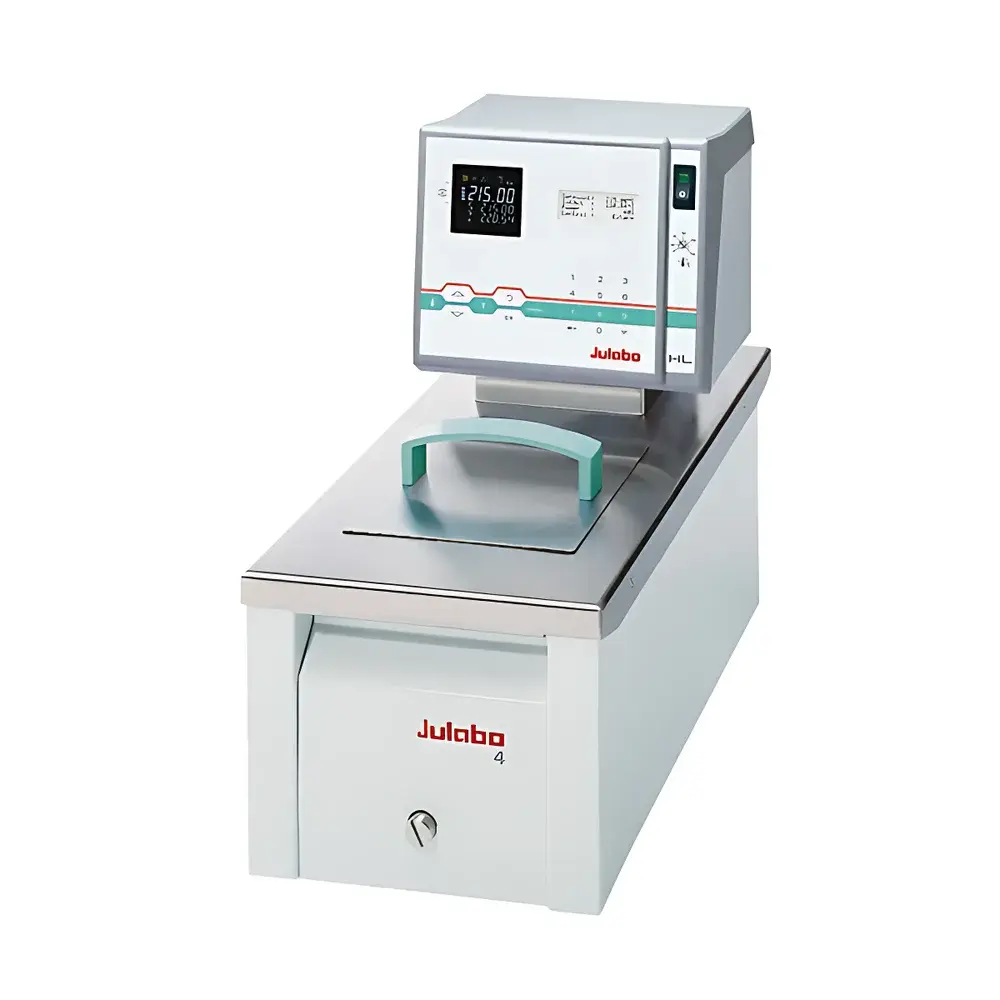
Julabo HL-4 Heating Circulating Bath
| Brand | Julabo |
|---|---|
| Origin | Germany |
| Model | HL-4 |
| Instrument Type | Heating Circulating Bath |
| Temperature Range | +5 to +250 °C |
| Temperature Stability | ±0.01 °C |
| Bath Volume | 4.5 L |
| Heating Power | 2 kW |
| Pump Flow Rate | 22–26 L/min |
| Pump Pressure | 0.4–0.7 bar |
| Bath Opening/Depth (W×L/D) | 13×15/15 cm |
| Internal Tubing Diameter | 8/12 mm |
| Weight | 11 kg |
| Dimensions (W×L×H) | 21×42×40 cm |
| Display | VFD LCD with Dual-Temperature Monitoring |
| Control Interface | RS232 / RS485 (optional Profibus) |
| Safety Class | DIN 12876-1 Class III (FL) |
| Programmable Ramp-Soak Profiles | 6×60 steps |
Overview
The Julabo HL-4 Heating Circulating Bath is a precision-engineered thermal management system designed for laboratory and industrial applications requiring stable, controllable heating across a wide operational range—from +5 °C up to +250 °C. Based on Julabo’s proprietary ICC (Intelligent Control Circuit) temperature regulation architecture, the HL-4 delivers exceptional thermal stability of ±0.01 °C under steady-state conditions—critical for applications demanding high reproducibility in material testing, analytical instrumentation support, and process validation. Unlike basic immersion heaters or non-circulating baths, the HL-4 integrates dual-mode circulation (internal bath recirculation and external loop delivery), enabling precise thermal conditioning of both submerged samples and externally connected equipment such as jacketed reactors, viscometers, chromatography columns, polarimeters, electrophoresis units, and spectrophotometers. Its stainless-steel construction, integrated cooling coil, and Class III (FL) certification per DIN 12876-1 permit safe operation with flammable heat transfer media—including silicone oils and glycols—without compromising structural integrity or regulatory compliance.
Key Features
- ICC Intelligent Temperature Control: Eliminates need for manual tuning; maintains setpoint stability without self-diagnostic intervention
- VFD-enhanced LCD display: Simultaneously shows set temperature, internal bath temperature, and external Pt100 sensor reading; supports real-time monitoring of pump power level, heating status, liquid level, output percentage, and supply voltage
- ATC3 three-point user calibration: Enables traceable in-house verification at user-defined temperatures (e.g., 25 °C, 100 °C, 200 °C) to maintain metrological confidence over time
- Smart Pump technology: Automatically adjusts impeller speed and pressure output based on fluid viscosity and system backpressure—ensuring consistent flow across changing thermal loads
- TCF (Temperature Control Framework): Configurable parameters include inter-temperature differential limits, dynamic ramp/soak profiles, and adaptive response algorithms for complex thermal sequences
- Dual safety architecture: Independent overtemperature cutoff with mechanical dial setting (C-temp alarm), plus programmable upper/lower temperature limits with audible and visual alerts
- Integrated external Pt100 input: Supports direct feedback control of remote systems—enabling closed-loop temperature regulation independent of bath fluid temperature
- 6×60-step programmable controller: Allows multi-segment thermal protocols for accelerated aging studies, thermal cycling, or reaction kinetics experiments
- Communication-ready interface: Standard RS232/RS485 ports support SCADA integration; optional Profibus-DP module enables seamless PLC synchronization in automated lab environments
Sample Compatibility & Compliance
The HL-4 accommodates diverse sample formats and thermal media. Its 4.5 L stainless-steel bath chamber accepts standard 8 mm and 12 mm flexible tubing via dual M16×1 pump ports, facilitating rapid connection to external loops. With a maximum operating temperature of +250 °C and certified Class III (FL) design per DIN 12876-1, it complies with stringent European safety requirements for use with combustible heat transfer fluids. The unit meets general electrical safety standards IEC 61010-1 and carries CE marking for laboratory use within the EU. While not inherently FDA 21 CFR Part 11 compliant, its audit-trail-capable software interface (when paired with Julabo’s LabSoft or third-party LIMS platforms) supports GLP/GMP-aligned workflows where electronic record integrity is required. No hazardous substances are used in construction per RoHS Directive 2011/65/EU.
Software & Data Management
The HL-4 operates autonomously via front-panel controls but is fully interoperable with Julabo’s LabSoft suite and generic terminal emulators via ASCII-based command protocol over RS232/RS485. Remote configuration, real-time data logging (temperature, pump status, alarms), and profile upload/download are supported. When integrated into larger automation frameworks, analog I/O modules enable 0–10 V or 4–20 mA signal mapping for PLC-driven start/stop, temperature setpoint modulation, or fault signaling. All communication events—including parameter changes and alarm triggers—are timestamped and can be exported in CSV format for traceability. Optional Profibus-DP integration provides deterministic cycle times (<10 ms) suitable for synchronized multi-device thermal control networks.
Applications
- Thermal conditioning of analytical instruments: Maintaining constant column oven temperature in HPLC/UHPLC systems; stabilizing detector housings in UV-Vis and fluorescence spectrometers
- Materials science testing: Controlled heating of polymer melts during rheological characterization or tensile strength evaluation under thermal load
- Chemical synthesis: Precise jacket temperature control for exothermic/endothermic reactions in glass or stainless-steel reactors
- Pharmaceutical QC: USP and -aligned temperature validation of dissolution apparatus baths and stability chambers
- Calibration laboratories: Serving as a stable reference source for thermometer and RTD calibration across extended ranges
- Electronics reliability testing: Thermal soak profiling of PCB assemblies prior to functional testing
FAQ
Can the HL-4 be used with silicone oil as a heat transfer medium?
Yes—the HL-4 is certified Class III (FL) per DIN 12876-1 and rated for continuous operation up to +250 °C, making it compatible with common silicone oils and other non-aqueous thermal fluids.
Does the HL-4 support external temperature feedback control?
Yes—it features a built-in Pt100 input channel for direct connection of an external probe, enabling true process temperature regulation rather than bath-fluid-only control.
Is the pump flow rate adjustable manually?
No—pump output is automatically regulated by Smart Pump logic; however, minimum/maximum pressure thresholds and response sensitivity can be configured via menu settings.
What is the purpose of the integrated cooling coil?
The internal cooling coil allows passive heat dissipation when ambient conditions permit, reducing overshoot during cooldown phases and improving thermal recovery time after high-temperature operation.
Can multiple HL-4 units be synchronized in a master-slave configuration?
Yes—via RS485 Modbus RTU or optional Profibus-DP, up to 31 units can be daisy-chained and coordinated from a central HMI or PLC.



