
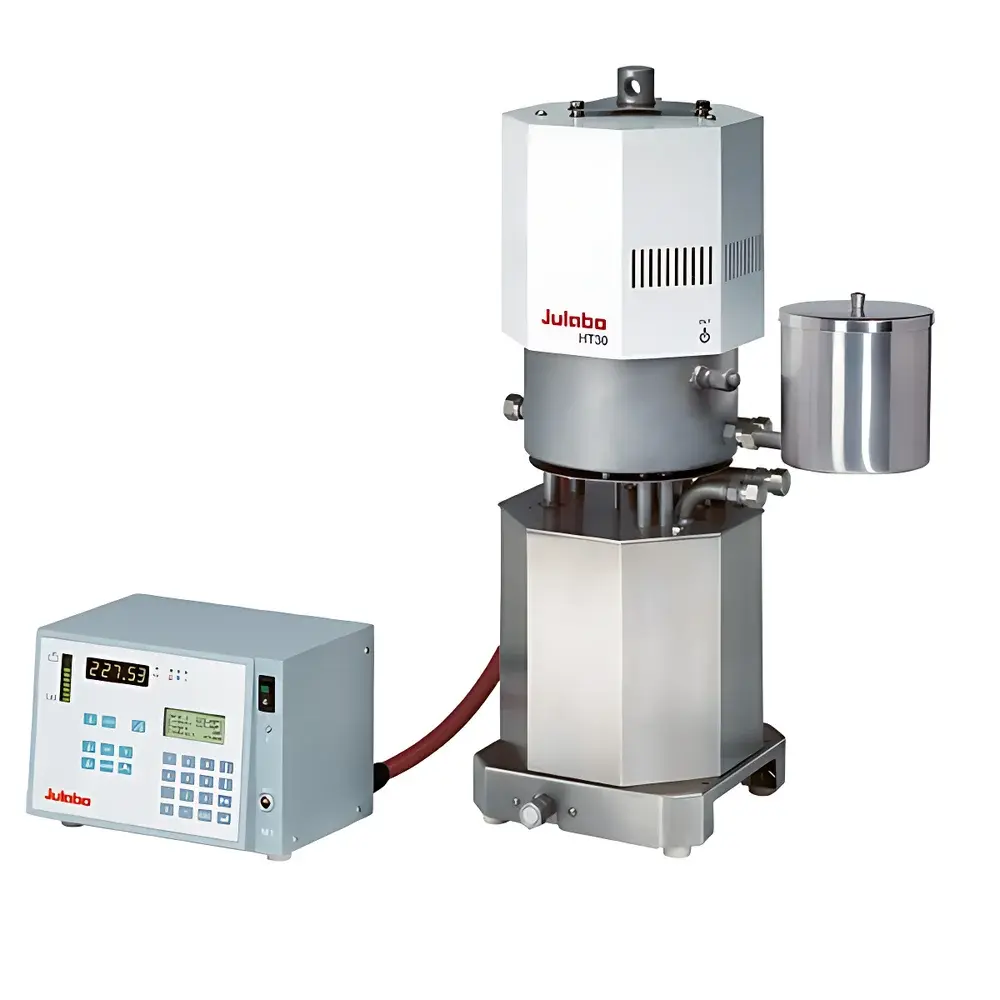
Julabo HT30-M1 Closed-Loop High-Temperature Dynamic Temperature Control System
| Brand | Julabo |
|---|---|
| Origin | Germany |
| Model | HT30-M1 |
| Instrument Type | Circulating Bath |
| Circulation Mode | Internal & External |
| Temperature Control | Heating-Only |
| Bath Volume | 2 L |
| Temperature Range | +70 to +400 °C |
| Temperature Stability | ±0.01 to ±0.1 °C |
| Heating Power | 3.0 kW |
| Supply Voltage | 230 V |
| Pump Flow Rate | 14–18 L/min |
| Pump Pressure | 0.8–1.2 bar |
| Controller Dimensions (W×L×H) | 25 × 25 × 18 cm |
| Circulator Dimensions (W×L×H) | 23 × 23 × 58 cm |
| Communication Interfaces | RS232, RS485, Analog I/O (0–10 V / 4–20 mA), Emergency Stop Input, Alarm Output, External HT Controller Interface |
Overview
The Julabo HT30-M1 is a closed-loop, high-temperature dynamic temperature control system engineered for precision thermal management in demanding laboratory and pilot-scale applications. Unlike conventional open-bath or low-temperature circulators, the HT30-M1 employs a fully sealed circulation architecture with inert gas-compatible sealing and optimized thermal insulation to operate continuously within the extended range of +70 °C to +400 °C—without bath fluid replacement or degradation. Its operation is based on forced convection via a high-efficiency centrifugal pump coupled with a robust resistive heating module, delivering stable thermal energy transfer to external reactors, jacketed vessels, or analytical instrumentation. The system is specifically designed for applications requiring long-duration, high-temperature stability under controlled oxidative conditions—such as polymerization kinetics, catalytic screening, high-temperature rheology, and accelerated aging studies compliant with ASTM D3045 or ISO 2578.
Key Features
- Fully sealed bath chamber minimizes oil oxidation and volatile emissions at elevated temperatures, extending thermal fluid service life and reducing maintenance frequency.
- Integrated intelligent ICC (Intelligent Current Control) temperature regulation algorithm ensures exceptional thermal stability of ±0.01 °C at setpoints near 100 °C and ±0.1 °C across the full operating range up to 400 °C.
- Dual-display interface (LED primary readout + LCD secondary display) supports intuitive local programming—including ramp/soak profiles, real-time monitoring of bath level, pump pressure, heating power, and coolant status.
- Modular design separates the circulation unit (HT30-M1) from the controller, enabling flexible benchtop integration and simplified service access.
- Standard analog I/O (0–10 V / 4–20 mA) and digital communication ports (RS232/RS485) allow seamless integration into automated lab environments, SCADA systems, or LIMS-controlled workflows.
- Optional C.U. (Cooling Unit) enables active heat extraction during exothermic processes, supporting dynamic temperature control across +40 °C to +400 °C—critical for reaction calorimetry and process safety validation.
Sample Compatibility & Compliance
The HT30-M1 is compatible with high-flash-point synthetic heat transfer fluids (e.g., silicone oils, aromatic hydrocarbons, or polyalkylene glycols) rated for continuous operation above 350 °C. Its sealed construction meets DIN EN 61000-6-3 for electromagnetic compatibility and complies with CE marking requirements for laboratory equipment under the Low Voltage Directive (2014/35/EU) and EMC Directive (2014/30/EU). When operated with validated thermal fluids and integrated into documented SOPs, the system supports GLP-compliant temperature validation per ISO/IEC 17025 and satisfies traceability requirements for temperature-critical pharmaceutical development (ICH Q5C, USP ). It is not intended for use with water or low-boiling-point solvents.
Software & Data Management
While the HT30-M1 operates autonomously via its front-panel controller, it supports external data acquisition and remote supervision through standardized protocols. RS232/RS485 interfaces enable bidirectional command exchange using ASCII-based SCPI-like syntax, permitting integration with LabVIEW, MATLAB, or custom Python scripts for automated temperature profiling and event-triggered logging. Analog outputs provide real-time voltage or current signals proportional to temperature, pump pressure, or heater duty cycle—facilitating connection to PLCs or distributed control systems. All operational parameters are timestamped and can be exported for audit trails; when deployed in regulated environments, users may implement supplementary 21 CFR Part 11-compliant electronic signatures and audit logs via third-party middleware.
Applications
- High-temperature material testing: thermal expansion coefficient measurement, viscoelastic characterization of thermosets above Tg, and creep/stress-relaxation analysis under sustained load.
- Catalysis research: precise thermal control of fixed-bed or slurry-phase reactors during kinetic studies of Fischer–Tropsch, hydrocracking, or dehydrogenation reactions.
- Pharmaceutical stability testing: accelerated degradation studies per ICH Q1A(R3) at elevated isothermal conditions (e.g., 70 °C, 100 °C, 150 °C).
- Calibration laboratories: reference temperature source for thermocouple or RTD calibration up to 400 °C, traceable to national standards.
- Process development: thermal simulation of industrial-scale reactor jackets in pilot plants, supporting scale-up modeling and HAZOP reviews.
FAQ
What thermal fluids are recommended for continuous operation at 400 °C?
Synthetic silicone oils (e.g., Dow Corning® 200 Fluid, Series 500) or specially formulated aromatic heat transfer fluids meeting DIN 51522 Class A specifications are recommended. Fluid selection must consider flash point (>450 °C), thermal stability limit, and vapor pressure at operating temperature.
Can the HT30-M1 be used for cooling-only applications?
No—the HT30-M1 is a heating-only circulator. For sub-ambient or dual-range operation, Julabo offers complementary models such as the F26 or PRESTO series, or the HT30-M1 may be paired with an external chiller via its C.U. interface.
Is the system suitable for vacuum-jacketed reactor connections?
Yes, provided the external loop maintains positive pressure and compatible fluid seals (e.g., Kalrez® or metal-CIP gaskets) are used at all interconnections to prevent thermal fluid ingress or vapor leakage.
How is temperature uniformity verified across the bath volume?
Uniformity is validated per ASTM E742 using three calibrated PT100 probes positioned at geometric center, top corner, and bottom corner of the 2 L reservoir during steady-state operation at 200 °C and 350 °C—typical deviation remains ≤±0.15 °C.
Does Julabo provide IQ/OQ documentation support?
Yes—factory-verified Installation Qualification (IQ) and Operational Qualification (OQ) protocols are available upon request, aligned with GAMP5 guidelines and customizable for site-specific risk assessments.



