
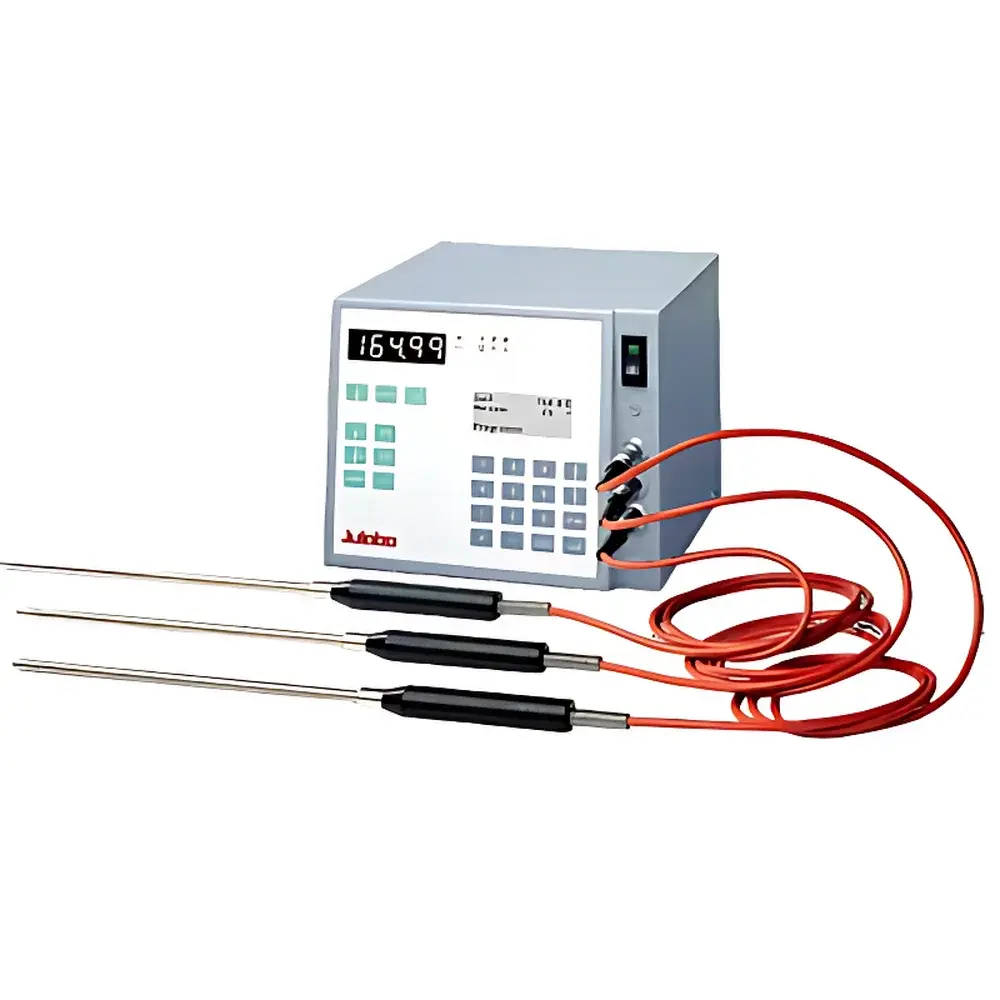
Julabo LC6 High-Precision Temperature Controller
| Brand | Julabo |
|---|---|
| Origin | Germany |
| Model | LC6 |
| Temperature Range | –100 °C to +400 °C |
| Temperature Stability | ±0.01 °C to ±0.5 °C |
| Display Resolution | 0.01 °C |
| Heating Power | 3 kW |
| Sensor Inputs | 3 × Pt100 (1 safety, 2 working) |
| Communication Interfaces | RS-232, RS-485 (optional Profibus) |
| Analog I/O | Yes |
| Environmental Operating Range | 5 °C to 40 °C |
| Dimensions (W×L×H) | 21 × 18 × 18 cm |
| Weight | 4 kg |
| Power Supply | 230 V / 50–60 Hz / 14 A |
| External Temperature Stability | > ±0.03 °C |
| Safety Protection | Integrated Pt100 safety probe with independent monitoring circuit |
| Max. Connected Load | ≤ 3 kW |
Overview
The Julabo LC6 High-Precision Temperature Controller is an industrial-grade, dual-mode (heating/cooling) thermal management system engineered for demanding laboratory and pilot-scale process applications requiring tight, stable, and traceable temperature control across an exceptionally wide range—from cryogenic –100 °C to high-temperature +400 °C. Unlike basic thermostats, the LC6 implements a fully digital PID control architecture with adaptive tuning algorithms, enabling dynamic compensation for thermal inertia, load variation, and ambient drift. Its core function is to regulate external heating elements (e.g., immersion heaters, heating jackets) and active cooling circuits (e.g., chilled water coils controlled via solenoid valves) in coordinated, closed-loop fashion—ensuring precise setpoint tracking even during rapid ramping or under variable thermal loads. Designed and manufactured in Germany, the LC6 complies with IEC 61000-6-2 (immunity) and IEC 61000-6-4 (emission) standards and meets CE marking requirements for electromagnetic compatibility and low-voltage safety.
Key Features
- Dual-mode thermal control: Simultaneous coordination of heating power output (up to 3 kW resistive load) and proportional solenoid valve actuation for coolant flow regulation.
- Triple Pt100 sensor support: Dedicated inputs for one safety sensor (independent hardware cutoff at user-defined limit) and two working sensors—enabling differential control, zone monitoring, or redundancy verification.
- High-resolution dual-display interface: Backlit LCD (1-digit integer, 0.01 °C resolution) and LED (1-digit integer only) provide real-time visibility of primary process temperature, safety threshold, and alarm status without menu navigation.
- Comprehensive connectivity suite: Standard RS-232 for PC-based logging and remote configuration; optional RS-485 or Profibus DP for integration into PLC-controlled environments or SCADA systems.
- Analog I/O capability: 0–10 V or 4–20 mA input for external setpoint modulation; analog output for recording temperature trends or feeding signals to supervisory controllers.
- Robust safety architecture: Hardware-enforced overtemperature cut-off, sensor break detection, and configurable hysteresis on all alarms—designed to meet GLP and GMP environmental monitoring prerequisites.
Sample Compatibility & Compliance
The LC6 is not a standalone thermal chamber but a controller module intended for integration with third-party thermal devices—including electric heating mantles, circulation chillers, jacketed reactors, and custom-built heating/cooling manifolds. It supports both 2-wire and 4-wire Pt100 configurations per DIN EN 60751 Class A tolerance, ensuring metrological consistency with accredited calibration labs. The device conforms to ISO/IEC 17025-relevant traceability principles when used with certified reference sensors. For regulated environments, its programmable alarm thresholds, non-volatile event logging (via RS-232), and hardware safety interlock satisfy foundational requirements of FDA 21 CFR Part 11 (when paired with compliant software), EU Annex 11, and ISO 13485 thermal process validation protocols.
Software & Data Management
While the LC6 operates autonomously via front-panel controls, its RS-232 port enables bidirectional communication with Julabo’s proprietary WinTherm software (Windows-based) for extended functionality: real-time graphing, multi-channel data export (CSV/TXT), script-driven temperature ramps, and audit-trail generation including operator ID, timestamp, parameter changes, and alarm acknowledgments. All logged events are time-stamped with millisecond precision and stored in non-volatile memory—even during power interruption. Optional RS-485 implementation supports Modbus RTU protocol, permitting integration into LabVIEW, MATLAB, or DeltaV systems for centralized data acquisition and automated reporting aligned with ALCOA+ data integrity principles.
Applications
- Calibration laboratories: Maintaining stable reference baths for thermometer and RTD verification across extreme ranges.
- Materials science: Controlling temperature profiles during DSC sample preparation, polymer curing studies, or ceramic sintering pre-heating stages.
- Pharmaceutical R&D: Regulating jacketed bioreactor temperatures during cell culture process development under defined thermal stress conditions.
- Chemical synthesis: Enabling exothermic reaction control via synchronized heating/cooling modulation in glass-lined reactors.
- Quality assurance: Supporting ASTM E2877-compliant thermal stability testing of reference materials and thermocouple wire calibration fixtures.
FAQ
Can the LC6 control both heating and cooling simultaneously on the same process stream?
Yes—the LC6 executes parallel heating and cooling actuation using separate outputs: a relay or SSR channel for heater power and a voltage-controlled signal for solenoid valve duty cycle, enabling true bipolar thermal regulation.
Is the safety sensor input electrically isolated from the working sensor circuits?
Yes—safety sensor circuitry features galvanic isolation and independent power conditioning to prevent common-mode failure modes and ensure fail-safe shutdown per IEC 61508 SIL 2 functional safety guidelines.
Does the LC6 support NIST-traceable calibration documentation?
Julabo provides factory calibration certificates (with uncertainty budgets) upon request; field recalibration is supported using external reference standards and WinTherm’s calibration wizard.
What is the maximum cable length supported for Pt100 sensors?
For optimal accuracy, Julabo recommends ≤ 10 m for 2-wire Pt100 connections; 4-wire configurations extend this to ≤ 50 m without significant lead resistance error.
Can the LC6 be integrated into a LIMS or MES environment?
Via RS-485/Modbus or OPC UA (using third-party gateway), yes—provided the host system supports standard industrial protocols and handles the LC6’s register map for temperature, status, and alarm variables.



