JULABO PMC-40 / PMC-85 Environmental Test Chamber for Power Module & Component Thermal Characterization
| Brand | JULABO |
|---|---|
| Origin | Germany |
| Model | PMC-40 / PMC-85 |
| Temperature Range | −30 to +150 °C (PMC-40) / −50 to +180 °C (PMC-85) |
| Flow Rate | 5–12 L/min |
| Temperature Stability | ±0.01 to ±0.05 °C (PMC-40) / ±0.05 to ±0.1 °C (PMC-85) |
| Display | 5.7″ TFT touchscreen, 0.01 °C resolution |
| Heating Power | 2.7 kW (PMC-40) / 6 kW (PMC-85) |
| Refrigeration Capacity | 1.2 kW @ 20 °C (PMC-40) / 2.5 kW @ 20 °C (PMC-85) |
| Pump Flow Range | 16–40 L/min (PMC-40) / 35–80 L/min (PMC-85) |
| Pump Pressure | 0.3–1.7 bar (PMC-40) / 0.48–3.2 bar (PMC-85) |
| Compressor Type | Single-stage air-cooled (PMC-40) / Two-stage air-cooled (PMC-85) |
| Heat Transfer Fluid | Thermal HL60 |
| Dimensions (W×D×H) | 33×59×67 cm (PMC-40) / 61×108×125 cm (PMC-85) |
Overview
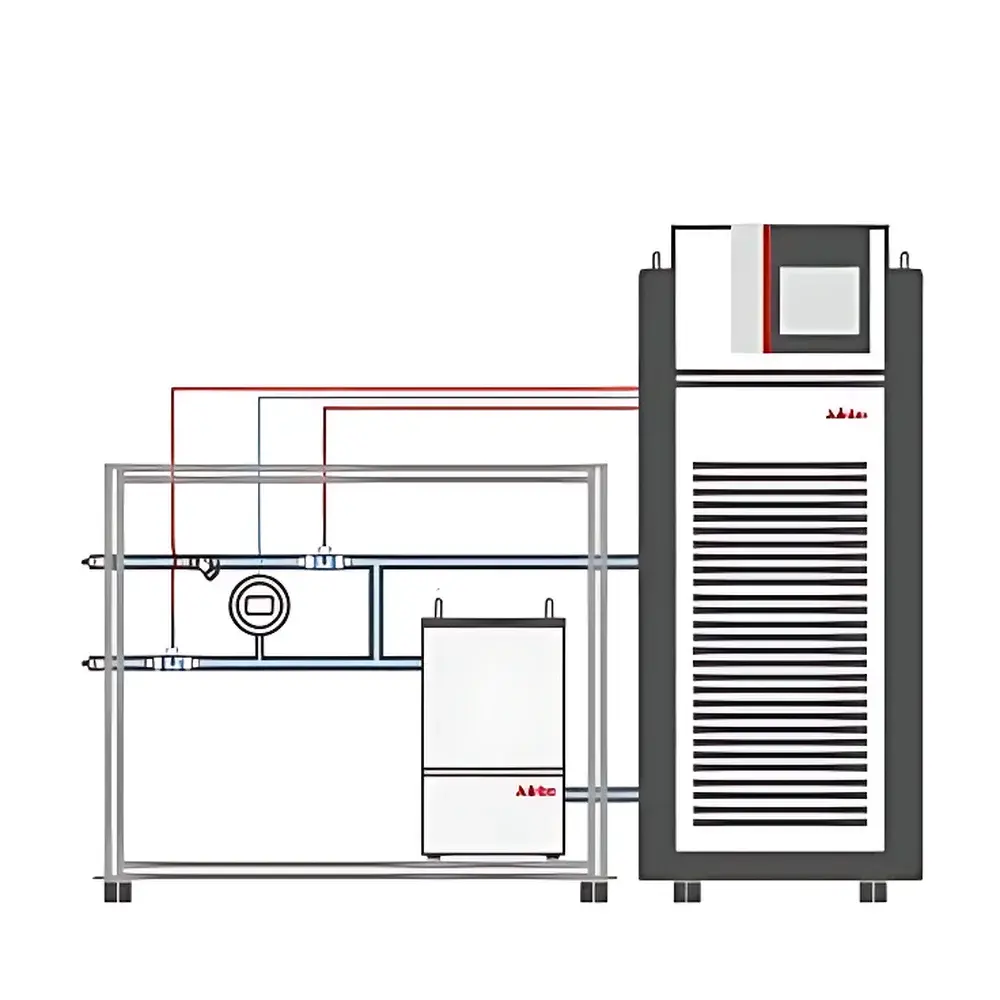
The JULABO PMC-40 and PMC-85 are precision-engineered environmental test chambers designed specifically for thermal stress evaluation and performance validation of power modules, DC-DC converters, onboard chargers (OBC), wireless charging units, and other high-reliability electronic components. Unlike general-purpose temperature chambers, the PMC series integrates closed-loop liquid temperature control with dynamic flow regulation to replicate real-world thermal boundary conditions—enabling accurate assessment of thermal derating, cold-start behavior, thermal runaway thresholds, and long-term stability under cyclic temperature loads. The system operates on a forced-circulation principle using Thermal HL60 heat transfer fluid, delivering controlled thermal energy or extraction directly to device-under-test (DUT) interfaces via external heat exchangers or cold plates. Its core architecture supports both steady-state thermal mapping and transient thermal profiling in compliance with IEC 60068-2-1 (cold), IEC 60068-2-2 (dry heat), and JEDEC JESD22-A104 (temperature cycling) standards.
Key Features
- Intelligent Dynamic Temperature Control (ICC) with stability up to ±0.01 °C—critical for evaluating low-drift voltage references and sensor bias drift in power management ICs.
- EHC (Enhanced Heat Exchange) segmented shock cooling technology enables rapid thermal ramping: ≤15 K/min from −40 °C to +100 °C (PMC-85), minimizing test cycle time without compromising thermal uniformity.
- ACC (Active Cooling Compensation) algorithm maintains sub-0.1 °C stability even at elevated setpoints (>150 °C), eliminating overshoot during hot-to-cold transitions—a key requirement for automotive-grade AEC-Q200 qualification testing.
- High-capacity dual-range circulation pump with programmable pressure control (0.3–3.2 bar) ensures consistent thermal contact across variable DUT interface geometries—including finned heatsinks, liquid-cooled cold plates, and embedded microchannel substrates.
- Hydraulically sealed fluid path with integrated 5 µm inline filter prevents particulate ingress into sensitive test fixtures and extends service intervals between maintenance cycles.
- Front-access operation panel with 5.7″ industrial-grade TFT touchscreen; rear-mounted quick-connect fluid ports simplify integration into automated test benches and HALT/HASS stations.
- Multi-protocol communication suite: Ethernet (TCP/IP), RS485 (Modbus RTU), and optional USB-C interface for firmware updates and configuration backup.
Sample Compatibility & Compliance
The PMC platform accommodates a broad spectrum of power electronics configurations—including Si, SiC, and GaN-based modules mounted on insulated metal substrates (IMS), direct-bonded copper (DBC) ceramics, or aluminum nitride (AlN) packages. Its open-loop fluid output allows seamless coupling with third-party cold plates, thermal interface material (TIM) testers, and impedance analyzers. All models comply with CE marking requirements under the EU Machinery Directive 2006/42/EC and Electromagnetic Compatibility Directive 2014/30/EU. For regulated industries, the system supports audit-ready data logging with timestamped parameter records (temperature, flow, pressure, power consumption), traceable to NIST-traceable reference sensors—meeting foundational expectations of ISO/IEC 17025 accredited labs and supporting FDA 21 CFR Part 11 electronic record integrity when paired with validated software environments.
Software & Data Management
JULABO’s proprietary PCC (Process Control Center) software provides full remote supervision and script-based test sequencing. Users define multi-step thermal profiles—including dwell times, ramp rates, and conditional triggers (e.g., “hold at +125 °C until DUT output voltage deviation exceeds ±1.5 %”). Real-time graphs display synchronized traces of fluid inlet/outlet temperatures, DUT case temperature (via optional thermocouple inputs), flow rate, and pump pressure. Export formats include CSV, PDF reports, and XML metadata bundles compatible with LabArchives, Benchling, and internal LIMS platforms. Optional OPC UA server integration enables bidirectional data exchange with MES systems for production-line traceability in automotive Tier-1 supplier environments.
Applications
- Thermal derating analysis of DC-DC converters across −40 °C to +175 °C operating envelopes per MIL-STD-704 and DO-160 Section 4.5.
- Validation of thermal shutdown response time in automotive gate drivers under rapid ambient transients (e.g., engine bay thermal soak followed by cold rain exposure).
- Long-duration burn-in testing of power modules at elevated junction temperatures (Tj ≥ 150 °C) to accelerate electromigration failure modes.
- Characterization of thermal interface material (TIM) performance under combined thermal cycling and mechanical vibration (when integrated with shaker tables).
- Pre-compliance screening for IEC 62368-1 Clause 5.5 (thermal hazard assessment) and UL 62368-1 Annex G (temperature limits for accessible surfaces).
FAQ
What is the minimum fluid volume required for stable operation?
The system requires ≥8 L of Thermal HL60 for PMC-40 and ≥22 L for PMC-85 to ensure sufficient thermal mass and avoid cavitation during high-flow, low-temperature operation.
Can the PMC series be used with water-glycol mixtures?
No—only JULABO-certified Thermal HL60 or equivalent synthetic heat transfer fluids with flash point >200 °C and viscosity <15 cSt at 20 °C are approved for use to maintain seal integrity and prevent compressor oil dilution.
Is external calibration support available?
Yes—JULABO offers factory-certified calibration services traceable to PTB (Physikalisch-Technische Bundesanstalt) standards, including as-found/as-left reports and uncertainty budgets per ISO/IEC 17025.
Does the system support custom PID tuning for non-standard DUT thermal masses?
Yes—the ICC controller allows user-defined gain scheduling and adaptive loop parameters via PCC software, enabling optimization for high-thermal-mass fixtures or low-inertia sensor packages.
How is safety interlocked during overtemperature events?
Dual independent hardware limiters (mechanical bimetal switch + solid-state relay) cut heater and compressor power simultaneously upon exceeding user-set thresholds; event logs include timestamp, sensor ID, and fault code per EN 61000-6-2 immunity requirements.