
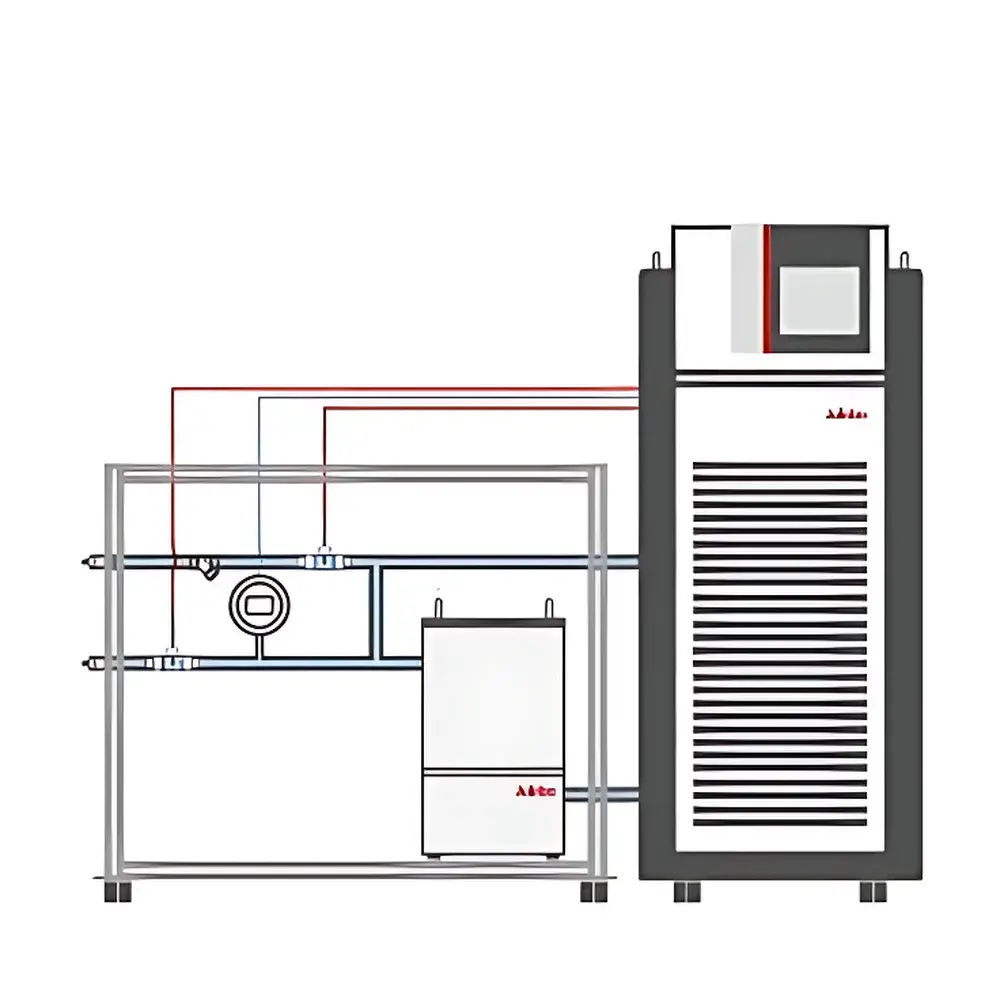
Julabo TMS Series Automotive Thermal Management System (TMS-50 & TMS-92)
| Brand | Julabo |
|---|---|
| Origin | Germany |
| Model | TMS-50 / TMS-92 |
| Temperature Range | −20 to +90 °C (TMS-50), −40 to +150 °C (TMS-92) |
| Temp. Stability | ±0.05 to ±0.1 °C (TMS-50), ±0.05 to ±0.2 °C (TMS-92) |
| Display | 5.7″ TFT, 0.01 °C resolution |
| Heating Power | 6 kW (TMS-50), 12 kW (TMS-92) |
| Cooling Power @20 °C | 7.5 kW (TMS-50), 25 kW (TMS-92) |
| Flow Rate | 35–76 L/min (TMS-50), 26–80 L/min (TMS-92) |
| Pump Pressure | 0.48–3.2 bar (TMS-50), 0.5–3.0 bar (TMS-92) |
| Compressor | Single-stage water-cooled (TMS-50), Two-stage water-cooled (TMS-92) |
| Heat Transfer Fluid | Antifreeze (Thermal HL60) |
| Dimensions (W×D×H) | 53×66.5×126 cm (TMS-50), 95×127×190 cm (TMS-92) |
Overview
The Julabo TMS Series Automotive Thermal Management System is a high-performance, industrial-grade temperature control unit engineered specifically for R&D and validation of vehicle thermal management systems (TMS). It operates on the principle of closed-loop, pressurized liquid circulation using antifreeze-based heat transfer fluid (e.g., Thermal HL60), enabling precise, dynamic thermal conditioning of engine coolant loops, battery cooling plates, power electronics, and wireless charging modules under realistic transient load profiles. Unlike standard chillers or heating circulators, the TMS series integrates real-time flow, pressure, and temperature actuation—critical for simulating the coupled thermomechanical behavior of modern electrified powertrains. Its design supports full-cycle testing from cold-start (-40 °C) to high-load hot-soak (+150 °C), meeting the stringent thermal boundary conditions defined in ISO 20685, SAE J1349, and UNECE R101 for automotive component validation.
Key Features
- 5.7-inch industrial TFT color touchscreen with intuitive HMI, supporting multi-parameter visualization and recipe-based operation
- EHC (Enhanced Heat Exchange Control) segmented shock-exchange technology — improves thermal ramp rates by up to 40% while extending compressor service life through optimized refrigerant distribution and reduced thermal cycling stress
- ACC (Active Condensation Control) dynamic refrigeration algorithm — maintains sub-zero cooling capacity even at ambient temperatures above 35 °C, eliminating condensation-induced instability during high-temperature hold phases
- ICC (Intelligent Cascade Control) adaptive PID architecture — delivers temperature stability of ±0.05 °C over extended dwell periods, validated per ASTM E220–22 calibration traceability protocols
- High-torque, brushless circulation pump with programmable pressure setpoints (0.5–3.2 bar) and flow modulation (26–80 L/min), compliant with ISO 5171 for hydraulic system fidelity
- Hydraulic-sealed wetted path compatible with ethylene glycol/water mixtures and OEM-specified coolants — no external heat exchanger required
- Dual-channel analog I/O (0–10 V / 4–20 mA), Ethernet (TCP/IP), RS485 Modbus RTU, and optional EtherCAT interface for seamless integration into dSPACE SCALEXIO, NI VeriStand, or AVL PUMA Open testbeds
- Front-access operation panel and rear-mounted fluid/communication ports — optimizes lab floor layout and reduces hose routing complexity
- Integrated 5-μm particulate filter in recirculation loop — prevents contamination of DUT interfaces and extends service intervals per ISO 4406:2022 cleanliness class requirements
Sample Compatibility & Compliance
The TMS series accommodates diverse automotive subsystems including internal combustion engine (ICE) cooling circuits, 48V mild-hybrid thermal loops, traction battery cold plates (NMC/LFP), SiC inverter coolant jackets, and resonant wireless charging pads. All models comply with CE marking directives (2014/30/EU EMC, 2014/35/EU LVD), RoHS 2011/65/EU, and carry factory-calibrated traceability to DKD/DAkkS-accredited standards. For GMP-aligned validation environments, optional audit-trail-enabled firmware supports 21 CFR Part 11 electronic signature compliance when paired with Julabo’s TMS-Link software suite.
Software & Data Management
TMS-Link PC software provides centralized configuration, real-time monitoring, and automated test sequence execution. It logs timestamped data streams (temperature, flow, pressure, power consumption) at user-defined intervals (down to 100 ms) and exports to CSV, MATLAB .mat, or ASAM MDF4 formats. The software includes built-in curve-fitting tools for deriving thermal time constants and heat transfer coefficients, and supports alarm-triggered data capture for failure mode analysis. Remote access via secure HTTPS or VPN tunnel enables off-site supervision without compromising network segmentation requirements typical in Tier-1 engineering centers.
Applications
- Dynamic calibration of engine coolant thermostats and electric water pumps under transient duty cycles (e.g., WLTC, RDE)
- Thermal stress screening of EV battery modules across SOC-dependent cooling demand profiles
- Validation of thermal runaway propagation mitigation strategies in pack-level tests
- Performance mapping of bidirectional DC-DC converters and onboard chargers under combined thermal-electrical loading
- Development and verification of model-predictive control (MPC) algorithms for integrated thermal energy management systems
- Environmental simulation for ISO 16750-4 (climate resistance) and ISO 19453-3 (battery thermal endurance) certification testing
FAQ
What is the maximum allowable backpressure at the outlet port?
The TMS-50 and TMS-92 are rated for continuous operation at up to 3.2 bar static backpressure; dynamic pressure spikes must remain below 4.0 bar per EN 13445-3 Annex C.
Can the unit operate with propylene glycol-based fluids?
Yes — provided the fluid meets Julabo’s viscosity (≤25 cSt at 20 °C) and thermal conductivity (>0.25 W/m·K) specifications; compatibility verification is recommended prior to first use.
Is remote firmware update supported over Ethernet?
Firmware updates require local USB connection for security and integrity verification; however, configuration parameter backups and restores can be performed remotely via TMS-Link.
How is temperature uniformity verified across the DUT interface?
Uniformity is characterized using calibrated PT100 probes placed at inlet, outlet, and mid-loop positions per ISO/IEC 17025-accredited procedures; typical deviation is ≤±0.15 °C over full flow range.
Does the system support dry-run protection for the circulation pump?
Yes — integrated flow sensor feedback triggers immediate shutdown if flow drops below 15% of setpoint for >3 seconds, preventing mechanical seal damage.




